Septic Inspection cost at a glance
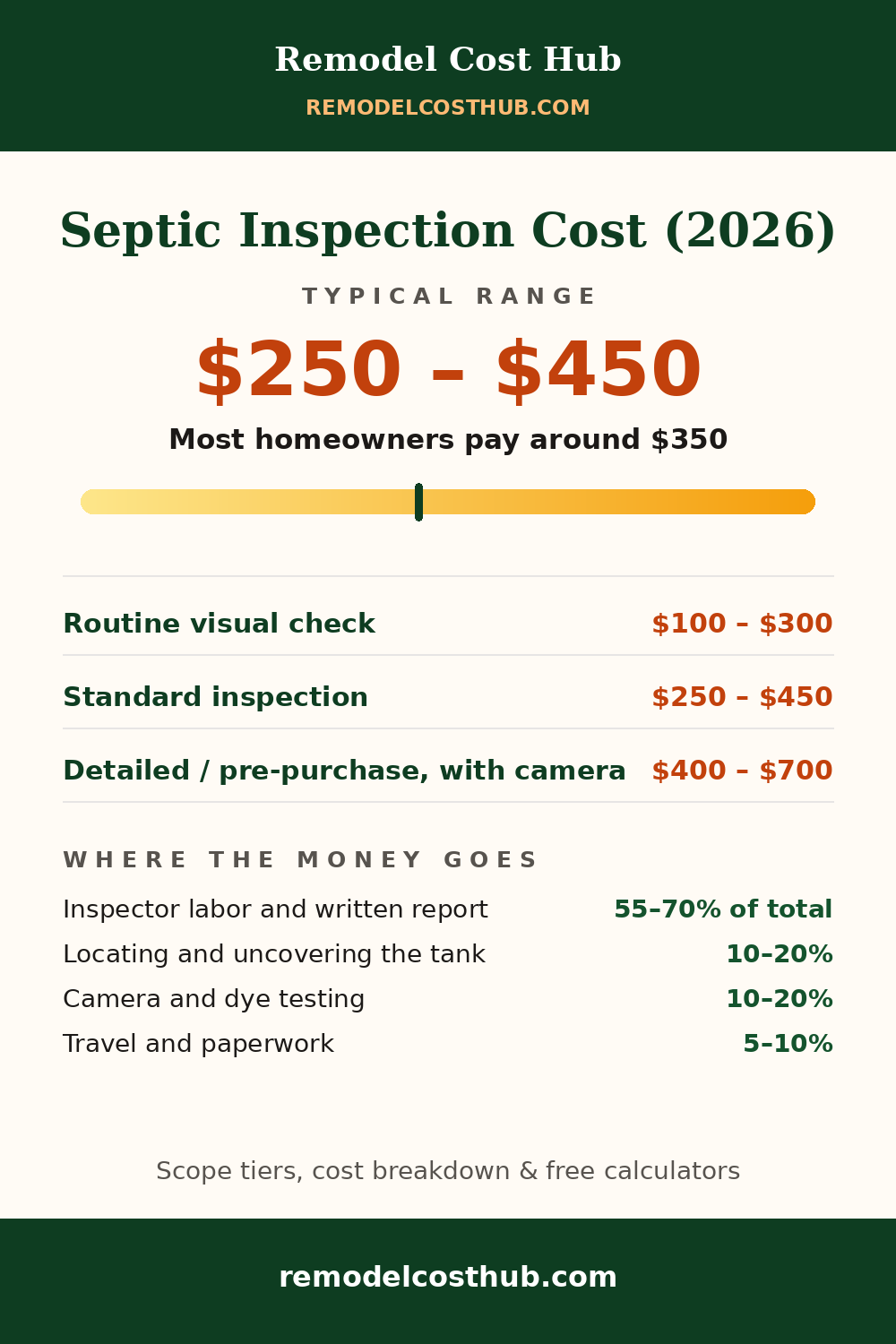
- Typical range: $250 – $450
- Most homeowners pay: around $350
- Prices vary most by: Inspector labor and written report (55–70% of the budget)
Cross-checked against two published sources for this project. Sources used for this page: Angi's septic inspection cost guide, updated October 7, 2026 (national average $550, most $200–$900, full range $100–$1,300; annual $200–$250, basic $250–$400, detailed $400–$700, camera $250–$900; digging to uncover a tank $50–$250; Title 5 $400–$600; repairs $630–$3,040), HomeGuide's septic and plumbing inspection cost data (routine inspection $150–$450; pumping $300–$700; filter cleaning $100–$400; well and septic inspection together $400–$650) and iBuyer's septic tank inspection cost guide (most $300–$650, national average $400–$550; routine visual $100–$300, standard pre-purchase $300–$600, pump-and-inspect $300–$650, camera add-on $250–$500, Title 5 $400–$800, emergency $500–$1,300). The page's typical band is the standard-scope overlap of the three guides; Angi's $550 average covers detailed and camera scopes and is tiered separately, not averaged away. Checked November 2026.. Sources last checked: October 2026 — HomeGuide, Angi. How we calculate these costs
Cost by scope
| Scope | Typical cost | What it includes |
|---|---|---|
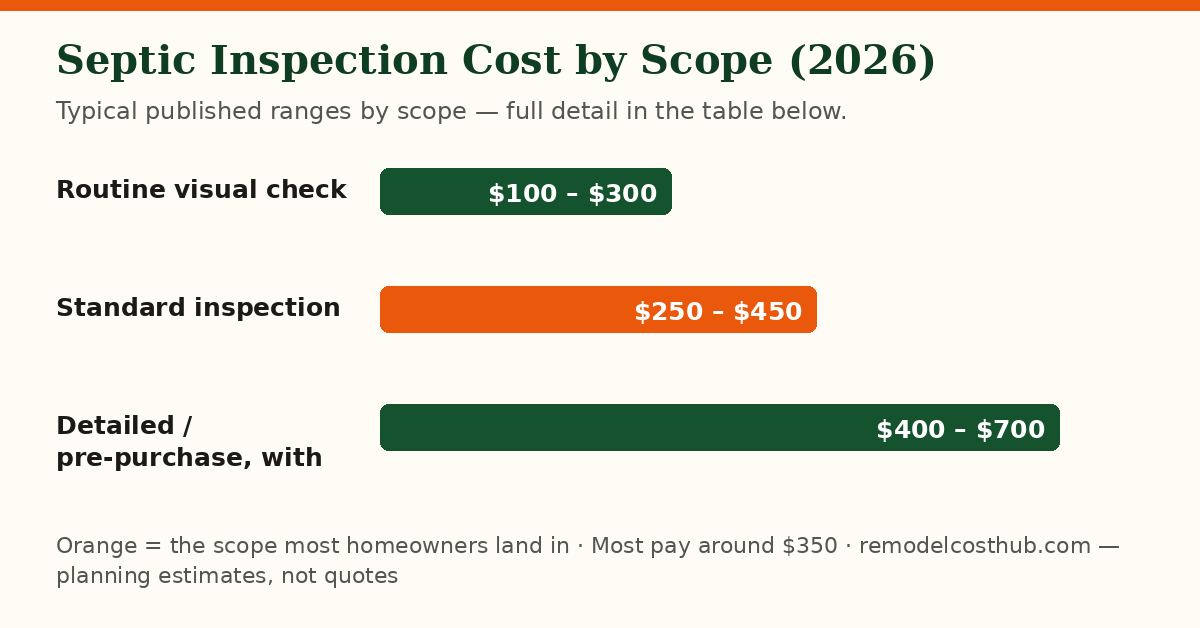
| Routine visual check | $100 – $300 | Annual maintenance look-over: levels, scum and sludge, baffles, and surface signs over the drain field |
| Standard inspection | $250 – $450 | The full standard scope — tank opened, components checked, drain field assessed, written report included |
| Detailed / pre-purchase, with camera | $400 – $700 | A deeper assessment for a home sale, with camera or dye testing where the inspector calls for it |
Where the money goes
| Part of the job | Share | Note |
|---|---|---|
| Inspector labor and written report | 55–70% of total | The inspection itself and the report a buyer or lender reads |
| Locating and uncovering the tank | 10–20% | Digging to uncover a buried lid adds $50–$250 in Angi's tables, and is often a separate line |
| Camera and dye testing | 10–20% | Camera work as an add-on runs $250–$500 in iBuyer's tables |
| Travel and paperwork | 5–10% | Getting to the property and filing the report — the reason small, remote jobs carry a minimum |
What moves the price most
Inspection type is first: Angi's type table runs annual at $200–$250, basic at $250–$400, detailed at $400–$700 and camera at $250–$900 — the scope, not the house, sets the band. Tank size, depth and access are second: a buried or unmarked lid has to be located and dug up, at $50–$250 extra in Angi's tables, and larger tanks take longer to assess. Sale scope is third: a pre-purchase or Title 5 inspection runs $400–$800 in iBuyer's tables, and pumping at $250–$500 is often required before or during it so the report reflects the system as it stands. Findings are fourth: repairs average $630–$3,040 in Angi's data and pumping $300–$700 in HomeGuide's — neither is inside the inspection price, and a clean report is not a repair quote. For the pumping that often accompanies an inspection, see our septic tank pumping guide, for a new system, see our septic system installation guide, and for a camera look inside the lines, see our sewer camera inspection guide.
Worked example: how a typical septic inspection budget breaks down
Take the typical job — a standard inspection of one tank and drain field, the lid uncovered, a camera check added, written report included. Here is a realistic $350 version of that invoice: The budget below totals $350 — the "most homeowners pay around" figure from the top of this page — split using this page's own cost breakdown. It shows how a real quote at that level is usually composed; every line is built from the ranges on this page, and it is an illustration, not a quote for your project.
| Line item | Example budget |
|---|---|
| Inspector labor and written report | $210 |
| Locating and uncovering the tank | $56 |
| Camera and dye testing | $56 |
| Travel and paperwork | $28 |
| Total | $350 |
What most people get wrong
- Comparing a routine visual check with a detailed pre-purchase inspection on the total — camera work and a lender report are different scopes, and only the same scope is comparable.
- Skipping the inspection because the system "works fine" — a saturated field and a cracked baffle show no symptom until the backup, and the repair then costs more than years of inspections.
- Assuming pumping is included — pumping at $300–$700 in HomeGuide’s data is a separate service, and a quote that does not say so is not yet a complete price.
- Accepting a report without the tank and field both named — a tank-only look leaves the field, where the expensive failures live, unexamined.
Costs in your city
Septic inspection is inspector-labor pricing around an area: the same standard inspection quotes near the bottom of the band where inspector rates are low and toward the top in a high-cost metro, while the report itself travels with the sale. Regulation travels with the city — Title 5 in Massachusetts and other point-of-sale rules change both the scope and who must order the inspection, and rural properties with buried, unmarked lids pay more for locating and digging. Ask each bidder for the inspection type, whether pumping is inside the total, and whether the report covers tank and field both.

Frequently asked questions
How much does a septic inspection cost?
Most standard inspections land between $250 and $450, with $350 typical. Angi's basic inspection runs $250–$400, HomeGuide puts routine inspections at $150–$450, and iBuyer's standard pre-purchase inspection runs $300–$600 — the band on this page is the standard-scope overlap.
How often should a septic system be inspected?
The EPA guidance cited by Angi is an inspection every one to three years, with the tank pumped every three to five years. A system that has never been inspected, or one changing hands in a sale, is inspected regardless of the calendar.
What does a septic inspection check?
The tank itself — levels, scum and sludge, baffles and structural condition — plus the pipes to and from it and the drain field, including surface signs of failure such as soggy ground or odors. Camera or dye testing is added where the inspector needs to see inside a line.
Who pays for a septic inspection when a house is sold?
It is negotiated in the sale in most markets, and the buyer commonly orders and pays for the pre-purchase inspection; some states and loan programs require one regardless of who pays, so the contract, not custom alone, decides it.
What happens if a septic inspection fails?
The report names the fault — a cracked baffle, a saturated field, a tank that needs pumping first — and the sale or the repair is priced from that finding. Repairs average $630–$3,040 in Angi's data, and a failed field can run far higher, which is why the inspection exists before the purchase, not after it.