Septic Tank Pumping cost at a glance
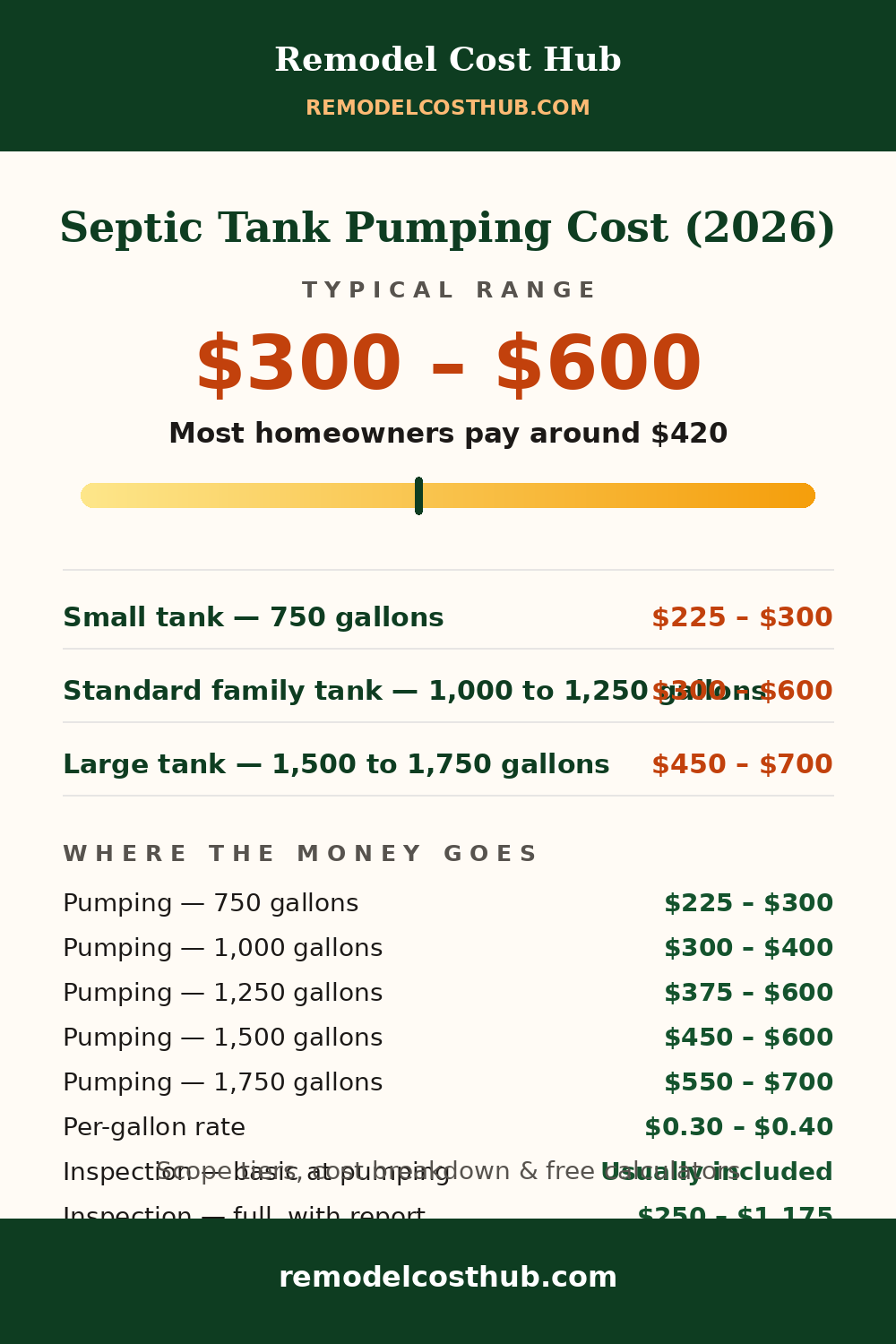
- Typical range: $300 – $600
- Most homeowners pay: around $420
Cross-checked against four published sources for this project. Sources used for this page: Angi's septic tank pumping cost guide (updated October 2026, national average $428 across 6,850 verified projects), Fixr's septic tank cleaning cost guide (average $400) and This Old House's septic pumping guide (average $420); HomeGuide's septic pumping guide for the size tables (same Angi family as Angi). Sources last checked: October 2026 — This Old House, HomeGuide, Fixr, Angi. How we calculate these costs
Cost by scope
| Scope | Typical cost | What it includes |
|---|---|---|
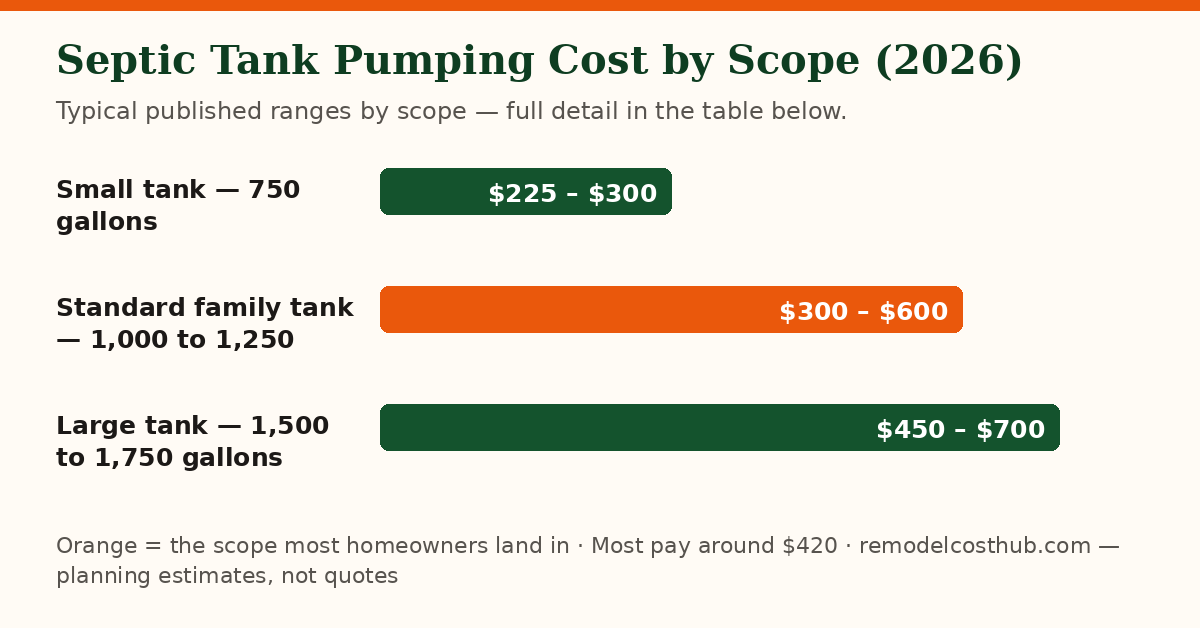
| Small tank — 750 gallons | $225 – $300 | The honest overlap of the Angi/HomeGuide family band ($225–$550) and Fixr's band ($175–$300) for a 750-gallon tank — the smallest standard residential size |
| Standard family tank — 1,000 to 1,250 gallons | $300 – $600 | The overlap of the family-tank bands: 1,000 gallons $300–$400 and 1,250 gallons $375–$600. Most homes use tanks in the 1,000 to 1,500-gallon range (Angi), so this is the tier most households actually pay |
| Large tank — 1,500 to 1,750 gallons | $450 – $700 | The overlap of the large-tank bands: 1,500 gallons $450–$600 and 1,750 gallons $550–$700. Angi/HomeGuide ceilings run higher for the largest tanks ($1,050–$1,250), so a big tank in poor condition can exceed this tier |
Where the money goes
| Part of the job | Share | Note |
|---|---|---|
| Pumping — 750 gallons | $225 – $300 | Overlap of Angi/HomeGuide ($225–$550) and Fixr ($175–$300) for a 750-gallon tank |
| Pumping — 1,000 gallons | $300 – $400 | Overlap of Angi/HomeGuide ($300–$700) and Fixr ($225–$400) for a 1,000-gallon tank |
| Pumping — 1,250 gallons | $375 – $600 | Overlap of Angi/HomeGuide ($375–$875) and Fixr ($300–$600) for a 1,250-gallon tank |
| Pumping — 1,500 gallons | $450 – $600 | Overlap of Angi/HomeGuide ($450–$1,050) and Fixr ($345–$600) for a 1,500-gallon tank |
| Pumping — 1,750 gallons | $550 – $700 | Overlap of Angi/HomeGuide ($525–$1,225) and Fixr ($400–$700) for a 1,750-gallon tank |
| Per-gallon rate | $0.30 – $0.40 | The band common to HomeGuide ($0.30–$0.70), Fixr ($0.30–$0.40) and This Old House ($0.23–$0.40); most firms bill by tank size, not per gallon |
| Inspection — basic at pumping | Usually included | A cursory check at pumping time is usual practice (Fixr); a one-off inspection outside a pumping visit runs $100–$300 (Fixr) |
| Inspection — full, with report | $250 – $1,175 | Angi's full-inspection band (This Old House $250–$1,180) — a different, deeper service than the check at pumping time, which is why the two inspection figures differ so widely |
| Filter cleaning | $100 – $200 if charged separately | Fixr and This Old House agree; HomeGuide puts it at $100–$400. Often included in the pumping visit itself |
| Riser add-on | $100 – $200 (Fixr) to $300 – $1,000 (This Old House) | An unresolved disagreement published as-is: Fixr's riser figure is far below This Old House's, and Angi's separate installation page lists $300–$600 — no consensus figure exists |
| Jet cleaning tank walls | $250 – $300 | Fixr's band for tanks left unpumped so long that solids have dried on the walls; HomeGuide prices jet cleaning as a $0.20–$0.30 per gallon add-on |
| Clog removal | $300 – $1,000 (HomeGuide) to about $1,700 (Angi) | A sharp disagreement published as-is — the two sources price different clog scopes |
| Overflow / yard cleanup | $7 – $15 per sq ft | Agreed by Angi, HomeGuide and This Old House |

What moves the price most
Tank size and household use drive both price and schedule: Angi's frequency table runs from 5 years for a 750-gallon tank serving 2 bedrooms down to 2 years for a 1,750-gallon tank serving 6+ bedrooms, with the general rule at every 3–5 years. Access is the next lever — a tank under a deck, on uneven ground or buried unusually deep costs more to reach, and This Old House prices a buried-access surcharge at $50–$200 with a neglected-tank extra of $100–$300. Season matters too: frozen winter ground and spring peak demand push prices up, while summer and early fall are the cheaper booking window (Angi). Pumping vs cleaning is a scope distinction worth knowing: HomeGuide prices pumping at $300–$700 and pumping plus cleaning combined at $500–$1,000. No source in this set publishes a separate hourly labour rate for pumping — labour is bundled in the pumping total everywhere, so none is invented here.
Costs in your city
Labor is the biggest variable in any remodel, and labor is local — the same bathroom can price very differently in Houston than in Boston. We are adding city editions metro by metro, each with its own labor index, permit notes and climate factors, written for that city rather than copied from this page. Wave 1: Houston, Dallas–Fort Worth, Phoenix, Atlanta, Miami–South Florida, Orlando, Tampa, Charlotte, Austin and San Antonio. Until your city's page is live, use the national range here and weight it the way contractors do: Sun Belt labor often prices near or below the national middle, while coastal California and the Northeast metros often price well above it.
Frequently asked questions
How much does septic tank pumping cost?
Typically $300–$600, with about $420 the most-pay figure. Angi averages $428, Fixr averages $400 and This Old House averages $420 — the three published averages cluster tightly, and HomeGuide's band of $300–$700 sits on top of them.
How often should I pump my septic tank?
Every 3–5 years in general (Angi, HomeGuide, Fixr). By size: a 750-gallon tank about every 5 years, 1,000 and 1,250 gallons about every 3 years, 1,500 gallons every 2–3 years and 1,750 gallons about every 2 years — smaller tanks and larger households need shorter intervals.
What makes one pumping job cost more than another?
Tank size first, then access and time since the last service (Angi). A tank under a deck or buried deep costs more to reach, a neglected tank can add $100–$300 (This Old House), and winter or spring-peak booking costs more than summer or early fall.
Is an inspection included in the pumping price?
A cursory check at pumping time is usual practice (Fixr). A full inspection with a report is a separate service at $250–$1,175 (Angi) — that scope difference is why inspection figures vary so widely between sources.
What if my tank lid is buried and hard to find?
Locating and digging it out is extra work, and adding a riser so the lid sits at ground level avoids digging it out again. The riser itself is the one figure sources genuinely disagree on: $100–$200 (Fixr) against $300–$1,000 (This Old House), published here as-is.