Rubber Flooring Installation cost at a glance
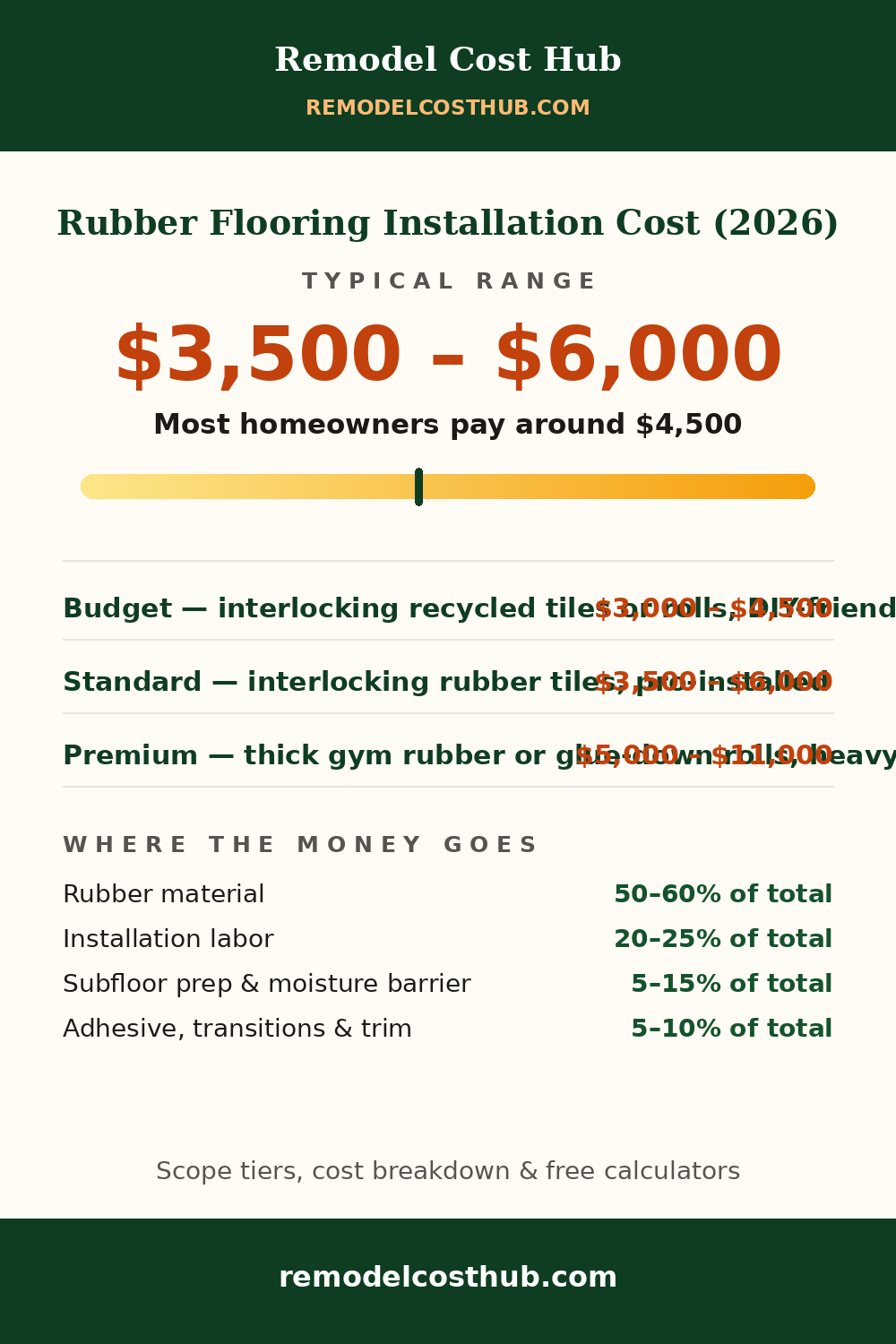
- Typical range: $3,500 – $6,000
- Most homeowners pay: around $4,500
- Per square foot: $7–$12 per sq ft
- Prices vary most by: Rubber material (50–60% of the budget)
Cross-checked against two published sources for this project. Sources used for this page: Angi's home gym flooring guide, updated July 15, 2026 (rubber flooring around $4–$12 per sq ft on average; foam $1–$5, vinyl $3–$7, carpet $3.50–$11, turf $2.50–$7, polished concrete $2–$8, hardwood $6–$22, cork $2–$10; rubber is the number-one gym option, durable and water-resistant, DIY-installable over existing flooring), HomeGuide's home gym cost guide (installing rubber tiles $4–$17 per sq ft; flooring $400–$3,400 depending on workout-space size) and RemodelingExpense's rubber flooring cost guide, updated June 23, 2026 ($7–$22 per sq ft installed; typical 500 sq ft project $3,500–$11,000; interlocking rubber tile $7–$15, glue-down rubber $10–$20, thick gym rubber $10–$22). mats4u corroborates ($3–$15 per sq ft incl. material and labor; tiles material $2–$8 plus install $1–$3, rolls $1.50–$12 plus $1–$3; DIY saves $300–$600 of labor) and buildsandbuys corroborates (basic rolls $3–$6, interlocking tiles $5–$9, virgin rubber $7–$11, recycled $4–$8, poured $8–$12; install $2–$4 per sq ft; 500 sq ft totals $2,250–$4,350 / $4,850–$7,000 / $7,500–$9,800; material 50–60%, labor 20–25%; thickness 3/8 in minimum residential, 1/2 in home gym, 3/4 in or more commercial). Synthesized typical = the standard interlocking-tile overlap at $3,500–$6,000 for 500 sq ft, with $4,500 most-pay at the middle of that band. Checked November 2026.. Sources last checked: October 2026 — HomeGuide, Angi. How we calculate these costs
Cost by scope
| Scope | Typical cost | What it includes |
|---|---|---|
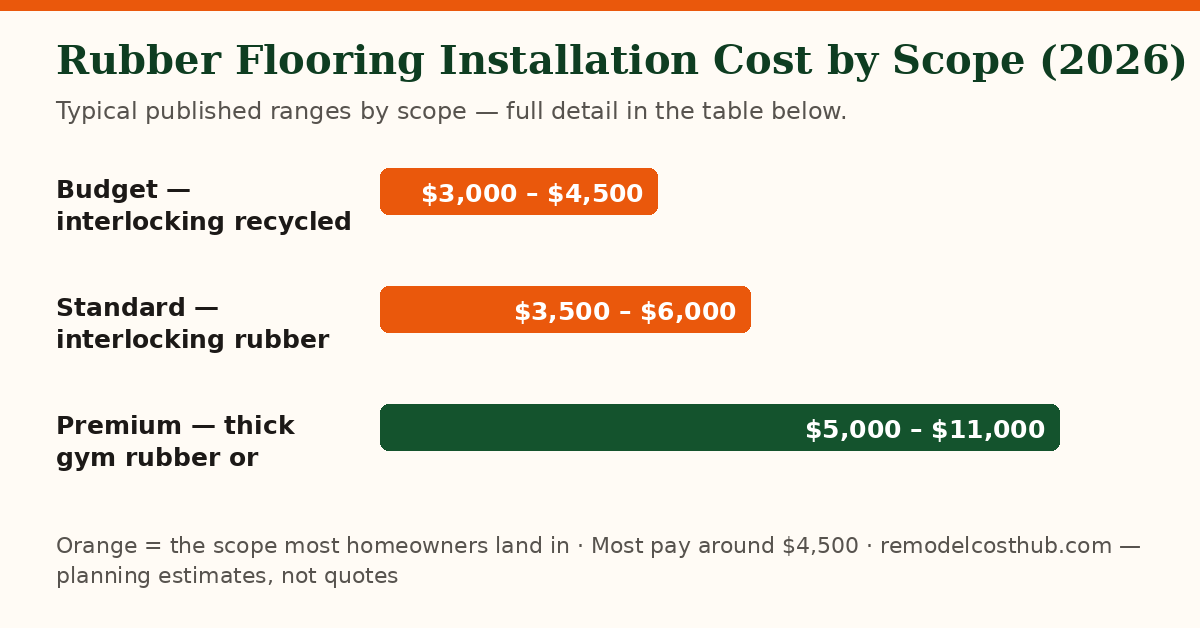
| Budget — interlocking recycled tiles or rolls, DIY-friendly | $3,000 – $4,500 | mats4u prices rubber tiles at $3–$11 per square foot all-in and buildsandbuys prices recycled rubber at $4–$8 per square foot; basic rolls run $3–$6. |
| Standard — interlocking rubber tiles, pro-installed | $3,500 – $6,000 | The typical project on this page: Angi prices rubber at $4–$12 per square foot and RemodelingExpense prices interlocking tile at $7–$15, overlapping at $7–$12. |
| Premium — thick gym rubber or glue-down rolls, heavy lifting | $5,000 – $11,000 | RemodelingExpense prices thick gym rubber at $10–$22 per square foot installed and glue-down at $10–$20 — a 500 sq ft room at the top of its typical $3,500–$11,000 band. |
Where the money goes
| Part of the job | Share | Note |
|---|---|---|
| Rubber material | 50–60% of total | buildsandbuys prices rubber material at 50–60% of a 500 sq ft project; mats4u prices tiles at $2–$8 per square foot for material alone |
| Installation labor | 20–25% of total | buildsandbuys prices labor at 20–25% of the project, $1–$3 per square foot for tiles and $2–$4 for professional installation |
| Subfloor prep & moisture barrier | 5–15% of total | A moisture barrier adds $0.50–$1 per square foot in buildsandbuys' data; patching and degreasing a concrete slab comes before any tile or roll goes down |
| Adhesive, transitions & trim | 5–10% of total | Specialist adhesive runs $100–$200 per bucket and transition strips $20–$40 per linear foot in buildsandbuys' data |
What moves the price most
Format is the first lever: RemodelingExpense prices interlocking tile at $7–$15 per square foot installed against glue-down at $10–$20 and thick gym rubber at $10–$22, and mats4u prices tiles at $3–$11 all-in against rolls at $2.50–$15 — rolls suit large open rooms, tiles suit DIY and small rooms. Thickness is second: buildsandbuys says 3/8 inch is the minimum for residential comfort, 1/2 inch for home gyms and 3/4 inch or more for commercial and CrossFit use, and Angi prices the whole rubber range at $4–$12 per square foot. Recycled or virgin is third: buildsandbuys prices recycled rubber at $4–$8 per square foot against virgin at $7–$11 — virgin has no odor and is the premium choice for a room inside the house. DIY or pro is fourth: Angi says rubber can be DIY-installed over existing flooring, and mats4u puts the DIY saving at $300–$600 of labor — glue-down rolls are the pro job. Worked example at the most-pay figure: rubber tiles $2,750 + labor $1,000 + subfloor prep & moisture barrier $500 + adhesive & transitions $250 = $4,500. For the room the floor goes in, see our home gym installation guide and our garage floor coating guide, and for the alternatives see our luxury vinyl flooring guide.
Costs in your city
Labor is the biggest variable in any remodel, and labor is local — the same bathroom can price very differently in Houston than in Boston. We are adding city editions metro by metro, each with its own labor index, permit notes and climate factors, written for that city rather than copied from this page. Wave 1: Houston, Dallas–Fort Worth, Phoenix, Atlanta, Miami–South Florida, Orlando, Tampa, Charlotte, Austin and San Antonio. Until your city's page is live, use the national range here and weight it the way contractors do: Sun Belt labor often prices near or below the national middle, while coastal California and the Northeast metros often price well above it.
Frequently asked questions
How much does rubber flooring cost?
$4–$12 per square foot in Angi's data and $7–$22 in RemodelingExpense's 2026 data; a standard 500 sq ft gym runs $3,500–$6,000 on this page.
How much does it cost to install rubber flooring in a home gym?
HomeGuide prices rubber tiles at $4–$17 per square foot installed, with flooring for a gym room at $400–$3,400 depending on the size of the space.
Are rubber tiles or rolls cheaper?
Tiles run $7–$15 per square foot installed in RemodelingExpense's data, and mats4u prices tiles at $3–$11 all-in against rolls at $2.50–$15 — rolls suit large open rooms, tiles suit DIY and small rooms.
How thick should gym rubber flooring be?
3/8 inch minimum for residential comfort, 1/2 inch for home gyms and 3/4 inch or more for commercial and CrossFit use in buildsandbuys' data.
Can I install rubber flooring myself?
Yes — Angi says rubber can be DIY-installed over existing flooring, and mats4u puts the DIY saving at $300–$600 of labor; glue-down rolls are the pro job. See our home gym installation guide for the room around the floor.