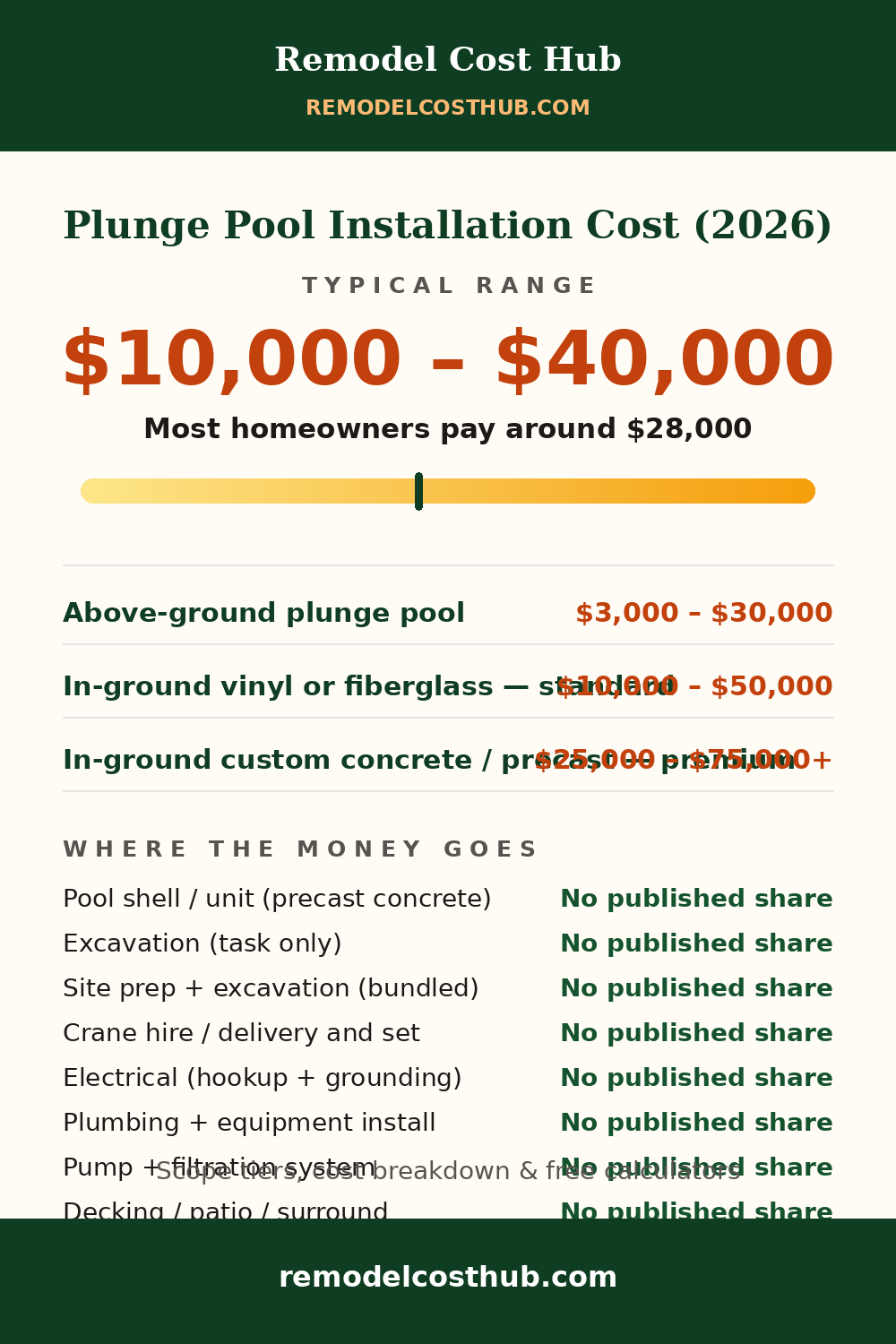
Plunge Pool Installation cost at a glance
- Typical range: $10,000 – $40,000
- Most homeowners pay: around $28,000
- Prices vary most by: Installation labour (25–50% of the budget)
Cross-checked against five published sources for this project. Sources used for this page: Angi, 'How Much Does a Plunge Pool Cost? (2026 Guide)', updated Oct 6, 2026 (typical installed $10,000–$40,000, national average $28,000; above-ground $3,000–$30,000; in-ground $10,000–$55,000; by size 4x4 ft $5,000–$10,000, 7x7 $10,000–$30,000, 9x5 $20,000–$40,000, 10x6 $30,000–$50,000, 13x7 $40,000–$60,000; by material vinyl $10,000–$30,000, fiberglass $18,000–$55,000, concrete $20,000–$75,000; labour $50–$150/hour, 25–50% of total; excavation $500–$3,000; permits $550–$3,100 EACH, most projects need multiple; pool heater $1,800–$4,200 installed; fence $1,500–$10,000; cover $900–$2,800; saltwater $500–$2,500; lights $625 each; jets $800–$1,200; infinity edge $11,000–$37,000; maintenance $400–$2,000/year), HomeGuide, 'How Much Does a Plunge Pool Cost? (2026)', published Oct 27, 2023, updated Jul 16, 2025 (average range $15,000–$40,000, national average $27,500; min $3,000, max $80,000; above-ground $3,000–$30,000; inground $10,000–$70,000+; by material concrete $25,000–$70,000, fiberglass $20,000–$50,000 table, vinyl $10,000–$25,000, steel shipping container $27,000–$46,000 installed; labour 25–50% of total; site prep $0.40–$2.00/sq ft; excavation $100–$300/hour or $2.50–$15.00/cu yd; permits $500–$2,000; delivery $100–$1,500+; fence $20–$60/linear ft; heater $1,600–$5,200; pump + filtration $1,000–$2,000; deck $25–$50/sq ft — its fiberglass BODY TEXT ($45,000–$100,000) contradicts its own table and matches full-size pool pricing, so it is NOT printed), Bob Vila, 'Plunge Pool Cost: What to Expect and How Much You'll Pay', updated Jun 30, 2022 (typical $10,000–$50,000; national average $20,000 — STALE 2022 data, explicitly 'According to Angi and HomeAdvisor', so it is corroboration only and its average is NOT printed as a current figure; above-ground $3,000–$30,000; inground $10,000–$35,000; site prep + excavation $1,500–$5,000; permits $400–$1,800; heater $1,600–$3,600; vinyl liner replacement every 5–9 years), Plungie, 'How much does a plunge pool cost in 2026?', updated Mar 18, 2026 (manufacturer pricing its OWN precast pools — fully installed Plungie total $42,000–$69,000+, shell $25,000–$35,000, permits $3,000–$4,000, installation $9,000–$14,000, crane hire $3,000–$15,000+, equipment from $3,600, plumbing + equipment install from $2,000, electrical + grounding from $2,800, freight from $1,540 — maker figures, labelled as such wherever used) and This Old House, 'How To Install a Plunge Pool', published Oct 1, 2018, updated Jun 12, 2026 (cost figures quoted from Angi — average $28,000, range $3,000–$75,000 — used for install process and the 4–6 week timeline only; precast shell up to 18,000 lb, flatbed + crane, ~18 inches of crushed stone base). Synthesized typical = the $10,000–$40,000 headline (Angi, freshest), with $28,000 most-pay at Angi's published national average; HomeGuide's $27,500 average agrees within $500 and both guides top out at $40,000. The honest overlap band is $15,000–$40,000 for most in-ground projects. ThePricer.org mirrors Angi's headline exactly and is not counted as an independent source. Checked November 2026.. Sources last checked: October 2026 — This Old House, HomeAdvisor, HomeGuide, Angi, ThePricer. How we calculate these costs
Cost by scope
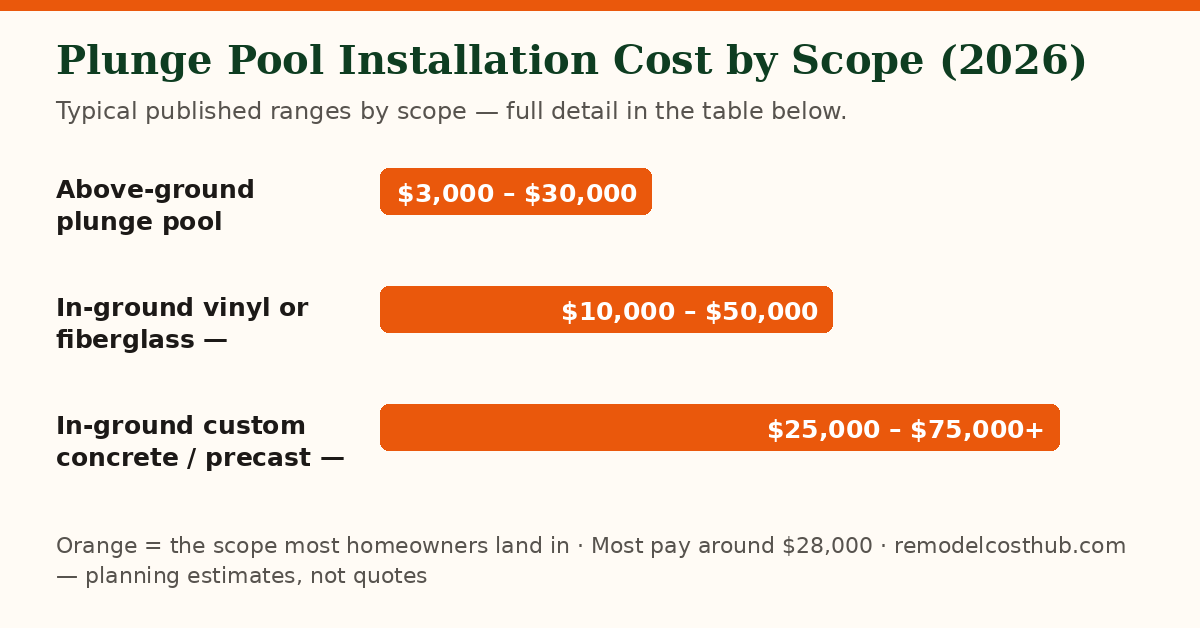
| Scope | Typical cost | What it includes |
|---|---|---|
| Above-ground plunge pool | $3,000 – $30,000 | A prefabricated vinyl or fiberglass shell set on a levelled pad, minimal excavation, basic pump and filtration. Usually needs no permit. A concrete slab underneath typically costs $3,600–$7,200 (Angi). All three guides agree exactly on the $3,000–$30,000 band. Small 6-ft pools sit at the low end ($10,000–$15,000, Bob Vila 2022). |
| In-ground vinyl or fiberglass — standard | $10,000 – $50,000 | The band most in-ground jobs land in: a vinyl-liner shell ($10,000–$25,000) or a fiberglass shell ($18,000–$55,000), excavation, plumbing and electrical hookups, pump and filtration ($1,000–$2,000), basic coping and permits. The $28,000 most-pay sits inside it. By size (Angi): 7x7 ft $10,000–$30,000; 9x5 ft $20,000–$40,000; 10x6 ft $30,000–$50,000. Fiberglass installs fastest — a prefab shell craned in; vinyl is cheapest up front but the liner needs replacing every 5–9 years. |
| In-ground custom concrete / precast — premium | $25,000 – $75,000+ | A custom concrete/gunite shell built on site — any shape, benches, jets and a tanning ledge moulded in — or a precast concrete shell ($42,000–$69,000+ fully installed, Plungie, maker figures). Full excavation, crane delivery and set ($3,000–$15,000+, Plungie), equipment, permits and basic coping. Precast sets in 1–2 weeks once permits clear; custom gunite takes months (HomeGuide) / 4–6 weeks total project (This Old House). Luxury custom builds with premium finishes can pass $80,000. |
Where the money goes
| Part of the job | Share | Note |
|---|---|---|
| Pool shell / unit (precast concrete) | No published share | $25,000–$35,000 by size and finish (Plungie, maker figures). |
| Excavation (task only) | No published share | $500–$3,000 (Angi). At $100–$300 per hour or $2.50–$15.00 per cubic yard (HomeGuide). |
| Site prep + excavation (bundled) | No published share | $1,500–$5,000 (Bob Vila, 2022 figures — rises for difficult areas, deeper pools and custom designs). |
| Crane hire / delivery and set | No published share | Crane hire $3,000–$15,000+ (Plungie, maker figures — flat site cheap, lifting over a two-storey house expensive). Shipping/delivery $100–$1,500+ (HomeGuide) is a different scope — never merged into one band. |
| Electrical (hookup + grounding) | No published share | From $2,800 (Plungie, maker figures); electrician $50–$130 per hour (HomeGuide) / $50–$100 per hour (Angi). |
| Plumbing + equipment install | No published share | From $2,000 (Plungie, maker figures); plumber $75–$150 per hour (HomeGuide) / $45–$200 per hour (Angi). |
| Pump + filtration system | No published share | $1,000–$2,000 (HomeGuide); full equipment package from $3,600 (Plungie). |
| Decking / patio / surround | No published share | Deck $25–$50 per sq ft; patio $5–$35 per sq ft (HomeGuide); concrete slab $3,600–$7,200 (Angi). No source publishes a standalone coping-only figure — coping sits inside the shell and deck figures. |
| Heater | No published share | $1,800–$4,200 installed (Angi); $1,600–$5,200 (HomeGuide); honest overlap $1,800–$3,600. |
| Permits | No published share | $400–$2,000 per permit (HomeGuide/Bob Vila); Angi $550–$3,100 each, usually multiple permits per project — budget $1,000–$3,000+ in total permit fees (DERIVED total, labelled as such). |
| Fencing / safety barrier | No published share | $1,500–$10,000 total (Angi); $20–$60 per linear foot (HomeGuide). Often legally required, not optional. |
| Installation labour | 25–50% of total | Contractors $50–$150 per hour (Angi). Angi and HomeGuide agree exactly on the 25–50% share — it drives the estimator's note and the 'Prices vary most by' glance row. |
What moves the price most
Worked example — illustrative arithmetic from published bands (not a published quote): a 7x7 ft vinyl-liner pool: shell $16,000 + excavation $2,500 + pump and filtration $1,800 + heater $3,000 + permits $1,500 + fencing $3,500 = $28,300 — within 1% of Angi's $28,000 published average. Each line is picked INSIDE its published band; do NOT present the $28,300 as a contractor quote. Size is the single biggest driver: Angi's size table runs $5,000–$10,000 for a 4x4 ft pool to $40,000–$60,000 for a 13x7 ft pool — and its size table tops out ABOVE its own $10,000–$40,000 headline range, because the headline covers common sizes. Small pools still carry fixed costs (excavation, permits, electrical, equipment) that do not shrink with the pool, so cost per square foot is high. Material: vinyl cheapest up front ($10,000–$25,000) but liners rip and need replacing every 5–9 years; fiberglass mid-range ($18,000–$55,000), fast install, low maintenance, catalog shapes only; concrete most customisable and most expensive ($25,000–$70,000), longest build, highest maintenance. HomeGuide's body text quotes fiberglass at $45,000–$100,000 — that contradicts its own table ($20,000–$50,000) and matches full-size fiberglass pool pricing, so it is NOT printed here. Above-ground vs in-ground: above-ground $3,000–$30,000 with little or no excavation and usually no permit; in-ground $10,000–$55,000+ with full excavation, structural work and permits. Do not let the $3,000 floor migrate into the in-ground band — $3,000 is the floor for a small above-ground pool; the in-ground floor is $10,000. Site access: tight yards, trees to preserve, or a pool close to a shed need specialised equipment and more labour (Angi). A precast shell weighing up to 18,000 lb needs a flatbed truck and a crane and about 4 ft of clearance for equipment (This Old House); lifting over a two-storey house pushes crane hire to $15,000+ (Plungie). Soil, rock and water table: excavation at $100–$300 per hour or $2.50–$15.00 per cubic yard (HomeGuide) rises fast in rock, a high water table or unstable soil. No source publishes a rock-excavation surcharge figure for plunge pools — the risk is named here, no number is printed. Region: warmer climates (California, Florida) are typically cheaper — pools are common and the market is more competitive (Angi); colder regions have fewer specialist contractors and higher prices. Permits and safety rules: most projects need multiple permits (excavation, construction, electrical); most cities require a fence or barrier around pools over a certain depth (HomeGuide); above-ground pools usually skip permits but HOAs may ban them. Features: heater $1,800–$4,200, jets $800–$3,000, lights $200–$1,200 each, covers $900–$11,000, saltwater $500–$2,500, spa system $3,500–$15,000, infinity edge $11,000–$37,000 (Angi) — features are what turn a $28,000 pool into a $50,000+ project. Shape: square or rectangular is cheapest; round, curved, L-shaped and custom shapes cost more (Angi, HomeGuide, Bob Vila). Season: fall and winter are the slower season — look for deals then (HomeGuide). Methodology: figures cross-checked across Angi (updated Oct 6, 2026), HomeGuide (updated Jul 16, 2025) and Bob Vila (updated Jun 30, 2022 — four years old and explicitly sourced from Angi/HomeAdvisor, so it is corroboration, not a third independent survey; its $20,000 average is NOT printed as a current figure) — plus Plungie (updated Mar 18, 2026, a manufacturer pricing its own precast pools — used only for crane, shell, equipment, electrical and plumbing line items, labelled as maker figures) and This Old House (updated Jun 12, 2026 — its cost figures are Angi's, quoted second-hand; used for install process and timeline). ThePricer.org mirrors Angi's headline exactly and is not counted as a source. A cold-plunge tub ($2,800–$9,500+ for the unit alone, HomeGuide) and a stock-tank pool ($500–$2,500) are different products and are not costed as tiers here. Related costs: deck building, fence installation, pool installation, concrete driveway, sprinkler system installation, outdoor kitchen installation and hot tub installation.
Costs in your city
Labor is the biggest variable in any remodel, and labor is local — the same bathroom can price very differently in Houston than in Boston. We are adding city editions metro by metro, each with its own labor index, permit notes and climate factors, written for that city rather than copied from this page. Wave 1: Houston, Dallas–Fort Worth, Phoenix, Atlanta, Miami–South Florida, Orlando, Tampa, Charlotte, Austin and San Antonio. Until your city's page is live, use the national range here and weight it the way contractors do: Sun Belt labor often prices near or below the national middle, while coastal California and the Northeast metros often price well above it.
Frequently asked questions
How much does plunge pool installation cost?
$10,000–$40,000 for a typical in-ground install, with most homeowners paying around $28,000 (Angi, updated Oct 2026; HomeGuide's 2025 average is $27,500 — the two agree within $500). Above-ground pools run $3,000–$30,000, and large or custom concrete in-ground pools reach $70,000–$75,000+.
Above-ground or in-ground — which is cheaper, and by how much?
Above-ground is far cheaper: $3,000–$30,000 installed — all three guides agree exactly — versus $10,000–$55,000+ in-ground. Above-ground skips most excavation and usually needs no permit, but it needs a concrete slab underneath ($3,600–$7,200) and looks less permanent.
Which plunge pool material is best — vinyl, fiberglass or concrete?
Vinyl is cheapest up front ($10,000–$25,000) but liners rip and need replacing every 5–9 years. Fiberglass ($18,000–$55,000) installs fastest — a prefab shell is craned in — and is low-maintenance, but shapes are limited to catalogues. Concrete ($25,000–$70,000) allows any shape and lasts longest but takes months to build and needs the most maintenance.
Do I need a permit and a fence for a plunge pool?
Almost always yes for in-ground: building permits run $400–$2,000 each and most projects need more than one (excavation, construction, electrical), so budget $1,000–$3,000+ in total. Most cities require a safety fence or barrier around pools over a certain depth — $1,500–$10,000 installed. Above-ground pools usually do not need a permit, but check your HOA rules first.
How long does it take to install a plunge pool?
A precast shell can be set in 1–2 weeks on site once permits are approved; a full project typically runs 4–6 weeks (This Old House). A custom concrete/gunite pool takes months to build (HomeGuide). Permit approval time is on top of the build time and varies by city.
Does a plunge pool add value to my home?
It can, but do not count on recovering the cost. Angi puts pool ROI at 5–56% with 'most people's return on the lower side'; This Old House notes homes with a pool often sell for about 8% more (PA Realtors), and HouseLogic says up to 7% in the right market. A plunge pool's lower maintenance than a full-size pool is part of its appeal to buyers — but treat it as a lifestyle purchase, not an investment.