Drain Field Replacement cost at a glance
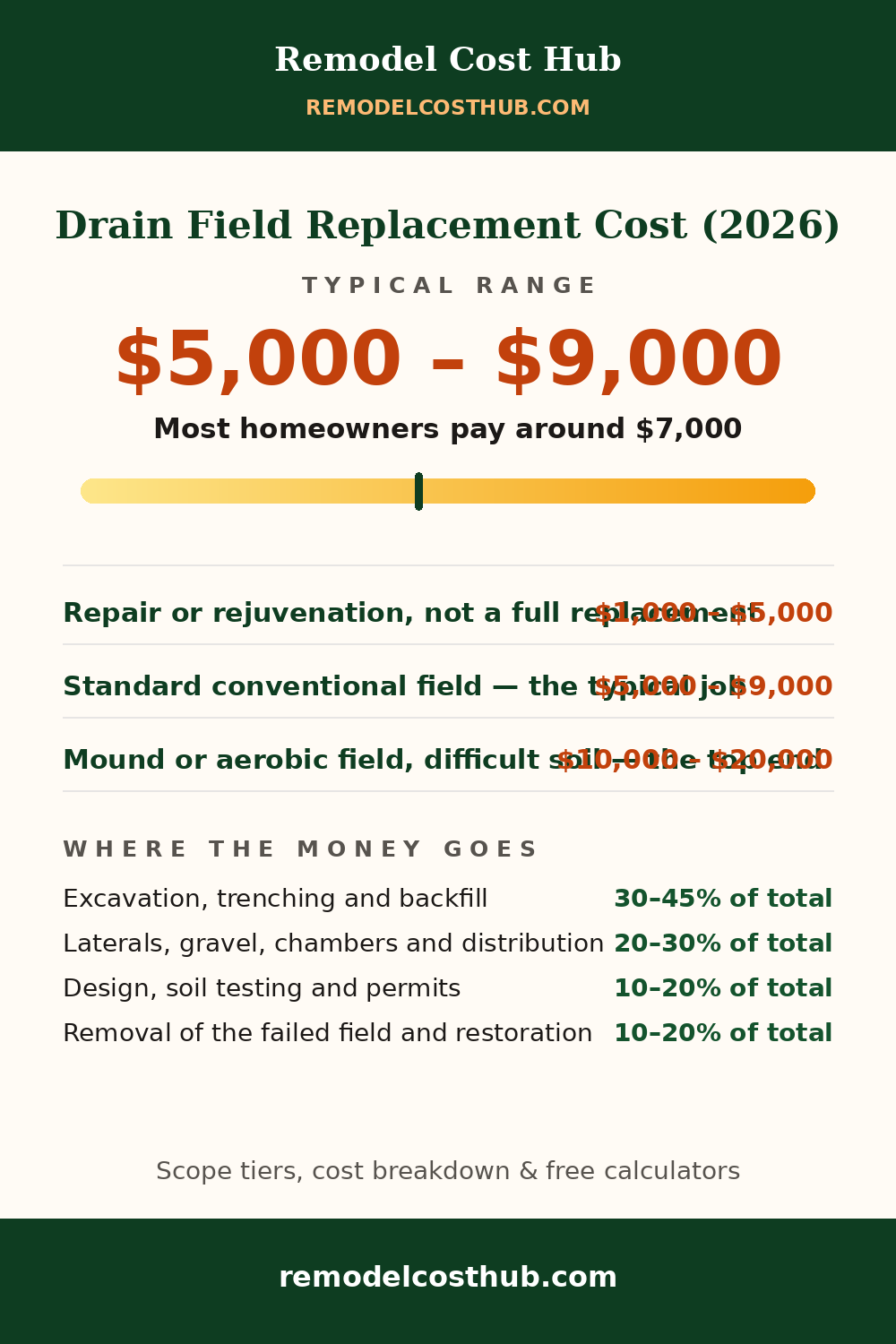
- Typical range: $5,000 – $9,000
- Most homeowners pay: around $7,000
- Prices vary most by: Excavation, trenching and backfill (30–45% of the budget)
Cross-checked against two published sources for this project. Sources used for this page: HomeGuide's leach/drain-field replacement guide (replacement $3,000–$15,000, national average $7,900; anaerobic field $2,000–$6,000, aerobic $7,000–$10,000, mound $10,000–$20,000, evapotranspiration $8,000–$15,000; rejuvenation/repair $1,000–$5,000; leach lines $20–$45 per linear foot; tank-and-field together $4,500–$20,000; field life 20–25 years), Angi's septic tank and drain-field replacement guide, updated October 29, 2026 (tank-and-field $5,000–$12,000, average $6,000; drain field alone around $7,000; anaerobic field $5,000, aerobic $7,000, mound $12,000; tank alone $3,000–$10,000) and Angi's septic system installation guide, updated October 14, 2026 (perc testing $700–$2,000; permits $450–$2,300; excavation $1,500–$6,300 when billed separately; old tank removal $45–$200 per hour; land clearing $1,200–$4,800) — the page's typical band is the conventional-field overlap, and its $7,000 most-pay figure is Angi's drain-field-alone figure, near HomeGuide's $7,900 average. Sources last checked: October 2026 — HomeGuide, Angi. How we calculate these costs
Cost by scope
| Scope | Typical cost | What it includes |
|---|---|---|
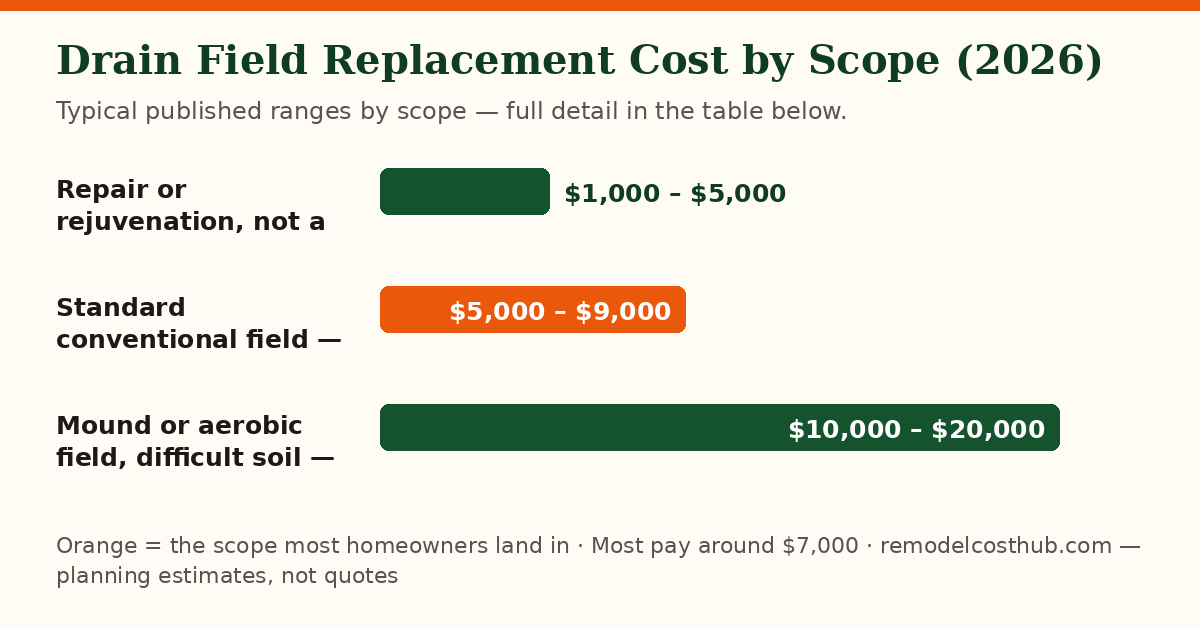
| Repair or rejuvenation, not a full replacement | $1,000 – $5,000 | The cheap end: HomeGuide prices leach-field rejuvenation or drain-field repair at $1,000–$5,000 — a broken pipe, a failed distribution box or clogged laterals, not worn-out soil |
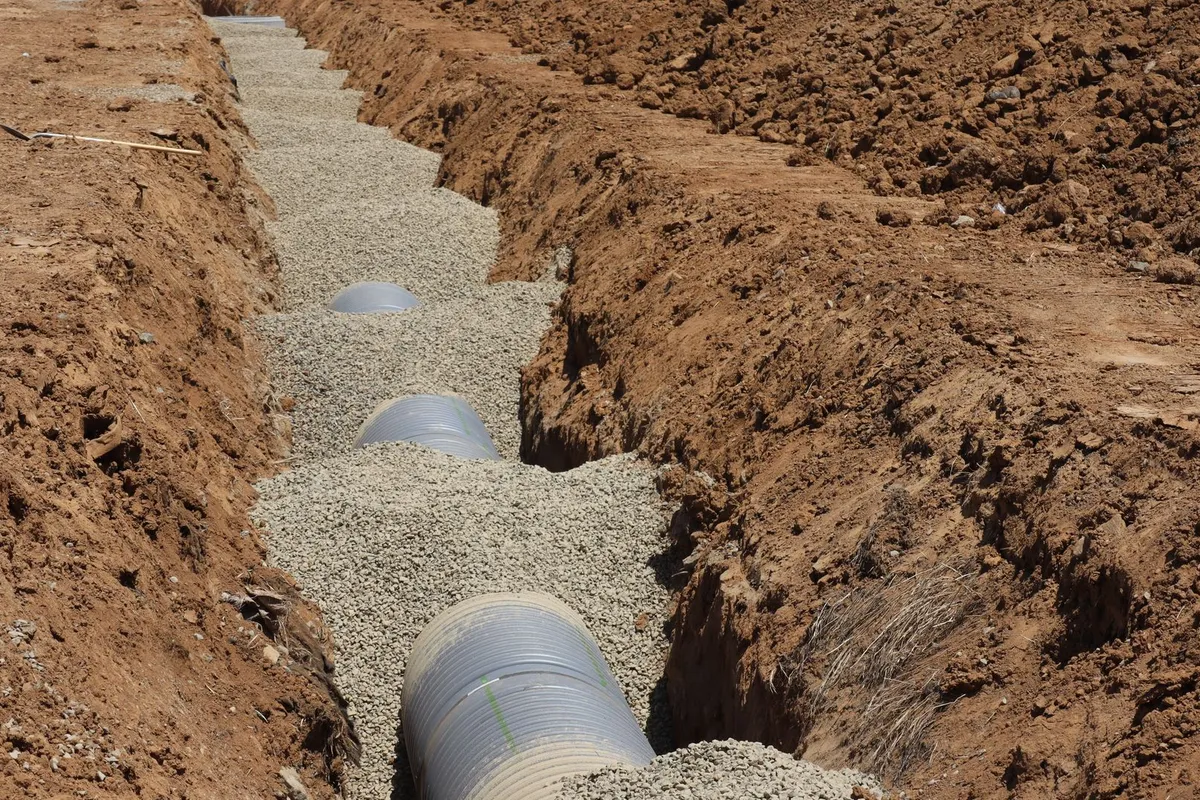
| Standard conventional field — the typical job | $5,000 – $9,000 | The shared band itself: Angi's around-$7,000 drain-field-alone figure inside HomeGuide's $3,000–$15,000 band — new laterals, gravel and chambers on fresh soil, sized to current code |
| Mound or aerobic field, difficult soil — the top end | $10,000 – $20,000 | The expensive end: HomeGuide prices mound fields at $10,000–$20,000 and aerobic fields at $7,000–$10,000, while Angi prices mound at $12,000 and aerobic at $7,000 — a high water table, shallow bedrock or a failed perc test pushes a job here |
Where the money goes
| Part of the job | Share | Note |
|---|---|---|
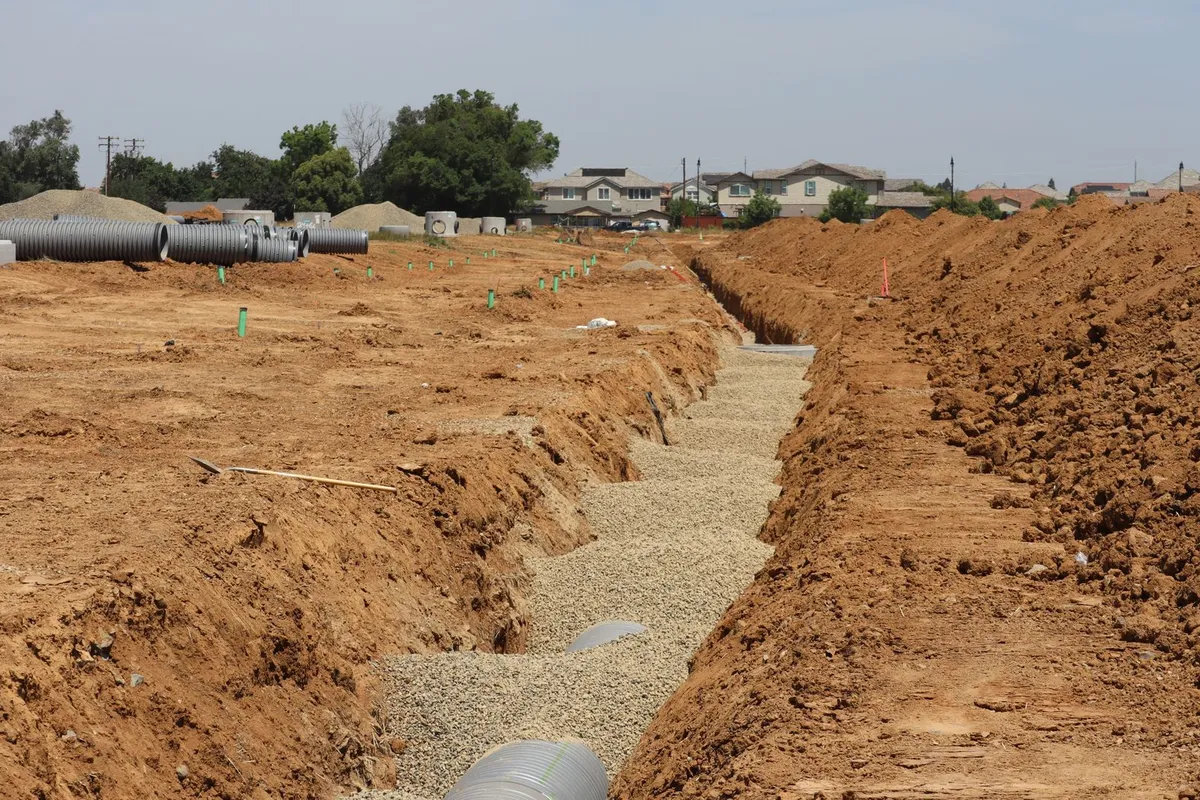
| Excavation, trenching and backfill | 30–45% of total | The earthwork: Angi's septic guides put excavation at $1,500–$6,300 when billed separately, and a failed field usually needs a new field on fresh soil, not the old footprint |
| Laterals, gravel, chambers and distribution | 20–30% of total | The field itself: HomeGuide prices replacing leach lines at $20–$45 per linear foot, and the pipe, gravel and chamber choice is the material ladder |
| Design, soil testing and permits | 10–20% of total | The paper before the digging: Angi prices perc testing at $700–$2,000 and permits at $450–$2,300, and the field size is set by the soil result, not by preference |
| Removal of the failed field and restoration | 10–20% of total | The old field comes out or is abandoned to code, and the lawn above it is restored — Angi prices old tank removal at $45–$200 per hour where it applies |
What moves the price most
The soil result is the first fork. Angi prices perc testing at $700–$2,000, and that result sets the field type: soil that percs well takes a conventional field at $5,000–$9,000, while a failed perc test means an engineered field at $10,000–$20,000 in HomeGuide. Fresh soil is the second fork: a failed field's soil is spent, so the replacement usually goes on new ground, sized to current code — which is why a replacement is priced as a new field, not a repair of the old one. Size is the third fork: HomeGuide prices leach lines at $20–$45 per linear foot, so bedroom count and water use set the trench length and the bill. Finally, access and permits bite: Angi prices excavation at $1,500–$6,300 when billed separately, and permits at $450–$2,300, with the health department signing off before the field is covered.
Costs in your city
Labor is the biggest variable in any remodel, and labor is local — the same bathroom can price very differently in Houston than in Boston. We are adding city editions metro by metro, each with its own labor index, permit notes and climate factors, written for that city rather than copied from this page. Wave 1: Houston, Dallas–Fort Worth, Phoenix, Atlanta, Miami–South Florida, Orlando, Tampa, Charlotte, Austin and San Antonio. Until your city's page is live, use the national range here and weight it the way contractors do: Sun Belt labor often prices near or below the national middle, while coastal California and the Northeast metros often price well above it.
Frequently asked questions
How much does it cost to replace a drain field?
Typically $5,000–$9,000 for a standard conventional field, with about $7,000 the figure most jobs land near — Angi's drain-field-alone figure, against HomeGuide's $7,900 average inside its $3,000–$15,000 band.
Can a drain field be repaired instead of replaced?
Sometimes: HomeGuide prices rejuvenation or repair at $1,000–$5,000 for a broken pipe, a failed distribution box or clogged laterals. Worn-out soil cannot be repaired — that is the case for a full replacement on fresh soil.
Why can't the new field go where the old one was?
Because the old field's soil is spent: it no longer absorbs effluent the way it did. A replacement field is normally built on fresh soil and sized to current code, which is also why the job is priced like a new field rather than a patch.
How long does a drain field last?
HomeGuide and EPA guidance put the average around 20–25 years, set by water use and maintenance — heavy water use, driving over the field and skipped pumping all shorten it.
Does the price include a new septic tank?
No: this page prices the field only. HomeGuide prices a tank-and-field job together at $4,500–$20,000 and Angi at $5,000–$12,000 averaging $6,000 — if the tank is also failing, that is a second scope, not part of this band.