Epoxy Flooring cost at a glance
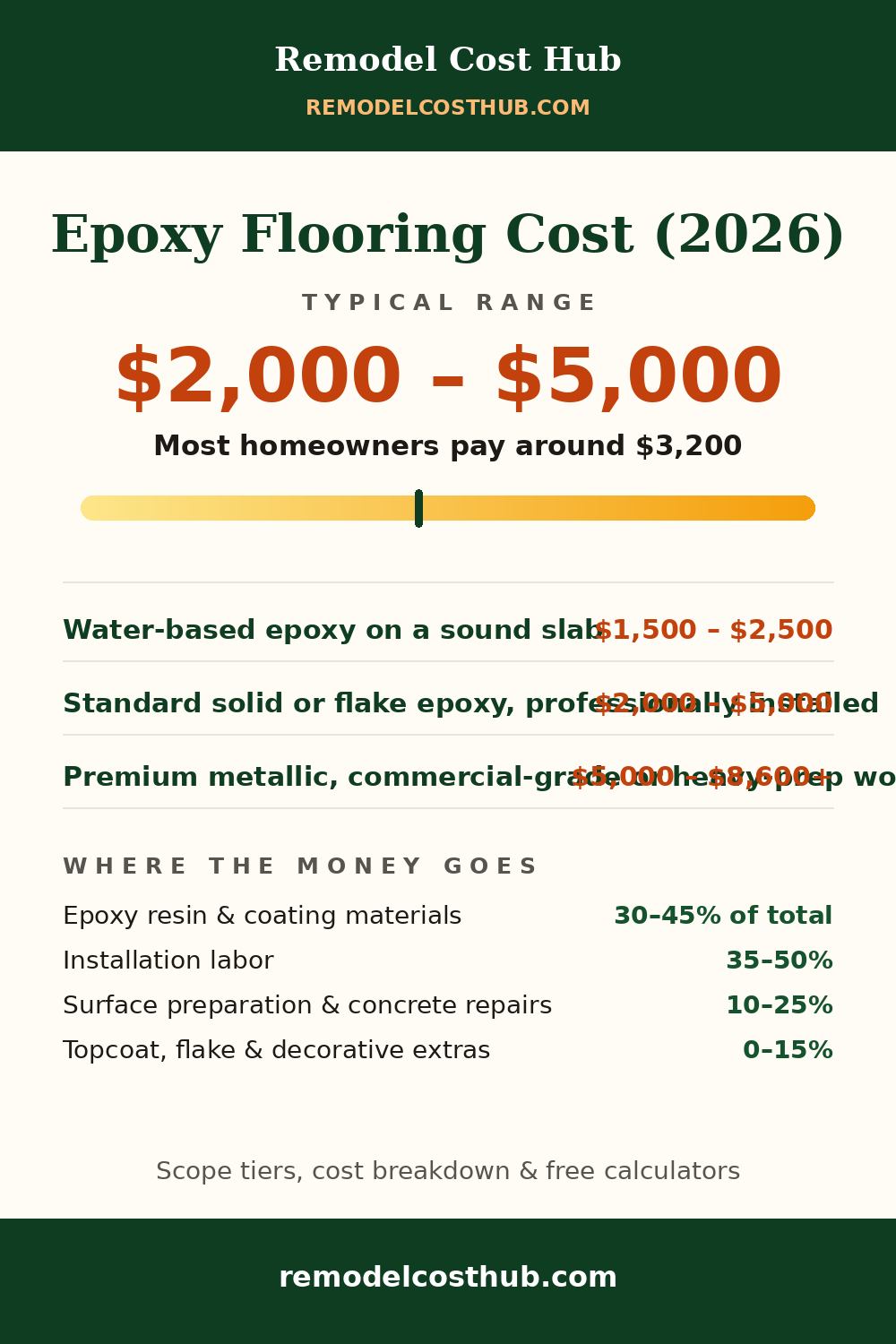
- Typical range: $2,000 – $5,000
- Most homeowners pay: around $3,200
- Per square foot: $4 – $10 per sq ft
- Prices vary most by: Installation labor (35–50% of the budget)
Cross-checked against three published sources for this project. Sources used for this page: the Angi epoxy flooring cost guide, HomeGuide's epoxy flooring cost guide and This Old House's epoxy flooring cost guide. Sources last checked: October 2026 — This Old House, HomeGuide, Angi. Last updated October 2026 · How we calculate these costs
Cost by scope
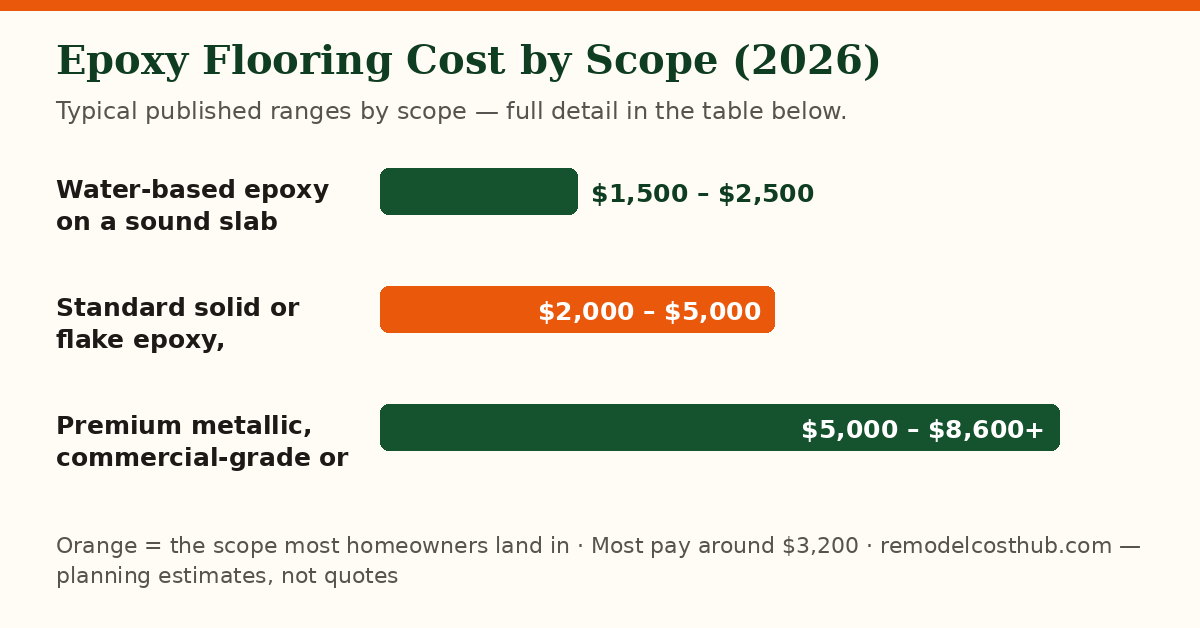
| Scope | Typical cost | What it includes |
|---|---|---|
| Water-based epoxy on a sound slab | $1,500 – $2,500 | A water-based system over about 500 sq ft of clean, sound concrete — the budget resin class in every guide: $40–$100 per gallon in HomeGuide and $30–$50 in This Old House, and the least durable, recoated in a few years in HomeGuide's lifespan data |
| Standard solid or flake epoxy, professionally installed | $2,000 – $5,000 | Where most garage projects land: a solid or decorative-flake system over about 500 sq ft — HomeGuide puts installed epoxy at $4–$10 per sq ft with a 2-car garage at $1,600–$5,800, Angi puts the average project at about $2,526, and This Old House puts professional work at $3–$12 |
| Premium metallic, commercial-grade or heavy-prep work | $5,000 – $8,600+ | Metallic or high-build systems, or a slab that needs real repair first — Angi's band runs to $12 per sq ft with concrete repairs or resurfacing adding $1,000–$5,000, and HomeGuide's garage table runs to $8,600 for large spaces |
Where the money goes
| Part of the job | Share | Note |
|---|---|---|
| Epoxy resin & coating materials | 30–45% of total | The resin system itself: HomeGuide puts epoxy materials at $1–$5 per sq ft, priced by the gallon by type — water-based $40–$100, solvent $50–$100 and solid $70–$150 per gallon, each gallon covering about 80–200 sq ft |
| Installation labor | 35–50% | Grinding or etching, priming, coating and topcoating in sequence: HomeGuide prices labor at $3–$5 per sq ft and Angi puts labor at about 33–60% of a professional job — the crew and the cure windows are what a DIY kit does not buy |
| Surface preparation & concrete repairs | 10–25% | The line that decides whether the floor lasts: crack filling, oil and coating removal and profiling the slab — HomeGuide prices concrete resurfacing at $3–$7 per sq ft where it is needed, and Angi budgets $1,000–$5,000 for resurfacing or foundation-level repairs on damaged floors |
| Topcoat, flake & decorative extras | 0–15% | Near zero on a plain solid-colour floor; a clear protective topcoat, decorative flake broadcast or metallic pigment work are real additions of their own when the finish goes beyond the standard system |
What moves the price most
Resin type is the epoxy budget. The guides ladder the same three resins in the same order: water-based is the cheapest and least durable ($40–$100 per gallon in HomeGuide, $30–$50 in This Old House), solvent sits in the middle ($50–$100 in HomeGuide), and solid epoxy is the durable, professional product ($70–$150 in HomeGuide, $45–$150 in This Old House). The installed bands agree once the system is fixed — HomeGuide at $4–$10 per sq ft, Angi at $2–$12 and This Old House at $3–$12 for professional work — and the standard-system overlap of roughly $4–$10 is the rate this page publishes as typical. Preparation is the second lever, and it is the one that decides the lifespan: epoxy bonds to the slab it is given, so grinding or etching, crack repair and moisture problems are priced before any resin is opened — Angi budgets $1,000–$5,000 for resurfacing-level prep, against a few hundred dollars of cleaning and etching on a sound slab. Size works in your favour: the per-square-foot rate falls as the floor grows, which is why HomeGuide's 1-car garage ($1,200–$3,900) prices dearer per foot than its 3-car ($2,300–$8,600). Finally, the DIY comparison is real but narrow: kits run $200–$700 in HomeGuide and $2–$5 per sq ft in This Old House — the saving is the labor line, and the risk transferred to you is the prep and the cure, which is where epoxy floors actually fail.
Worked example: how a typical epoxy flooring budget breaks down
A typical job: a 2-car garage of about 500 sq ft, slab cleaned, ground and crack-checked, a standard solid epoxy system with a decorative flake broadcast and a clear topcoat. The budget below totals $3,200 — the "most homeowners pay around" figure from the top of this page — split using this page's own cost breakdown. It shows how a real quote at that level is usually composed; every line is built from the ranges on this page, and it is an illustration, not a quote for your project.
| Line item | Example budget |
|---|---|
| Epoxy resin and coating materials — standard solid system | $1,216 |
| Installation labor | $1,376 |
| Surface preparation and concrete repairs | $384 |
| Topcoat, flake and decorative extras | $224 |
| Total | $3,200 |
What most people get wrong
- Coating over an untested slab — moisture vapour pushing up through concrete is the classic epoxy failure, and a moisture test before coating is cheaper than stripping a bubbled floor.
- Comparing a water-based kit quote with a solid epoxy quote as if they were the same floor — the resin class decides the lifespan, and the guides put years, not months, between them.
- Skipping the grinding to save the prep line — acid etching alone is the shortcut behind most peeling floors; the profile ground into the slab is what the coating actually holds onto.
- Driving on it by the weekend because it feels hard — surface dry is not cured; the guides' 2–7 day vehicle window exists because hot tyres on soft epoxy lift it in sheets.
Costs in your city
Epoxy follows the slab and the weather. Humid and coastal regions fight slab moisture year-round, so moisture testing and vapour-tolerant primers join more quotes there; freeze-thaw regions bring cracked, salt-damaged garage slabs that price the repair line before any resin; and hot regions schedule around cure windows, because epoxy applied to a sun-baked slab cures badly. Installer depth varies too — epoxy is a specialist trade, and outside the metros fewer crews compete, which widens the spread between the careful quote and the cheap one. The resin itself is priced nationally; what your region changes is the condition of the concrete it has to stick to.
Frequently asked questions
How much does epoxy flooring cost for a 2-car garage?
About $2,000–$5,000 professionally installed is the typical band on this page for about 500 sq ft, with most projects landing around $3,200. HomeGuide prices a 2-car garage at $1,600–$5,800, and Angi puts the average epoxy project at about $2,526 across a $750–$5,800 span.
How much does epoxy flooring cost per square foot?
HomeGuide puts installed epoxy at $4–$10 per sq ft (materials $1–$5, labor $3–$5), Angi at $2–$12 and This Old House at $3–$12 for professional installation. A standard solid or flake system on a sound slab lands around $4–$10; metallic and heavy-prep work runs above it.
Is DIY epoxy flooring worth it?
On material price alone, yes: DIY kits run $200–$700 in HomeGuide and $2–$5 per sq ft in This Old House, against a professional labor line of $3–$5 per sq ft. What the kit does not include is the grinding, moisture testing and repair work that decide whether the coating bonds — water-based DIY systems are also the shortest-lived, at 3–5 years in HomeGuide against 10–20 for solid epoxy.
How long does an epoxy floor last?
It depends on the resin class. HomeGuide puts water-based epoxy at 3–5 years before recoating and solid epoxy at 10–20 years, and Angi likewise puts a professionally installed floor at 10–20 years with proper preparation. Prep quality moves those numbers more than brand does.
How long does epoxy flooring take to cure?
Do not walk on it for 16–24 hours and do not drive on it for 2–7 days, per HomeGuide's cure guide: water-based systems take a second coat in 8–10 hours, while solid epoxy needs about 24 hours between coats and a full 7 days to cure completely. Warm, dry weather is part of the schedule — epoxy cannot bond properly to a wet or humid slab.