Dumbwaiter Installation cost at a glance
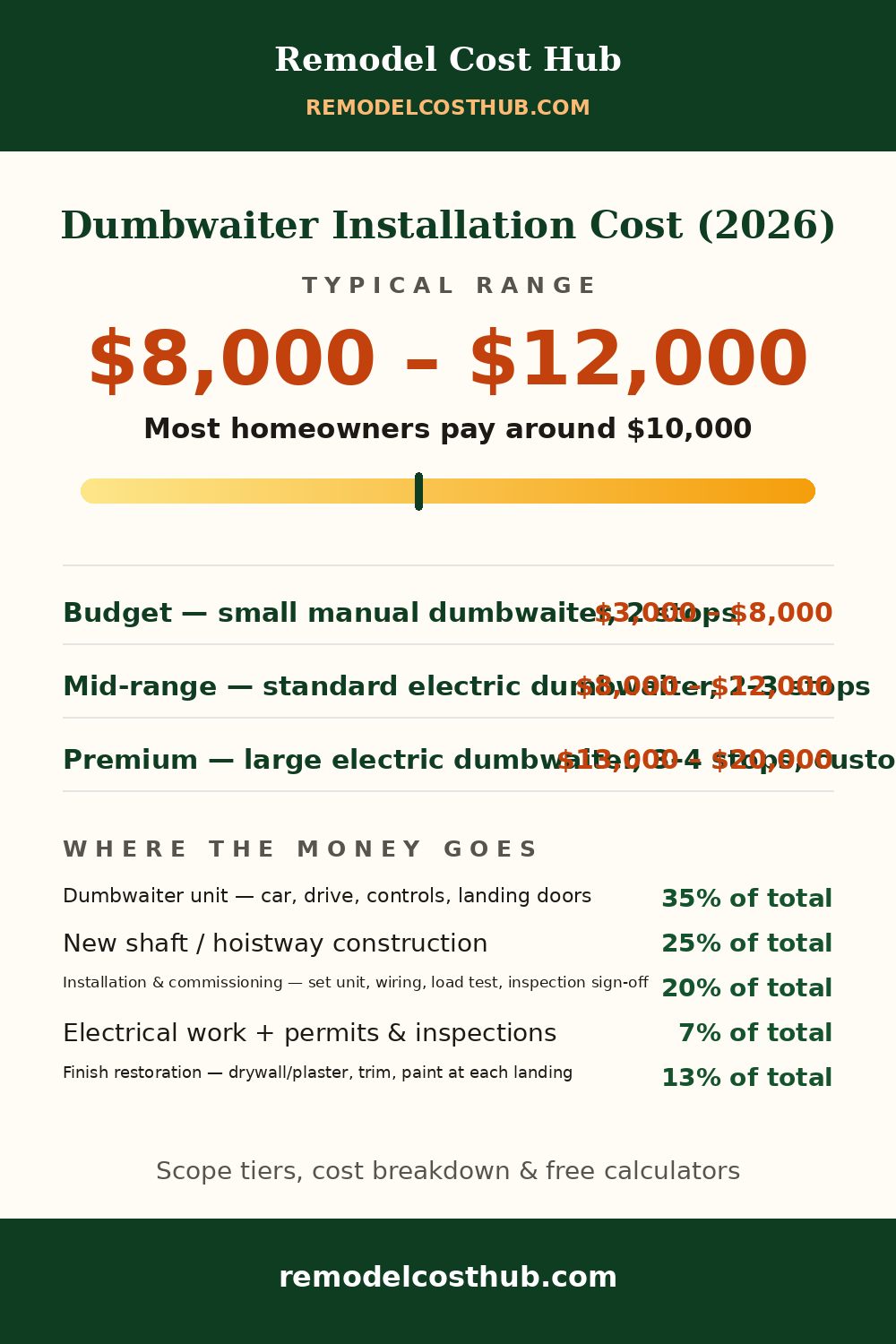
- Typical range: $8,000 – $12,000
- Most homeowners pay: around $10,000
Cross-checked against two published sources for this project. Sources used for this page: Angi, How Much Does a Dumbwaiter Cost to Install in 2026? (updated Oct 27, 2026 — avg $10,000; typical $8,000-$12,000; low $4,000 / high-end electric $20,000; manual $3,000-$8,000, electric $10,000-$20,000; size table mini $2,000-$7,500 / standard $4,000-$12,000 / mid $7,000-$17,000 / oversized $10,000-$20,000; units $2,000-$7,000, materials ~45% / labour ~55%; shaft $2,500-$3,500, fitting $750-$7,500, total labour $3,500-$11,000; location kitchen/bath $8,000-$12,000, bedroom $4,000-$10,000, dining $6,000-$10,000; brands Matot $2,000-$6,000, Inclinator $3,500-$6,000, PowerLift $4,000-$7,000, Harmar $4,000-$7,000; install ~1 day, 2-3 days large; home elevator $2,000-$60,000, most ~$30,000); HomeGuide, How Much Does a Dumbwaiter Cost? (2026) (published Dec 12, 2024 — size tiers compact ≤100 lb $8,000-$12,000 / standard ≤200 lb $10,000-$16,000 / large ≤300 lb $13,000-$20,000 / oversized ≤500 lb $15,000-$30,000+; motorized $10,000-$20,000; basic manual $8,000-$12,000; installation labour $4,000-$8,000+; materials $500-$2,000; permits $200-$500+; home elevator $30,000-$60,000); Block Renovation, Dumbwaiter Installation Cost: Home Retrofit Guide (published Oct 16, 2026 — new construction $7,000-$18,000; retrofit $10,000-$30,000, can pass $35,000; retrofit premium $3,000-$12,000; component table equipment $3,000-$10,000, install/commissioning $2,000-$5,000, hoistway $3,000-$8,000, structural $1,000-$3,000, electrical $500-$1,500, permits $200-$1,500, restoration $1,000-$4,000; timeline 2-4 months end-to-end; AmeriGlide Pro $6,599 equipment-only); Vacuum Elevators (PVE), Dumbwaiter Cost Guide 2026 (published Apr 6, 2026, updated Sep 14, 2026 — low-end $3,000-$8,000+, mid-range $8,000-$12,000+, high-end $13,000-$20,000+; goods-only rule; up to 3-4 stops, 30-35 ft travel). Disagreements flagged, not averaged away: manual price Angi/PVE $3,000-$8,000 vs HomeGuide $8,000-$12,000; top end $20,000 lift-only vs $30,000-$35,000 full retrofit; shaft Angi $2,500-$3,500 bundled vs Block $3,000-$8,000 + structural + restoration; install time ~1 day (Angi, lift only) vs 2-4 months (Block, end-to-end). The $10,000 most-pay figure is Angi's average only — the $8,000-$12,000 band is the 3-source figure. No source publishes a per-stop dollar rate. Worked example and shares are modelled from the source ranges, not published line items. Checked November 2026.. Sources last checked: October 2026 — HomeGuide, Angi. How we calculate these costs
Cost by scope
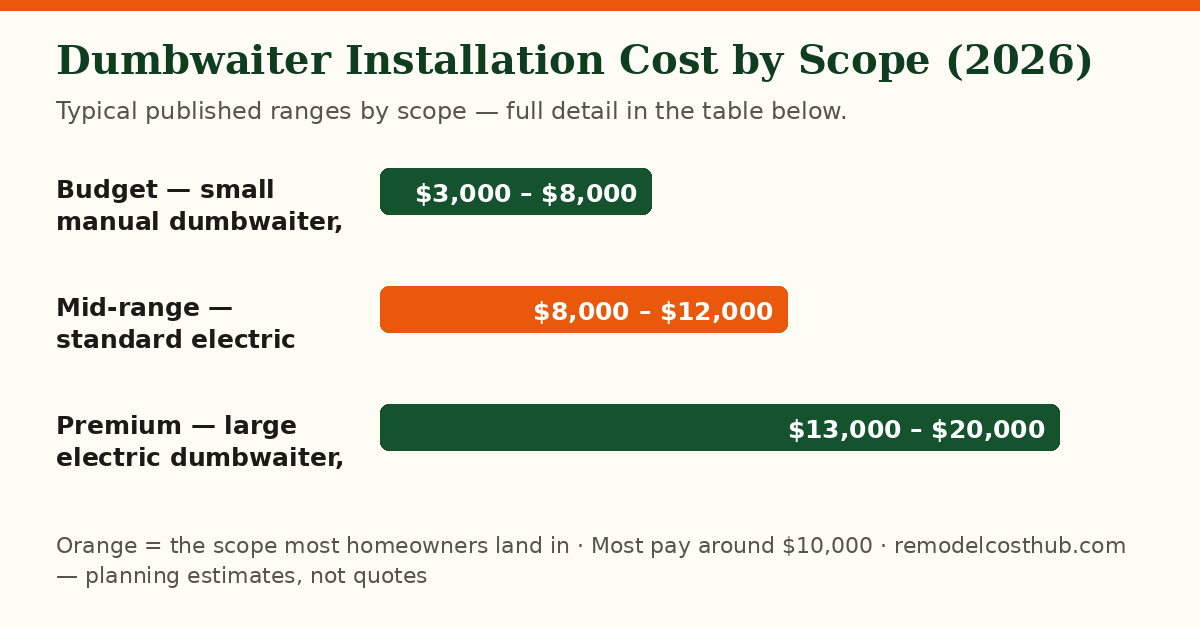
| Scope | Typical cost | What it includes |
|---|---|---|
| Budget — small manual dumbwaiter, 2 stops | $3,000 – $8,000 | A small manual rope-and-pulley unit, about 14×14×20 in and 50–100 lb capacity, 2 stops, fitted into an existing shaft or a simple location. No motor, no electrical work, minimal finishes. Angi and PVE both price this at $3,000–$8,000 — though HomeGuide puts a basic manual at $8,000–$12,000 (see the disagreement note). Manual units have largely fallen out of favor (Angi). |
| Mid-range — standard electric dumbwaiter, 2–3 stops | $8,000 – $12,000 | The typical project on this page: a standard electric unit, about 24–30 in square and 100–200 lb capacity, 2–3 stops, new shaft, push-button controls, standard finishes. Angi's average for this job is $10,000; PVE prices the same tier at $8,000–$12,000+. |
| Premium — large electric dumbwaiter, 3–4 stops, custom cab | $13,000 – $20,000 | A large or oversized electric unit, 250–500 lb capacity, custom-built cab up to 36×36×48 in, 3–4 stops, with automation, sensors and smart-home integration. HomeGuide and PVE both cap this tier at $20,000 — but that is the lift system only; a full retrofit into a finished home runs $10,000–$30,000 and can pass $35,000 (Block). |
Where the money goes
| Part of the job | Share | Note |
|---|---|---|
| Dumbwaiter unit — car, drive, controls, landing doors | 35% of total | $3,500 — inside Angi's $2,000–$7,000 unit band and Block's $3,000–$10,000 lift-equipment band. Share derived from the worked example below, not a published percentage. |
| New shaft / hoistway construction | 25% of total | $2,500 — the low end of Angi's $2,500–$3,500 new-shaft band; Block prices a hoistway higher at $3,000–$8,000. Share derived from the worked example below, not a published percentage. |
| Installation & commissioning — set unit, wiring, load test, inspection sign-off | 20% of total | $2,000 — the low end of Block's $2,000–$5,000 install/commissioning band; Angi prices fitting into a shaft at $750–$7,500. Share derived from the worked example below, not a published percentage. |
| Electrical work + permits & inspections | 7% of total | $700 — a modelled split: electrical $500 (Block $500–$1,500, low end) + permits $200 (HomeGuide $200–$500+, Block $200–$1,500, low end). Share derived from the worked example below, not a published percentage. |
| Finish restoration — drywall/plaster, trim, paint at each landing | 13% of total | $1,300 — inside Block's $1,000–$4,000 finish-restoration band. Share derived from the worked example below, not a published percentage. |
What moves the price most
Number of stops is the first fork. A 3-floor unit always costs more than a 2-floor one (Angi): each extra stop adds a landing door, an interlock, controls and another round of demolition and patching (Block). No source publishes a dollar-per-stop rate, so this page publishes none. Shaft construction is the biggest swing: Angi prices a new shaft at $2,500–$3,500 and fitting a unit into an existing shaft at $750–$7,500; Block prices the hoistway alone at $3,000–$8,000, with structural review at $1,000–$3,000 and finish restoration at $1,000–$4,000 as separate lines. A straight vertical route through stacked closets is cheapest; a route that jogs sideways "doubles the construction" (Block). Electric or manual: manual $3,000–$8,000 against electric $10,000–$20,000 (Angi); an electric unit needs a dedicated 120V or 240V circuit (Block). Capacity and car size: Angi's unit ranges run from a mini car at $2,000–$7,500 to an oversized car at $10,000–$20,000. Finishes and features: a custom cab, premium finishes, automation, sensors, smart-home integration and fire-rated doors all add cost (HomeGuide, PVE, Block). Permits and inspections: a building permit for the floor openings plus an electrical permit, and some areas require an elevator permit or inspection even for a goods-only lift — $200–$500+ (HomeGuide) to $200–$1,500 (Block); ASME A17.1/CSA B44 applies. Location in the home: kitchen and bathroom installs run $8,000–$12,000 against $4,000–$10,000 for a bedroom and $6,000–$10,000 for a dining room (Angi), because kitchens and baths usually need plumbing rerouted. New construction or retrofit: a retrofit into a finished home carries a $3,000–$12,000 premium over the same lift in new construction (Block), and older homes, plaster and historic-district rules push costs up. Brand: Angi's unit-only ranges are Matot $2,000–$6,000, Inclinator $3,500–$6,000, PowerLift $4,000–$7,000 and Harmar $4,000–$7,000. Where the sources disagree: the manual price — Angi and PVE price a manual unit at $3,000–$8,000 while HomeGuide puts a basic manual at $8,000–$12,000, likely because HomeGuide's figure bundles a full installed project; the top end — Angi caps a high-end electric unit at $20,000 while Block's finished-home retrofit runs $10,000–$30,000 and can pass $35,000, because Block's figure includes the full building work; and install time — Angi's "about one day" is the lift install alone, while Block's 2–4 months is the whole job from order to inspection. The $10,000 most-pay figure is Angi's average only, not a 3-source consensus — the $8,000–$12,000 band is the figure all four sources support. Angi puts materials at about 45% of the total and labour at 55%; this page's worked example puts the unit at 35% and the building work at 65%, because Block's component table prices the shaft, structural and restoration work higher than Angi's figures do. Worked example at the most-pay figure: a standard electric dumbwaiter, 2–3 stops, new shaft — dumbwaiter unit $3,500 + new shaft / hoistway $2,500 + installation & commissioning $2,000 + electrical work & permits $700 + finish restoration $1,300 = $10,000. The shares are whole-percent roundings of this worked example; the breakdown is modelled from the published ranges, not a published line-item breakdown. For moving people instead see our home elevator installation guide, for the stair alternative see our stair lift installation guide, for the laundry room it often serves see our laundry room remodel guide, for the kitchen it often serves see our kitchen remodel guide, and for the garage it can carry luggage to see our garage remodel guide.
Costs in your city
Labor is the biggest variable in any remodel, and labor is local — the same bathroom can price very differently in Houston than in Boston. We are adding city editions metro by metro, each with its own labor index, permit notes and climate factors, written for that city rather than copied from this page. Wave 1: Houston, Dallas–Fort Worth, Phoenix, Atlanta, Miami–South Florida, Orlando, Tampa, Charlotte, Austin and San Antonio. Until your city's page is live, use the national range here and weight it the way contractors do: Sun Belt labor often prices near or below the national middle, while coastal California and the Northeast metros often price well above it.
Frequently asked questions
How much does a residential dumbwaiter cost to install?
Typically $8,000–$12,000 installed, averaging about $10,000 (Angi). A retrofit into a finished home runs $10,000–$30,000 (Block); a manual unit can be as low as $3,000–$8,000 and a high-end electric unit up to $20,000 (Angi).
How long does a dumbwaiter installation take?
The lift itself usually takes a professional about one day to install, or 2–3 days for a large unit spanning 3+ floors (Angi). End-to-end, Block says plan 2–4 months from order to use: equipment lead time 4–12 weeks, shaft work 1–3 weeks, lift install 2–4 days, finish restoration about a week, plus 1–2 weeks waiting for inspection.
Do I need a permit to install a dumbwaiter?
In many jurisdictions, yes — a building permit for the floor openings plus an electrical permit for the circuit, and some areas require an elevator permit or inspection even for a goods-only lift (Block, HomeGuide, PVE). Permit and inspection costs run $200–$500+ (HomeGuide) to $200–$1,500 (Block).
Can I install a dumbwaiter myself?
DIY is possible but not recommended — hire a professional, especially for electrical work and custom features (HomeGuide, Angi). The work involves heavy lifting, moving parts, wiring and structural cutting; incorrect installation can cause injury (Angi).
Can a dumbwaiter carry people?
No — dumbwaiters are for goods only, never people, pets or mobility devices (PVE, Block). For moving people, a residential home elevator is the right choice: about $30,000 typically (Angi) or $30,000–$60,000 (HomeGuide).
What is the difference between a manual and an electric dumbwaiter?
A manual unit is raised and lowered by rope and costs $3,000–$8,000 installed (Angi); an electric unit is motorized with push-button controls, carries heavier loads and costs $10,000–$20,000 (Angi). Electric is more convenient for daily use; manual needs less maintenance (Angi, PVE). Note: HomeGuide prices a basic manual higher, at $8,000–$12,000.