Stair Lift Installation cost at a glance
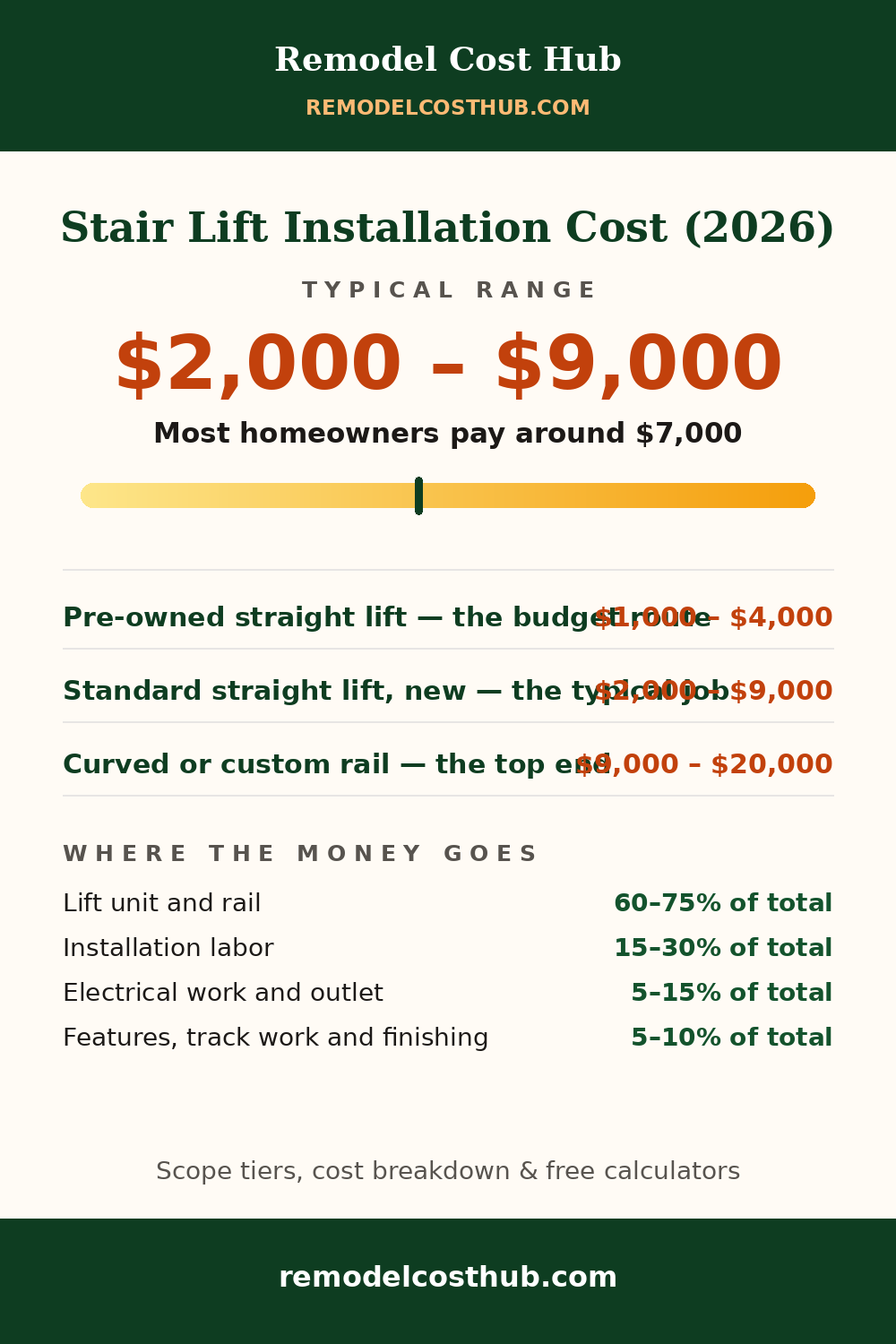
- Typical range: $2,000 – $9,000
- Most homeowners pay: around $7,000
- Prices vary most by: Lift unit and rail (60–75% of the budget)
Cross-checked against one published sources for this project. Sources used for this page: Angi's stair lift hiring guide (updated May 21, 2026: professional installation $2,300–$24,000 overall, straight average around $7,050, pre-owned models from $1,500, curved or lengthy outdoor installations to $30,000) and Angi's stair lift type and curved guides (straight $2,000–$9,000; curved $9,000–$20,000 installed, national average $13,000, installation $1,000–$5,000, outlet work $150–$450, 10–14 steps $9,000–$12,000, 30+ steps $20,000–$30,000), Bob Vila's stair lift cost guide (typical $2,000–$20,000, national average $6,000; straight $2,000–$9,000 in text and $2,000–$8,000 in its type table, curved $9,000–$20,000 in summary and $8,000–$20,000 in text; installation $1,000–$5,000, wiring $600–$2,200, electrical panel $600–$1,800, rental $300–$500 per month plus $400–$700 installation and $300–$600 removal, pre-owned from $1,000, heavy-duty $5,000–$20,000, outdoor $4,000–$12,000, platform $5,000–$20,000, track lengthening $50–$75 per linear foot) and Harmar's stairlift FAQ (dated October 5, 2026: straight stairlifts approximately $4,000–$5,000 for many new installations, curved often starting around $9,000). Sources last checked: October 2026 — Angi. How we calculate these costs
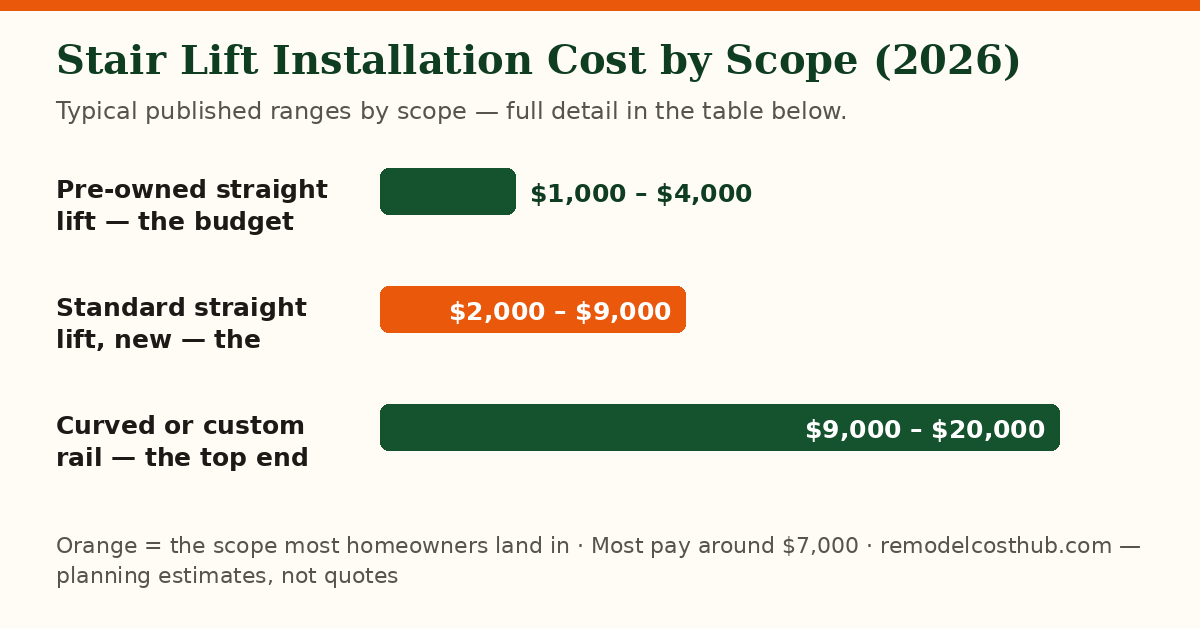
Cost by scope
| Scope | Typical cost | What it includes |
|---|---|---|
| Pre-owned straight lift — the budget route | $1,000 – $4,000 | The cheap end: Bob Vila prices pre-owned lifts from $1,000 and Angi from $1,500, and both sit below Harmar's $4,000–$5,000 for many new straight installs — a refurbished straight unit on a straight staircase, with installation, which is why it prices below a new straight job even after a service check |
| Standard straight lift, new — the typical job | $2,000 – $9,000 | The shared band itself: Angi prices straight lifts at $2,000–$9,000 and Bob Vila prices straight models at $2,000–$9,000 in its text (its type table shows $2,000–$8,000) — a new chair and a straight rail on a single straight flight, which is the common job and the band this page is built on |
| Curved or custom rail — the top end | $9,000 – $20,000 | The expensive end: Angi prices curved lifts at $9,000–$20,000 installed with a $13,000 national average, Bob Vila prices curved at $9,000–$20,000 in its summary ($8,000–$20,000 in its text), and Angi's hire guide puts curved or lengthy outdoor work as high as $30,000 — the rail is custom-built to the staircase, so length, turns and landings set the price |
Where the money goes
| Part of the job | Share | Note |
|---|---|---|
| Lift unit and rail | 60–75% of total | The chair, motor and rail are the bulk of the bill: Angi's curved band of $9,000–$20,000 against $1,000–$5,000 of installation labor shows how much of a curved job is the custom rail itself, and Bob Vila prices heavy-duty models at $5,000–$20,000 and platform lifts at $5,000–$20,000 before labor — capacity and rail type move this line more than any other |
| Installation labor | 15–30% of total | Bob Vila prices installation at $1,000–$5,000 and Angi prices curved installation at $1,000–$5,000 — a straight rail on a straight flight is a day's work at the bottom of that band, while a custom curved rail, a long run or an outdoor install sits at the top |
| Electrical work and outlet | 5–15% of total | Angi prices outlet work at $150–$450 on its curved guide and Bob Vila prices wiring at $600–$2,200 and an electrical panel at $600–$1,800 where a new circuit is needed — a staircase with an outlet nearby skips most of this line, while a run that needs a new circuit does not |
| Features, track work and finishing | 5–10% of total | Bob Vila prices track lengthening at $50–$75 per linear foot, and powered swivel seats, folding rails and weather covers for outdoor models sit in this line — small against the unit, but the difference between a basic straight job and one that fits a tight landing |
What moves the price most
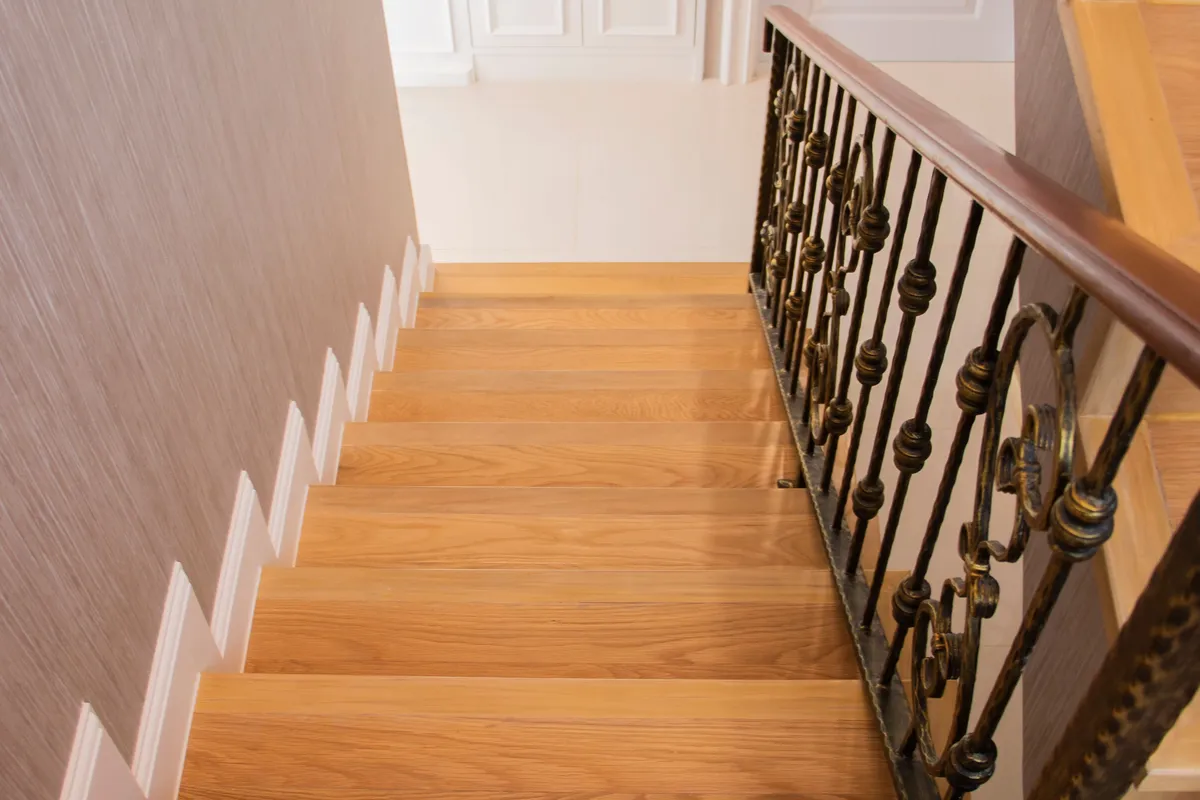
Straight versus curved is the first driver: Angi prices straight lifts at $2,000–$9,000 against $9,000–$20,000 for curved, and Harmar puts many new straight installs at about $4,000–$5,000 against curved work that often starts around $9,000 — a staircase with a turn or a landing is a custom-rail job by definition. Length and steps are second: Angi's curved guide prices 10–14 steps at $9,000–$12,000 and 30+ steps at $20,000–$30,000, so a long staircase prices above a short one even before it turns. Indoor versus outdoor is third: Bob Vila prices outdoor lifts at $4,000–$12,000, because weatherproofing and a covered rail cost more than an indoor install. Capacity is fourth: Bob Vila prices heavy-duty models at $5,000–$20,000, so a lift rated above the standard weight limit prices above the typical band. Electrical is fifth: Angi prices outlet work at $150–$450 and Bob Vila prices a new circuit at $600–$2,200 — a staircase without a nearby outlet pays this line in full. Finally, rent versus buy: Bob Vila prices rental at $300–$500 a month plus $400–$700 installation and $300–$600 removal, so a short-term need can price below a purchase, while a permanent need cannot.
Costs in your city
Labor is the biggest variable in any remodel, and labor is local — the same bathroom can price very differently in Houston than in Boston. We are adding city editions metro by metro, each with its own labor index, permit notes and climate factors, written for that city rather than copied from this page. Wave 1: Houston, Dallas–Fort Worth, Phoenix, Atlanta, Miami–South Florida, Orlando, Tampa, Charlotte, Austin and San Antonio. Until your city's page is live, use the national range here and weight it the way contractors do: Sun Belt labor often prices near or below the national middle, while coastal California and the Northeast metros often price well above it.
Frequently asked questions
How much does stair lift installation cost?
Typically $2,000–$9,000 for a standard straight lift, with about $7,000 the figure most straight jobs land near. Angi prices straight lifts at $2,000–$9,000 with a $7,050 straight average, Bob Vila puts the national average at $6,000, and Harmar prices many new straight installs at about $4,000–$5,000 — curved or custom rails are a different job at $9,000–$20,000 on Angi.
Why is a curved stair lift so much more expensive?
Because the rail is custom-built to your staircase: Angi prices curved lifts at $9,000–$20,000 with a $13,000 average, against $2,000–$9,000 for a straight rail that comes off the shelf. Length matters too — Angi prices 10–14 steps at $9,000–$12,000 and 30+ steps at $20,000–$30,000 on its curved guide, so a long curved staircase can price double a short one.
Is a pre-owned stair lift worth it?
For a straight staircase, often yes: Bob Vila prices pre-owned lifts from $1,000 and Angi from $1,500, against $2,000–$9,000 for a new straight lift. The catch is fit and warranty — a pre-owned straight unit only works on a straight staircase, and a used curved rail fits nobody else's staircase, which is why pre-owned is a straight-lift bargain and a curved-lift non-starter.
Should I rent a stair lift instead of buying one?
For a short-term need, rental can win: Bob Vila prices rental at $300–$500 a month plus $400–$700 installation and $300–$600 removal. For a permanent need, purchase wins — a year of rental at those rates approaches the $2,000–$9,000 price of a new straight lift, and you own nothing at the end of it.
Does a stair lift need an electrician?
Only where no outlet exists near the staircase: Angi prices outlet work at $150–$450, while Bob Vila prices wiring at $600–$2,200 and a panel at $600–$1,800 where a new circuit is needed. Most straight installs plug into a nearby outlet and need no electrical work at all — the outlet question is part of the quote, so ask it before you sign.