Home Elevator Installation cost at a glance
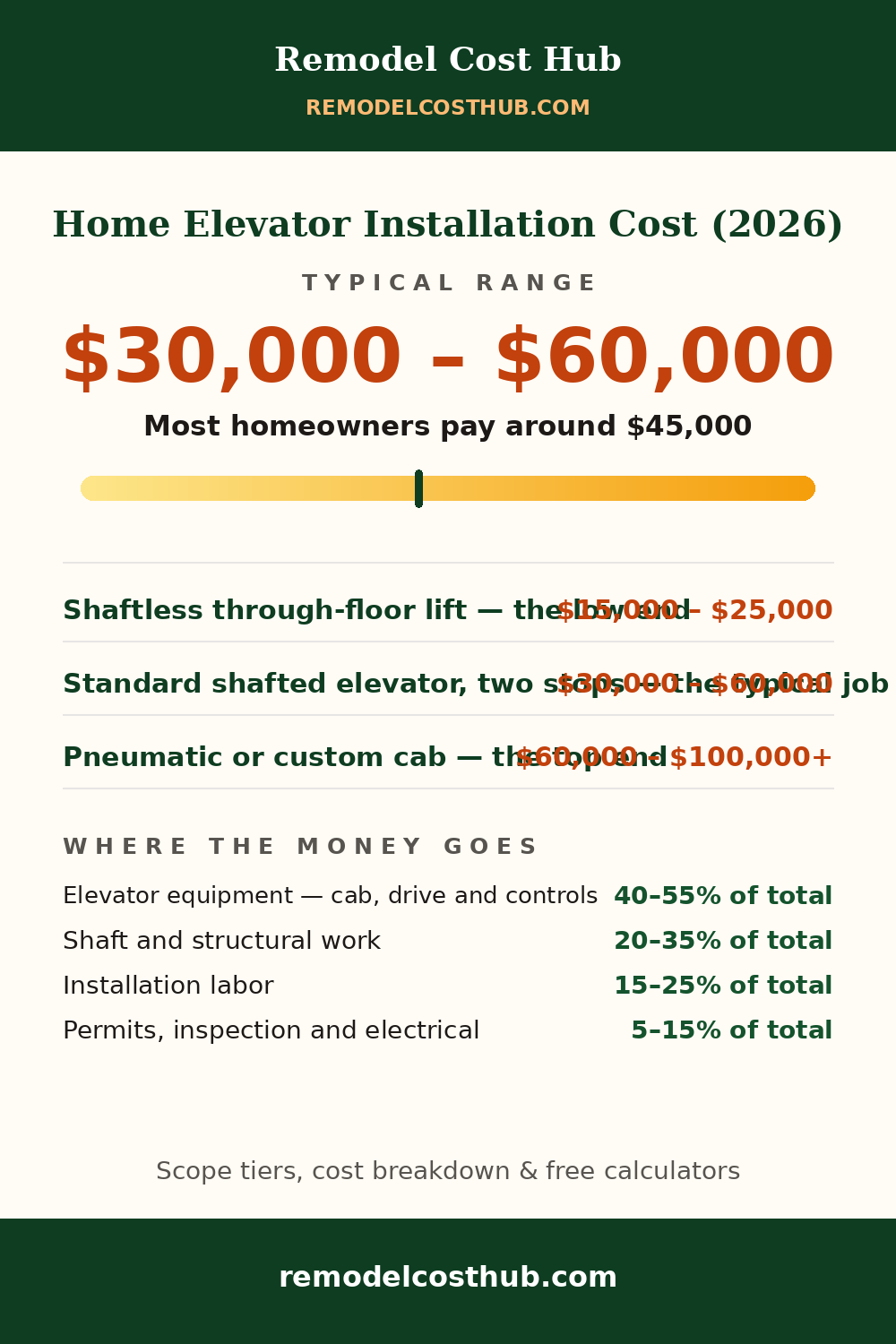
- Typical range: $30,000 – $60,000
- Most homeowners pay: around $45,000
- Prices vary most by: Elevator equipment — cab, drive and controls (40–55% of the budget)
Cross-checked against two published sources for this project. Sources used for this page: Angi's home elevator cost guide, updated October 17, 2026 (headline project average $4,191, most $2,711–$5,930 — published here as the disagreement, not used for the band, since it sits far below every type price in the same guide; type table: vertical platform lift $5,000–$20,000, pneumatic $35,000–$60,000, hydraulic $25,000–$50,000, shaftless $15,000–$25,000, cable-driven $15,000–$35,000, geared traction $25,000–$38,000, gearless traction $29,000–$55,000, outdoor $2,000–$10,000; installer $700–$15,000, site preparation $500–$15,000, contractors $300–$500 per day, equipment and materials $1,000–$40,000, cab finishes +$300–$5,000, extra floor +$5,000–$15,000, permits $200–$2,000, annual inspection $75–$300, maintenance contract $200–$350 per year, cable replacement $2,000–$3,000 every 3–5 years, concealed custom shaftless +$70,000+, decorative sliding door +$25,000), Fixr's home elevator data ($35,000–$60,000 installed, average $50,000, January 2025) as published in the HomeElevatorInstallation comparison of published ranges, and EngineerFix's home elevator guide (full range $25,000 to over $100,000; hydraulic equipment $15,000–$60,000, traction units $18,000–$50,000, pneumatic equipment $20,000 to over $85,000, hoistway construction $10,000–$25,000, vertical platform lifts $5,000–$20,000). Sources last checked: October 2026 — Fixr, Angi. How we calculate these costs
Cost by scope
| Scope | Typical cost | What it includes |
|---|---|---|
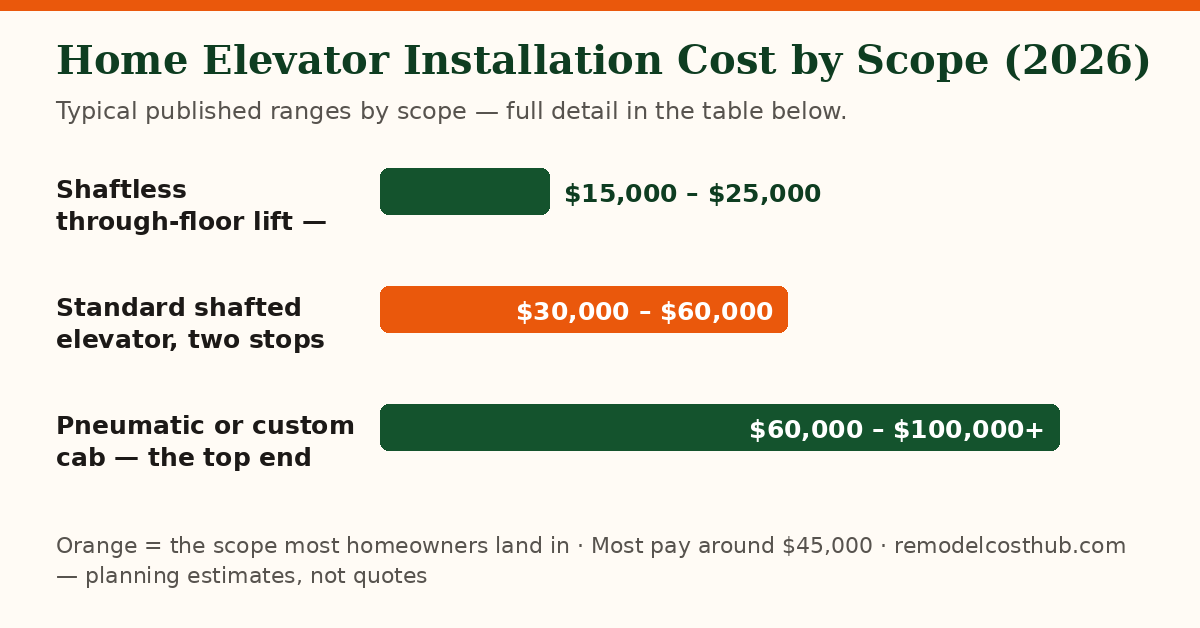
| Shaftless through-floor lift — the low end | $15,000 – $25,000 | The compact option: Angi prices shaftless elevators at $15,000–$25,000 for a one-floor, single-person lift that needs no hoistway — it drills through the ceiling rather than building a shaft — while a concealed custom version can add $70,000 or more on top |
| Standard shafted elevator, two stops — the typical job | $30,000 – $60,000 | The shared band itself: Fixr’s $35,000–$60,000 installed band, Angi’s hydraulic $25,000–$50,000 and gearless traction $29,000–$55,000 — a cab, drive and shaft serving two floors in an existing home |
| Pneumatic or custom cab — the top end | $60,000 – $100,000+ | The expensive end: Angi prices pneumatic elevators at $35,000–$60,000 before custom finishes, EngineerFix prices large pneumatic units over $85,000 for the equipment alone, and Angi notes a decorative automatic sliding door can add up to $25,000 |
Where the money goes
| Part of the job | Share | Note |
|---|---|---|
| Elevator equipment — cab, drive and controls | 40–55% of total | The machine itself: Angi prices equipment and materials at $1,000–$40,000 across types, EngineerFix prices hydraulic equipment at $15,000–$60,000 and traction units at $18,000–$50,000 — cab finishes alone can add $300–$5,000 in Angi |
| Shaft and structural work | 20–35% of total | The hole the elevator travels in: EngineerFix prices hoistway construction at $10,000–$25,000, and Angi prices site preparation at $500–$15,000 — a retrofit that reroutes HVAC, electrical or plumbing lines pays the most |
| Installation labor | 15–25% of total | The fitting: Angi prices hiring an elevator installer at $700–$15,000 depending on the home, with contractors at $300–$500 a day — retrofits run to the top of that range |
| Permits, inspection and electrical | 5–15% of total | The paper and power: Angi prices building permits at $200–$2,000, annual inspections at $75–$300 and maintenance contracts at $200–$350 a year — a dedicated circuit and any panel work sit in this line |
What moves the price most
Drive type is the first driver: Angi’s type table runs from a shaftless lift at $15,000–$25,000 and a cable-driven elevator at $15,000–$35,000 through hydraulic at $25,000–$50,000 to pneumatic at $35,000–$60,000 — the mechanism is the price ladder. Floors are second: Angi adds $5,000–$15,000 for each additional floor served, so a four-story home pays $15,000–$45,000 beyond the two-stop base. New construction versus retrofit is third: Angi says a retrofit can cost up to three times more than building the elevator in during construction, because the shaft and equipment space must be carved out of a finished home. Finishes and doors are fourth: Angi puts high-end customizations over $50,000 and a decorative automatic sliding door at up to $25,000 extra, while cab finishes alone add $300–$5,000. Finally, ongoing costs are small but real: annual inspections at $75–$300 and maintenance contracts at $200–$350 a year in Angi, plus cable replacement at $2,000–$3,000 every three to five years on cable-driven models.
Costs in your city
Labor is the biggest variable in any remodel, and labor is local — the same bathroom can price very differently in Houston than in Boston. We are adding city editions metro by metro, each with its own labor index, permit notes and climate factors, written for that city rather than copied from this page. Wave 1: Houston, Dallas–Fort Worth, Phoenix, Atlanta, Miami–South Florida, Orlando, Tampa, Charlotte, Austin and San Antonio. Until your city's page is live, use the national range here and weight it the way contractors do: Sun Belt labor often prices near or below the national middle, while coastal California and the Northeast metros often price well above it.
Frequently asked questions
How much does a home elevator cost?
About $30,000–$60,000 for a standard two-stop residential elevator, installed, with about $45,000 the middle of the band. Fixr averages $50,000 for the same scope, and Angi’s hydraulic and traction type prices sit inside the band.
Why does Angi also quote a $4,191 average for home elevators?
Its headline project average sits far below every elevator type price in its own guide — shaftless alone starts at $15,000 — so this page follows the type table, Fixr and EngineerFix instead, and publishes the disagreement rather than averaging it away.
Is a stair lift a cheaper alternative?
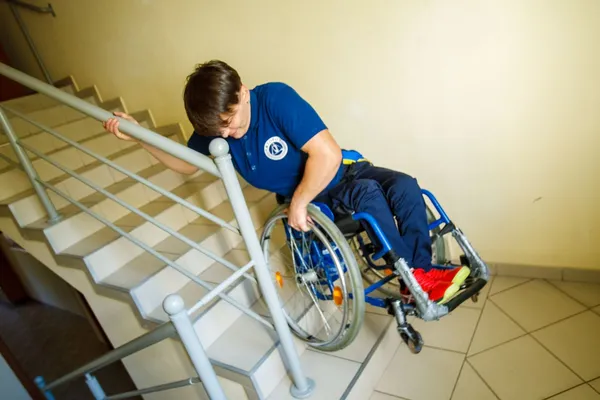
Yes, and often the right one: Angi prices stair lifts at $2,300–$24,000 against $15,000–$60,000 for an elevator, with platform lifts for wheelchairs at $5,000–$20,000. An elevator is the choice when a wheelchair or walker must travel between floors, or when carrying things matters as much as people.
Does a home elevator need a shaft and a machine room?
A shafted elevator does; a shaftless lift does not, and a gearless traction model keeps its machine inside the hoistway rather than in a separate room. Hydraulic models need a pit and space for the pump, which is part of why retrofits cost more than new-construction installs.
What does a home elevator cost to keep running?
Angi prices annual inspections at $75–$300 and maintenance contracts at $200–$350 a year, and cable-driven models need cable replacement at $2,000–$3,000 every three to five years. Budget the contract from year one, not as an afterthought.