Invisible Fence Installation cost at a glance
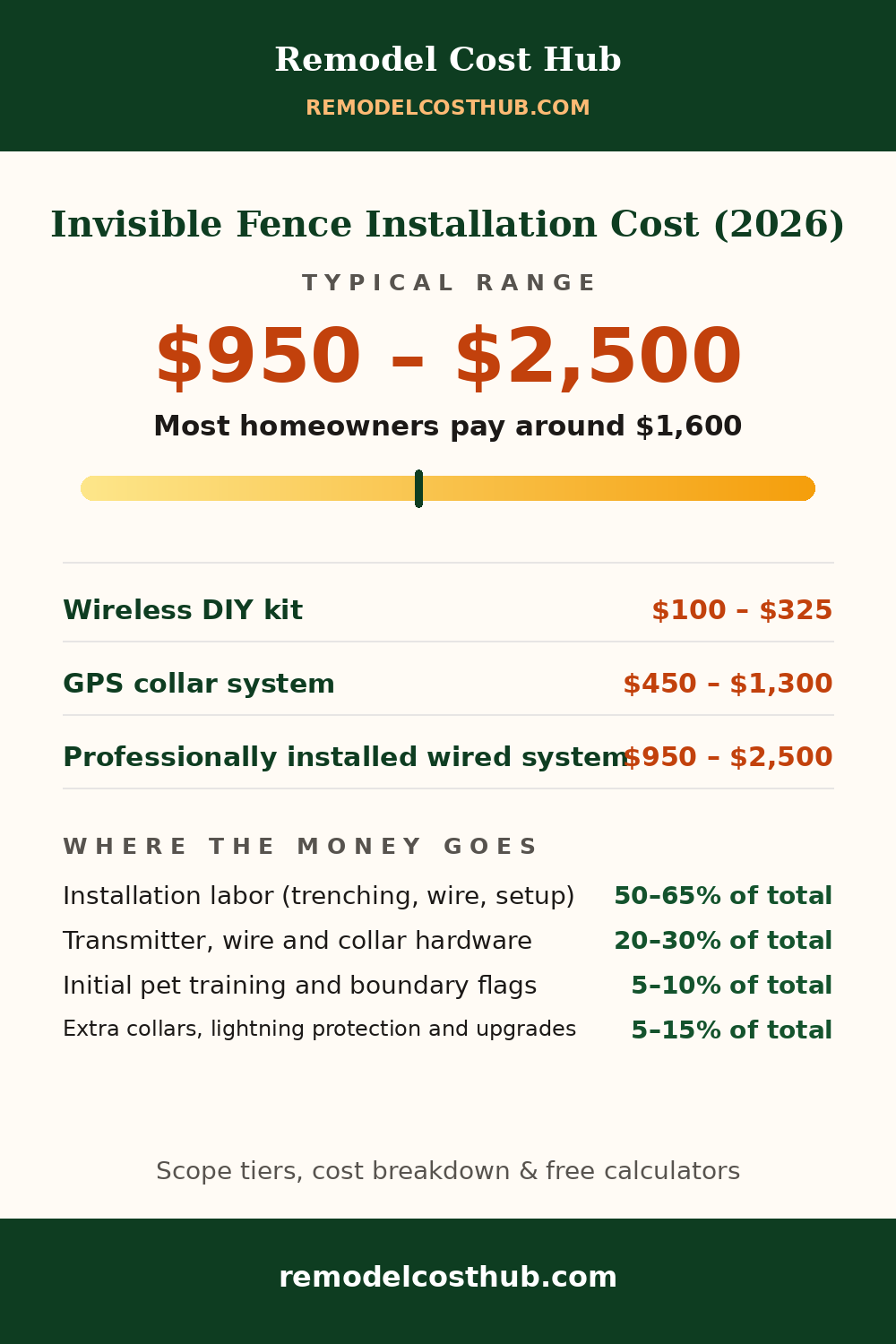
- Typical range: $950 – $2,500
- Most homeowners pay: around $1,600
- Prices vary most by: Installation labor (trenching, wire, setup) (50–65% of the budget)
Cross-checked against three published sources for this project. Sources used for this page: Angi's invisible fence cost guide, updated October 25, 2026 (national average $1,600; most pay $950–$2,500 professionally installed; underground $2–$4 per linear foot; yard bands: small 400–800 ft $700–$1,200, large 1,200–1,800 ft $1,500–$2,500; wired average about $1,000, wireless about $350, GPS about $2,000; DIY kits $200–$700; installer labor $50–$100 per hour; extra collars $50–$150 each), HomeGuide's invisible fence cost guide ($800–$2,800 installed on average, $2–$7 per linear foot; underground $800–$2,800, GPS $450–$1,300 installed, wireless DIY $100–$325; $1,600–$2,000 per acre requiring 850–900 linear feet of wire for a rectangular yard) and HomeAdvisor's underground invisible fence data as reported in a 2026 synthesis ($2–$6 per linear foot, $1,000–$5,000 per acre), cross-checked against an independent 2026 synthesis (in-ground $800–$2,800 installed, hardware $200–$500, labor $600–$2,300, GPS collars $10–$20 per month subscription). Synthesized typical = Angi's professionally installed band; $1,600 most-pay is Angi's national average and sits inside HomeGuide's band. Checked November 2026.. Sources last checked: October 2026 — HomeAdvisor, HomeGuide, Angi. How we calculate these costs
Cost by scope
| Scope | Typical cost | What it includes |
|---|---|---|
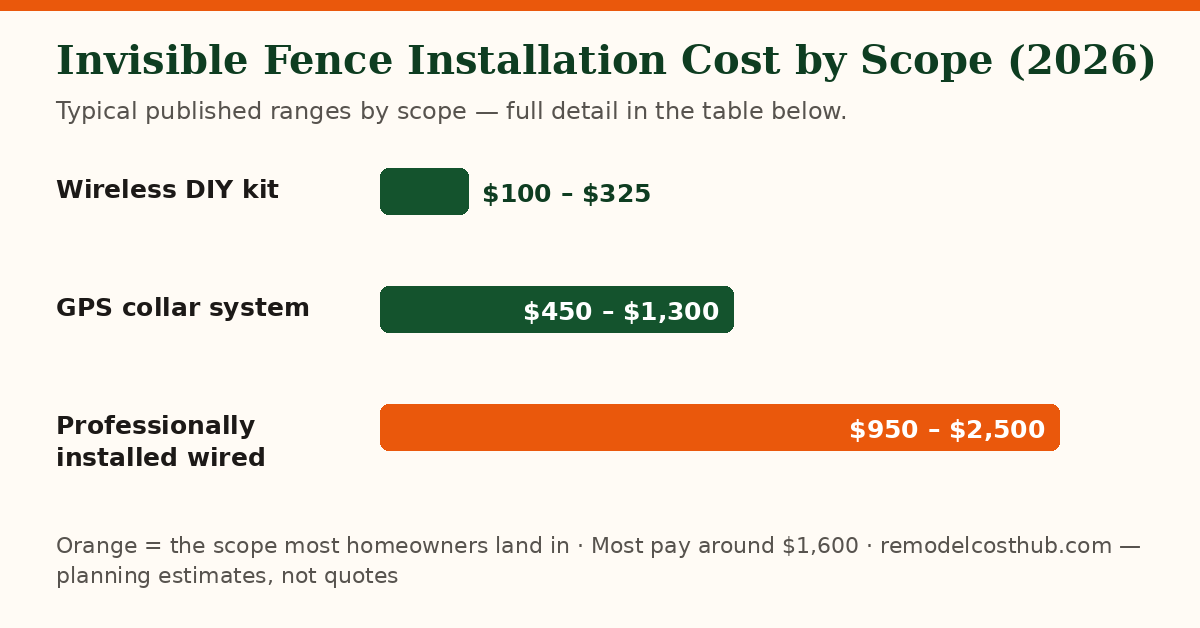
| Wireless DIY kit | $100 – $325 | HomeGuide's wireless band: a transmitter and collar you set up yourself, no buried wire, best for small open yards. |
| GPS collar system | $450 – $1,300 | HomeGuide's GPS band: a satellite-boundary collar with no wire to bury, usually plus a $10–$20 monthly subscription in third-party guides. |
| Professionally installed wired system | $950 – $2,500 | The typical project on this page: Angi's professionally installed band, averaging $1,600, with buried wire, setup and training. |
Where the money goes
| Part of the job | Share | Note |
|---|---|---|
| Installation labor (trenching, wire, setup) | 50–65% of total | Angi prices trenching and wire at $2–$4 per linear foot and installer labor at $50–$100 per hour; a third-party synthesis puts labor at $600–$2,300 of an $800–$2,800 total |
| Transmitter, wire and collar hardware | 20–30% of total | The same synthesis puts hardware at $200–$500 of the total — the transmitter box, the boundary wire and the first collar |
| Initial pet training and boundary flags | 5–10% of total | Professional packages include setup, testing and the first training sessions that teach the dog the boundary |
| Extra collars, lightning protection and upgrades | 5–15% of total | Angi prices extra collars at $50–$150 each; surge protection and heavier-gauge wire add here |

What moves the price most
Yard size and linear feet are the first lever: Angi prices a small yard at 400–800 feet and $700–$1,200 against a large yard at 1,200–1,800 feet and $1,500–$2,500, and HomeGuide prices $1,600–$2,000 per acre, which needs 850–900 feet of wire for a rectangular yard. System type is second: a wireless kit is a purchase, a GPS collar is a purchase plus a subscription, and a wired system is mostly labor — the same yard prices three different ways. Multiple pets are third: every extra dog needs its own collar at $50–$150, and a collar sized for a large dog costs more than one for a small dog. Local rules and the dog itself are fourth: HomeGuide notes some local ordinances prohibit these systems and flags containment and behavior concerns — check the ordinance and talk to your vet before buying, since a fence that does not suit the dog is money spent twice. Worked example at the most-pay figure: transmitter, wire and collar $450 + installation labor $950 + training and flags $200 = $1,600. For the visible alternative, see our fence installation guide and our wood fence installation guide, and for another pet-related install see our pet door installation guide.
Costs in your city
Labor is the biggest variable in any remodel, and labor is local — the same bathroom can price very differently in Houston than in Boston. We are adding city editions metro by metro, each with its own labor index, permit notes and climate factors, written for that city rather than copied from this page. Wave 1: Houston, Dallas–Fort Worth, Phoenix, Atlanta, Miami–South Florida, Orlando, Tampa, Charlotte, Austin and San Antonio. Until your city's page is live, use the national range here and weight it the way contractors do: Sun Belt labor often prices near or below the national middle, while coastal California and the Northeast metros often price well above it.

Frequently asked questions
How much does invisible fence installation cost?
Typically $950–$2,500 for a professionally installed wired system, with $1,600 the national average in Angi's 2026 data — inside HomeGuide's $800–$2,800 band for underground systems.
How much does an invisible fence cost per linear foot?
Angi prices underground systems at $2–$4 per linear foot installed, HomeGuide at $2–$7; HomeAdvisor's data, as reported in a 2026 synthesis, puts it at $2–$6 per linear foot or $1,000–$5,000 per acre.
What is the difference between wireless, GPS and wired invisible fences?
Wireless is a DIY kit ($100–$325) that broadcasts a circular boundary from a transmitter. GPS uses a satellite boundary in a collar ($450–$1,300) with no wire to bury, usually plus a monthly subscription. Wired buries a custom-shaped loop ($950–$2,500 installed) and follows the yard's actual shape.
How long does the training take?
Professional packages include initial training sessions that teach the dog where the boundary is. How fast a dog learns varies by dog — ask the installer exactly what their training program covers, and how many sessions are included, before you buy.
What are the ongoing costs?
Collar batteries need periodic replacement, and GPS collars usually add a $10–$20 monthly subscription. Wired systems have no subscription, but a cut wire — from digging or aeration — is a repair call.