Central Vacuum Installation cost at a glance
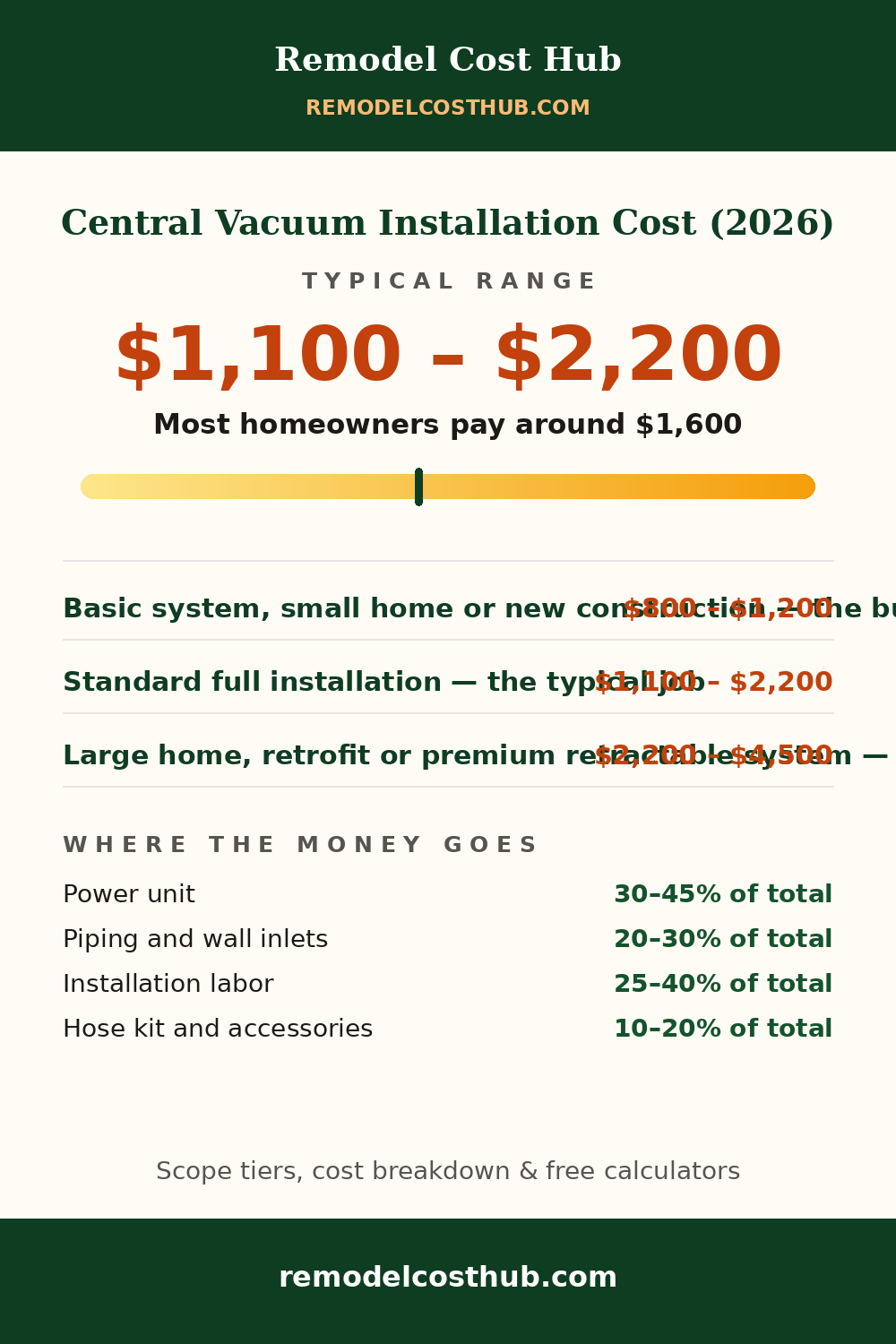
- Typical range: $1,100 – $2,200
- Most homeowners pay: around $1,600
- Prices vary most by: Power unit (30–45% of the budget)
Cross-checked against one published sources for this project. Sources used for this page: Angi's central vacuum cost guide (updated October 14, 2026: professional installation $1,094–$2,194, average $1,583 across 457 verified projects; labor $50–$120 per hour; permits $50–$200) and Angi's central vacuum hiring guide (installation $1,100–$2,200, average $1,600; labor 25–40% of the total; one inlet covering 700–1,000 square feet), EngineerFix's central vacuum installation guide (total $800–$3,500, average about $2,000 for a standard 2,000-square-foot home — higher than Angi's average because it spans basic new-construction to premium systems, published here as the scope difference, not blended; power unit $200–$2,000+, labor $400–$1,500, retrofit adding $400–$1,000 over new construction; retractable hose $350–$500 or more per inlet; bags $20–$40 a pack, filters $15–$80) and CentVac's central vacuum FAQ (complete installation $1,200–$3,000 for a home under 3,000 square feet, about $1–$2 per square foot by accessory kit, inlets, power unit and hose). Sources last checked: October 2026 — Angi. How we calculate these costs
Cost by scope
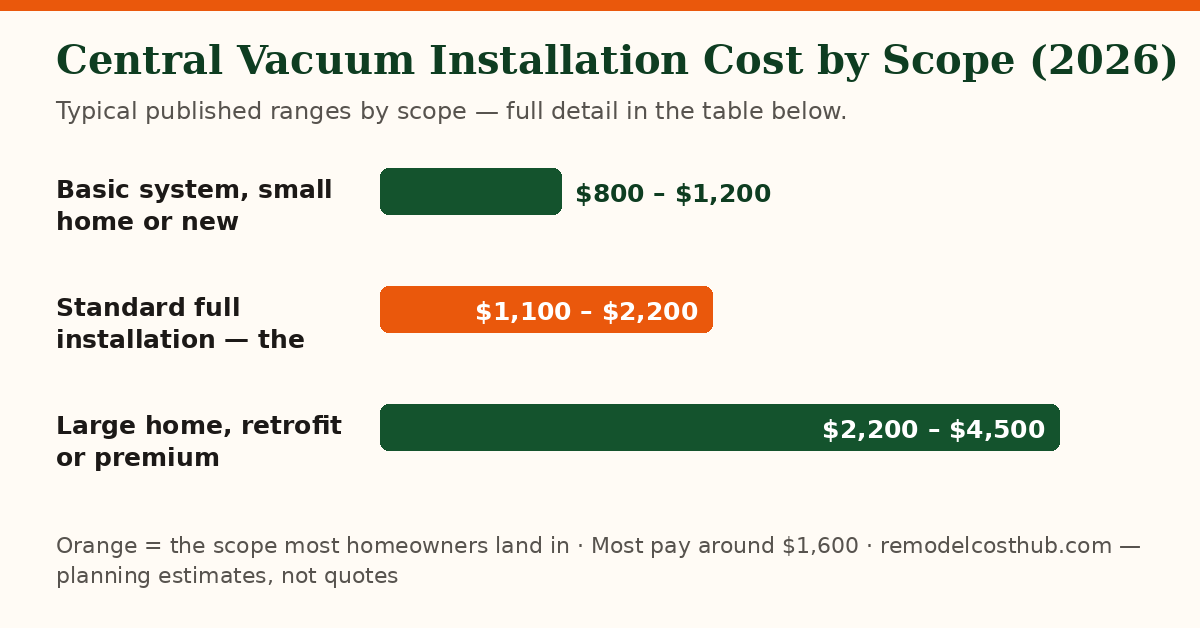
| Scope | Typical cost | What it includes |
|---|---|---|
| Basic system, small home or new construction — the budget route | $800 – $1,200 | The cheap end: EngineerFix prices a basic cyclonic system in new construction from $800, where piping runs through open walls before drywall, and Angi's band opens at $1,094 — a smaller home with few inlets, installed while walls are open, which is why it prices below a finished-home retrofit |
| Standard full installation — the typical job | $1,100 – $2,200 | The shared band itself: Angi prices professional installation at $1,094–$2,194 with a $1,583 average and its hiring guide at $1,100–$2,200 with a $1,600 average, while CentVac prices a complete installation at $1,200–$3,000 for a home under 3,000 square feet — a power unit, piping and three to five wall inlets with a hose kit, which is the common job and the band this page is built on |
| Large home, retrofit or premium retractable system — the top end | $2,200 – $4,500 | The expensive end: EngineerFix prices high-end installations toward $4,500 or more and adds $400–$1,000 of labor for a retrofit over new construction, with retractable hose systems adding $350–$500 or more per inlet — a large or multi-storey home, finished walls that need cutting and patching, or Hide-A-Hose inlets are what push a job past the standard band |
Where the money goes
| Part of the job | Share | Note |
|---|---|---|
| Power unit | 30–45% of total | The largest single item: EngineerFix prices a power unit from $200 for a budget system to over $2,000 for a high-capacity premium model, sized by home square footage and required suction in Air Watts — a larger home or longer pipe runs need a stronger unit to hold suction at the farthest inlet |
| Piping and wall inlets | 20–30% of total | The hidden network: PVC piping run through walls to inlet valves, with Angi putting one inlet per 700–1,000 square feet and HomeVacuumZone at one per 600–800 — inlet count follows floor area, and every extra inlet is pipe, a valve and a low-voltage wire run |
| Installation labor | 25–40% of total | Angi's hiring guide puts labor at 25–40% of the total at $50–$120 per hour, and EngineerFix prices labor at $400–$1,500 — routing pipe, cutting inlets and wiring the low-voltage loop are the hours, and a retrofit through finished walls adds $400–$1,000 over new construction in EngineerFix |
| Hose kit and accessories | 10–20% of total | What you hold: a hose and attachment set, with EngineerFix pricing specialized pet-hair or delicate-floor tools at $150–$550 and retractable hose systems at $350–$500 or more per inlet — a standard hose kit is inside the standard band, and Hide-A-Hose is the upgrade that moves this line |
What moves the price most
New construction versus retrofit is the first driver: EngineerFix prices labor at $400–$1,500 and adds $400–$1,000 for a retrofit over a new build, because piping through open wall cavities before drywall is straightforward while a finished home needs cutting, patching and repainting — timing the install with a remodel or build is the cheapest way to buy a central system. Home size and inlet count are second: Angi puts one inlet per 700–1,000 square feet, so a 2,000-square-foot home needs roughly three inlets and a larger or multi-storey home needs more pipe, more valves and a stronger power unit, which EngineerFix prices from $200 to over $2,000 by Air Watts. Unit grade is third: cyclonic units cost less upfront than filtered or HEPA systems in EngineerFix, and a premium unit with advanced filtration is bought for air quality as much as suction. Finally, hose system and extras decide the top end: a standard hose kit is inside the standard band, retractable Hide-A-Hose adds $350–$500 or more per inlet in EngineerFix, and Angi budgets permits at $50–$200 where electrical work or wall modifications are involved.
Costs in your city
Labor is the biggest variable in any remodel, and labor is local — the same bathroom can price very differently in Houston than in Boston. We are adding city editions metro by metro, each with its own labor index, permit notes and climate factors, written for that city rather than copied from this page. Wave 1: Houston, Dallas–Fort Worth, Phoenix, Atlanta, Miami–South Florida, Orlando, Tampa, Charlotte, Austin and San Antonio. Until your city's page is live, use the national range here and weight it the way contractors do: Sun Belt labor often prices near or below the national middle, while coastal California and the Northeast metros often price well above it.
Frequently asked questions
How much does it cost to install a central vacuum?
Most standard full installations land in the $1,100–$2,200 band on this page, with a common middle around $1,600 — Angi's hiring-guide average. A basic system in a small home or new construction can come in below that band, and a large retrofit with retractable hoses usually lands above it.
How many wall inlets does a central vacuum need?
Angi puts one inlet per 700–1,000 square feet of living space, and HomeVacuumZone puts it at one per 600–800 — so a 2,000-square-foot home typically needs three inlets, placed so one 30-foot hose reaches every room. More inlets mean more pipe and valve work, which is why inlet count is a price driver, not a detail.
Is a central vacuum cheaper to install during construction or as a retrofit?
During construction, by a clear margin: EngineerFix adds $400–$1,000 of labor for a retrofit over a new build, because finished walls need cutting, patching and repainting while open framing lets pipe run straight through cavities and joists. A retrofit is still common work, usually done in a day for an average-size house in Angi's local guides, but it is never the cheap route.
Can I install a central vacuum myself?
Technically yes, but Angi's local guides call it a very difficult DIY: planning pipe routes, cutting into walls and running the low-voltage wiring to every inlet is skilled work, and a badly routed system loses suction at the far inlet. EngineerFix puts the DIY saving at 30–50% of the total, which is the labor line a professional installation buys.
Is central vacuum installation different from central vacuum repair?
Yes — this page prices a complete new system: power unit, piping, inlets and hose kit. Central vacuum repair, priced on its own page, covers a failed motor, a broken inlet or a blocked pipe on a system that already exists, and Angi prices a motor repair alone at $100–$700 plus installation fees.