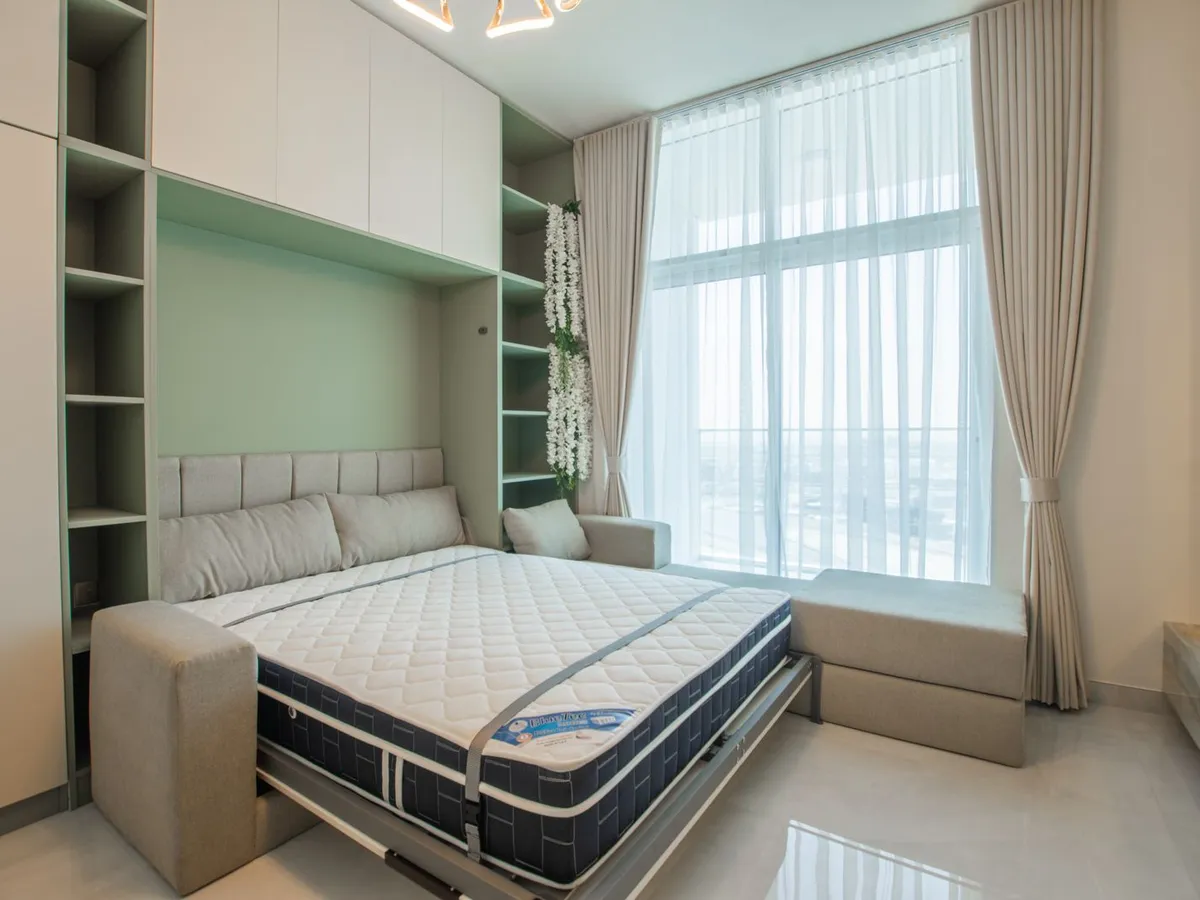
Murphy Bed Installation cost at a glance
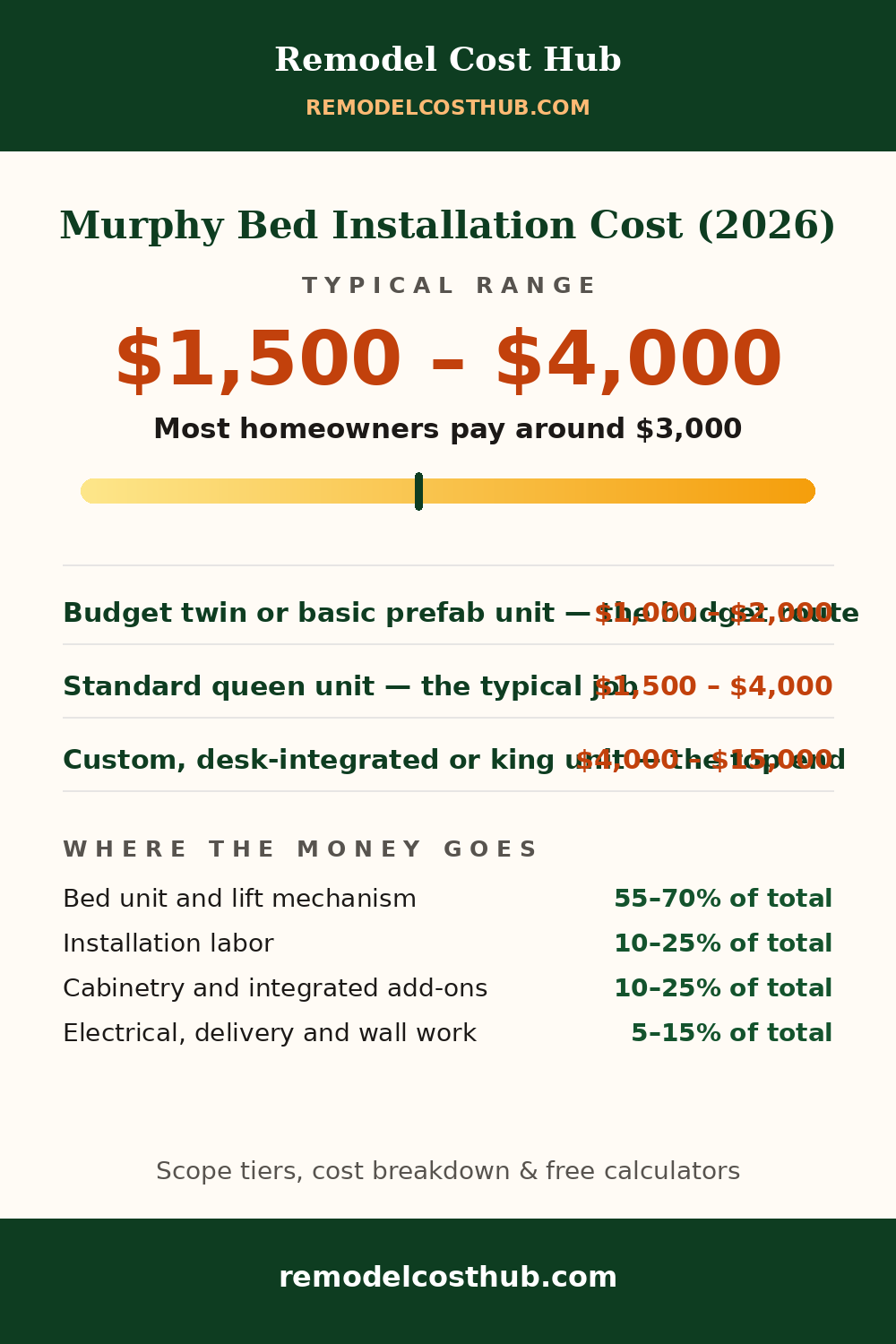
- Typical range: $1,500 – $4,000
- Most homeowners pay: around $3,000
- Prices vary most by: Bed unit and lift mechanism (55–70% of the budget)
Cross-checked against one published sources for this project. Sources used for this page: Angi's Murphy bed guides (professional installation $1,000–$7,500, average $3,000; DIY build $100–$500 for tools and materials), Renuity's Murphy bed buyer's guide (citing Angi's 2025 data: most installations $2,000–$4,000, average $3,000; wall-mounted standard $1,000–$3,000, cabinet-style $2,000–$5,000, desk-integrated $2,500–$6,000, custom $3,500–$15,000+; queen $1,500–$4,000, king $2,500–$6,000; shelving $200–$1,000, cabinetry $500–$2,500, lighting $100–$500; labor $50–$150 per hour or $300–$800 flat), EngineerFix's Murphy bed installation cost guide (basic units $400–$899 twin, mid-range $900–$1,499, premium solid wood $1,500–$6,000; hardware kit $279–$359; labor $50–$150 per hour or $300–$800 flat over two to six hours; add-ons $200–$2,500, electrical $100–$500, delivery $100–$400, stud reinforcement or masonry $500–$2,000) and Lori Beds' Murphy bed installation cost guide (labor $250–$1,200; basic prefab unit plus installation $1,000–$3,000, custom cabinetry $3,500–$15,000+; queen frame plus installation $1,500–$4,000, king $2,500–$6,000). Sources last checked: October 2026 — Angi. How we calculate these costs
Cost by scope
| Scope | Typical cost | What it includes |
|---|---|---|
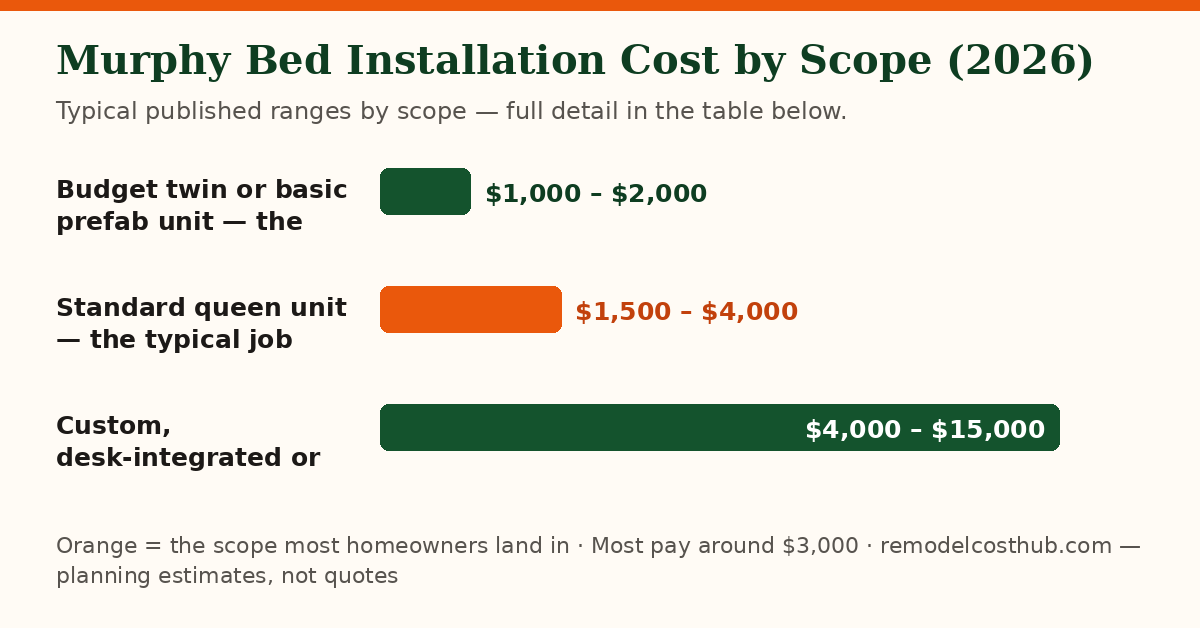
| Budget twin or basic prefab unit — the budget route | $1,000 – $2,000 | The cheap end: EngineerFix prices basic particleboard or melamine units from $400–$899 for a twin, and Lori Beds prices a basic prefab unit plus installation at $1,000–$3,000 — a small occasional-use bed with a simple mechanism, which is why it prices below a queen cabinetry unit |
| Standard queen unit — the typical job | $1,500 – $4,000 | The shared band itself: Renuity prices a queen at $1,500–$4,000, and Angi averages $3,000 across installations — a queen cabinet or wall-mounted unit with a piston or spring mechanism, professionally anchored to the studs, which is the common job and the band this page is built on |
| Custom, desk-integrated or king unit — the top end | $4,000 – $15,000 | The expensive end: Renuity prices custom configurations at $3,500–$15,000 or more, desk-integrated units at $2,500–$6,000 and kings at $2,500–$6,000, while Lori Beds prices custom cabinetry builds at $3,500–$15,000 or more — solid wood, integrated shelving, desks and lighting are what push a job past the standard band |
Where the money goes
| Part of the job | Share | Note |
|---|---|---|
| Bed unit and lift mechanism | 55–70% of total | The largest portion, in EngineerFix's words: basic units at $400–$899 for a twin, mid-range engineered wood at $900–$1,499 and premium solid wood at $1,500–$6,000, with a hardware kit alone at $279–$359 — piston mechanisms cost slightly more than spring systems and lift more smoothly, and size steps the whole line up from twin to king |
| Installation labor | 10–25% of total | The anchoring: EngineerFix prices standard installation at a $300–$800 flat rate or $50–$150 per hour over two to six hours, and Lori Beds prices labor at $250–$1,200 — assembly, securing the frame to the wall structure and testing the lift mechanism, usually a two-person job |
| Cabinetry and integrated add-ons | 10–25% of total | What turns a bed into furniture: Renuity prices integrated shelving at $200–$1,000, cabinetry at $500–$2,500 and lighting at $100–$500, while EngineerFix prices add-ons at $200–$2,500 — side cabinets, a fold-down desk and lighting are the features that lift a standard unit toward custom prices |
| Electrical, delivery and wall work | 5–15% of total | The small lines that surprise: EngineerFix prices electrical additions at $100–$500, delivery of the heavy components at $100–$400 and reinforcing studs or dealing with masonry at $500–$2,000 — a wall that is not ready for anchoring is what pushes this line up |
What moves the price most
Bed size is the first driver: Renuity prices a queen at $1,500–$4,000 against $2,500–$6,000 for a king, and EngineerFix prices basic twins from $400–$899 for the unit alone — a bigger bed needs more material, a larger mechanism and more wall. Unit type is second: Renuity prices wall-mounted standard units at $1,000–$3,000, cabinet-style units at $2,000–$5,000 and desk-integrated units at $2,500–$6,000, because cabinetry and a desk are furniture, not just a frame. Material and mechanism are third: EngineerFix prices particleboard and melamine at the bottom, engineered wood in the middle and solid wood at $1,500–$6,000, with piston lifts slightly pricier than spring systems but smoother to operate. Finally, the wall itself decides the labor: EngineerFix prices stud reinforcement or masonry anchoring at $500–$2,000, and a wall with badly spaced studs or a moved outlet or vent needs a licensed trade on top of the installer.
Costs in your city
Labor is the biggest variable in any remodel, and labor is local — the same bathroom can price very differently in Houston than in Boston. We are adding city editions metro by metro, each with its own labor index, permit notes and climate factors, written for that city rather than copied from this page. Wave 1: Houston, Dallas–Fort Worth, Phoenix, Atlanta, Miami–South Florida, Orlando, Tampa, Charlotte, Austin and San Antonio. Until your city's page is live, use the national range here and weight it the way contractors do: Sun Belt labor often prices near or below the national middle, while coastal California and the Northeast metros often price well above it.
Frequently asked questions
How much does it cost to install a Murphy bed?
Most standard queen units land in the $1,500–$4,000 band on this page, with a common middle around $3,000 — Angi's average. A basic twin can come in below that band, and custom, desk-integrated or king units usually land above it.
How much more does a king Murphy bed cost than a queen?
Roughly a thousand or more at the same grade: Renuity prices a queen at $1,500–$4,000 against $2,500–$6,000 for a king, because the larger frame, mechanism and cabinetry all scale with the bed — and a king also needs more clear floor space in front of the wall to fold down.
Can I install a Murphy bed myself?
Angi prices a DIY build at $100–$500 for tools and materials, but calls the professional route $1,000–$7,500 for a reason: EngineerFix stresses the unit must be anchored directly into wall studs or masonry, installation is usually a two-person job over two to six hours for a pro, and a weekend DIY can easily run longer — a badly anchored wall bed is a safety risk, not a cosmetic flaw.
Does my wall need reinforcement for a Murphy bed?
Sometimes: EngineerFix prices reinforcing studs or dealing with masonry at $500–$2,000, because the frame must land on solid structure, not drywall alone — a wall with well-spaced studs is a standard install, while masonry, steel studs or a missing stud bay turn it into a bigger job.
Is the mattress included in the Murphy bed price?
Check the quote: the guides on this page price the unit, mechanism and installation, and a mattress is often a separate purchase — Renuity's queen band of $1,500–$4,000 is framed as frame plus installation, so confirm whether the mattress, bedding and any sofa or desk front are in the number before comparing quotes.
Murphy bed or sofa bed — which is the better space saver?
A Murphy bed, for nightly use: it sleeps on a real mattress on a proper frame and folds fully away to free the whole floor, while a sofa bed keeps a thinner mattress inside a sofa frame — the Murphy bed costs more upfront at $1,500–$4,000 for a standard queen, but it is the one built to be slept on every night.