Cedar Shake Roof cost at a glance
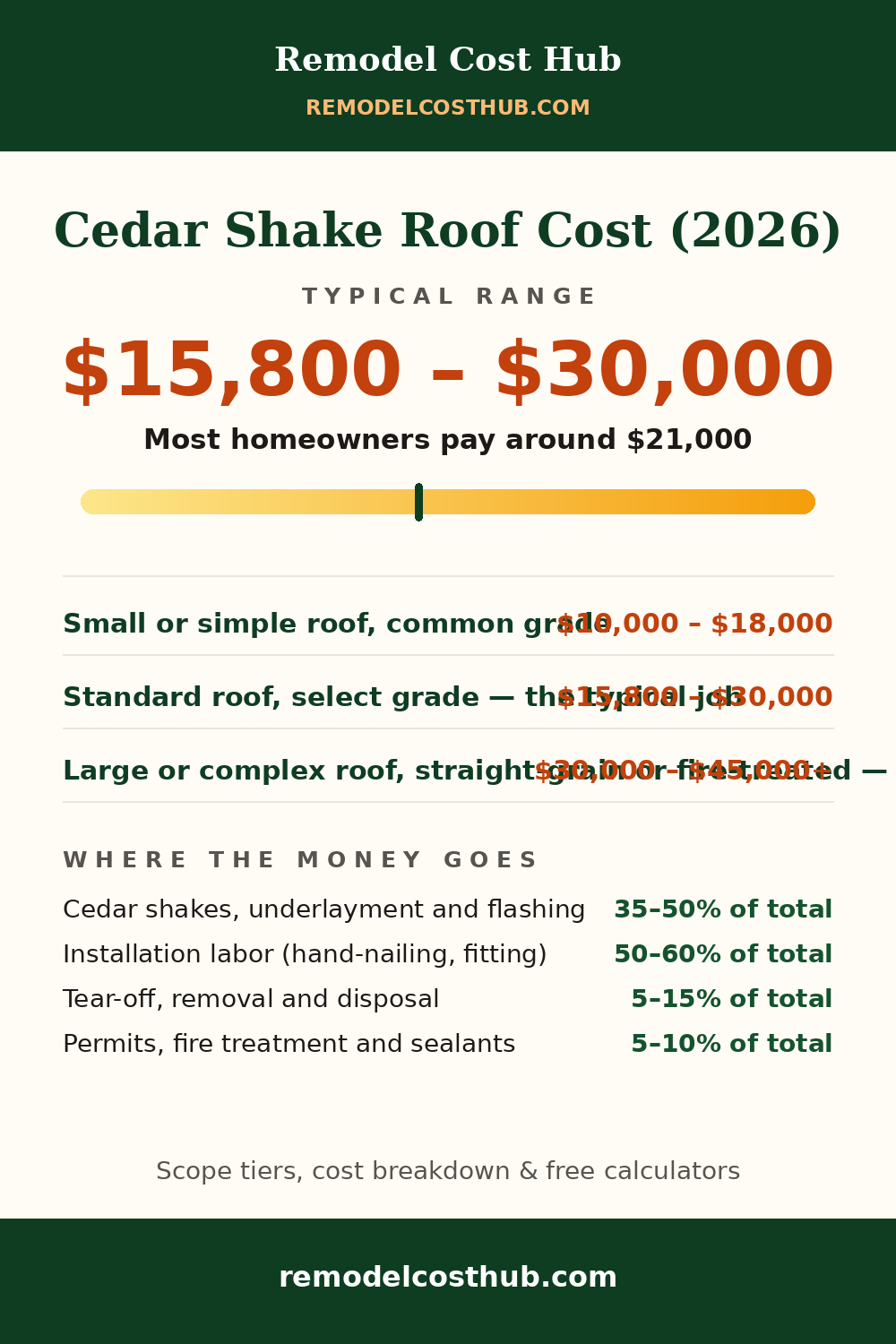
- Typical range: $15,800 – $30,000
- Most homeowners pay: around $21,000
- Prices vary most by: Installation labor (hand-nailing, fitting) (50–60% of the budget)
Cross-checked against two published sources for this project. Sources used for this page: Angi's cedar shake roof guide, updated October 27, 2026 (average $21,000, most $15,800–$30,000; $6–$15 per square foot installed; labor 50–60% of the total, about $10,500–$12,600 on an average roof; grades common $6–$8, select $7–$11, straight-grain $8–$15 per square foot; old roof removal $1,000–$5,000; underlayment replacement about $3,300; sealants $2–$5 per square foot), HomeGuide's cedar shake roof guide (real wood shake $25–$30 per square foot installed, average project $12,900–$28,200; synthetic $12–$20 per square foot; penetrations $150–$500 each; real cedar lifespan 30–50 years) and HomeBuddy's cedar shake roof cost guide ($16,000–$64,000 by size and grade; installation labor $500–$700 per roofing square) — HomeGuide's higher per-square-foot figure is published as its larger-roof all-in rate, not averaged away. Sources last checked: October 2026 — HomeGuide, Angi. How we calculate these costs
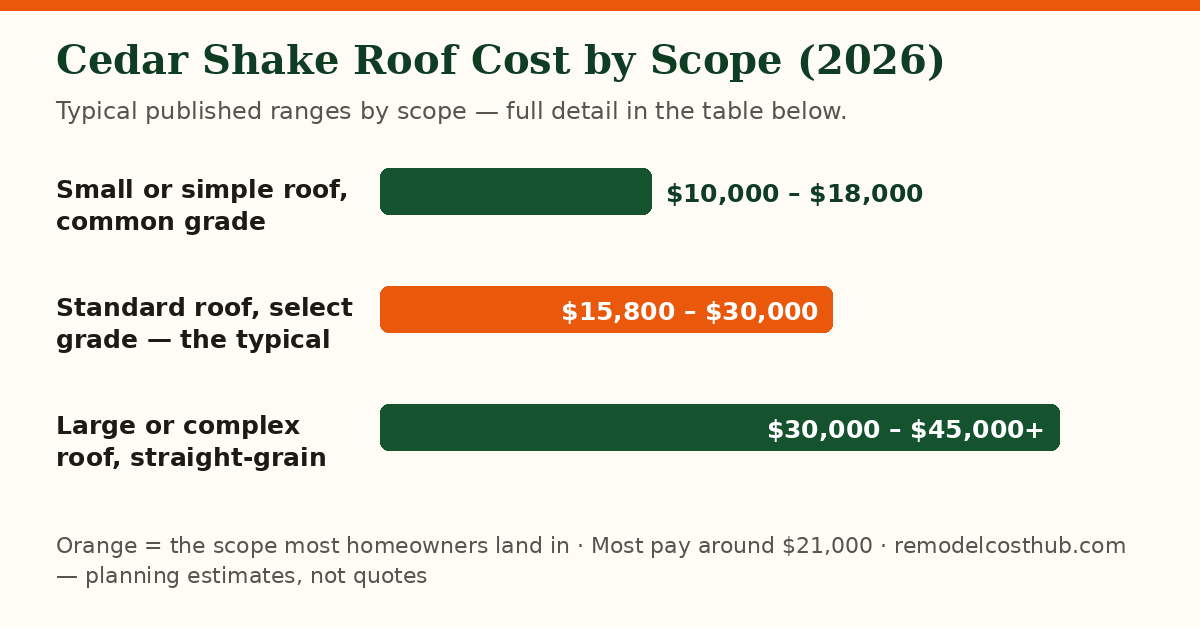
Cost by scope
| Scope | Typical cost | What it includes |
|---|---|---|
| Small or simple roof, common grade | $10,000 – $18,000 | The cheap end: Angi prices common-grade shakes at $6–$8 per square foot, and a smaller or simpler roof with fewer valleys and penetrations stays at this end |
| Standard roof, select grade — the typical job | $15,800 – $30,000 | The shared band itself: Angi averages $21,000 for this scope, and HomeGuide's average project of $12,900–$28,200 overlaps it — the grade and size most homes actually buy |
| Large or complex roof, straight-grain or fire-treated — the top end | $30,000 – $45,000+ | The expensive end: Angi prices straight-grain shakes at $8–$15 per square foot, HomeBuddy runs to $64,000 on larger roofs, and steep pitches, many penetrations and fire-retardant treatment all push the same roof upward |
Where the money goes
| Part of the job | Share | Note |
|---|---|---|
| Cedar shakes, underlayment and flashing | 35–50% of total | The materials: Angi prices shakes by grade at $6–$15 per square foot installed overall, underlayment replacement at about $3,300, and sealants at $2–$5 per square foot — grade is the ladder inside this line |
| Installation labor (hand-nailing, fitting) | 50–60% of total | The fitting: Angi puts labor at 50–60% of the total, about $10,500–$12,600 on an average roof, because every shake is hand-nailed and fitted individually |
| Tear-off, removal and disposal | 5–15% of total | The strip-out: Angi budgets old roof removal at $1,000–$5,000, and new shakes should not go over an existing wood shake roof, so tear-off is not optional |
| Permits, fire treatment and sealants | 5–10% of total | The rest: fire-retardant treatment matters where codes restrict wood roofing, and Angi prices wood-specific sealants at $2–$5 per square foot |
What moves the price most
Grade is the first driver: Angi prices common shakes at $6–$8 per square foot, select at $7–$11 and straight-grain at $8–$15 — the same roof in straight-grain costs roughly twice what it costs in common grade. Roof size and complexity are second: pitch, valleys, dormers and penetrations add cutting and flashing time, and HomeGuide prices each penetration at $150–$500. Labor is third: at 50–60% of the total in Angi, cedar is one of the most labor-heavy roofs, and a crew that specializes in wood shakes is not interchangeable with a shingle crew. Finally, the published disagreement is real: HomeGuide's $25–$30 per square foot for real cedar sits above Angi's $6–$15 band — HomeGuide's figure reads as a larger-roof, all-in installed rate, and this page's typical band follows Angi's verified-project average rather than averaging the two away.
Costs in your city
Labor is the biggest variable in any remodel, and labor is local — the same bathroom can price very differently in Houston than in Boston. We are adding city editions metro by metro, each with its own labor index, permit notes and climate factors, written for that city rather than copied from this page. Wave 1: Houston, Dallas–Fort Worth, Phoenix, Atlanta, Miami–South Florida, Orlando, Tampa, Charlotte, Austin and San Antonio. Until your city's page is live, use the national range here and weight it the way contractors do: Sun Belt labor often prices near or below the national middle, while coastal California and the Northeast metros often price well above it.
Frequently asked questions
How much does a cedar shake roof cost?
Typically $15,800–$30,000, with about $21,000 the figure most jobs land near — Angi averages $21,000 at $6–$15 per square foot installed, HomeGuide averages $12,900–$28,200 a project, and HomeBuddy ranges $16,000–$64,000 by size and grade.
What is the difference between cedar shakes and cedar shingles?
Shakes are hand-split and thicker with a rustic, irregular face; shingles are sawn on both sides for a smoother, more uniform look. Angi's grade ladder — common $6–$8, select $7–$11, straight-grain $8–$15 per square foot — applies to shakes, and the split face is part of why shakes cost more to fit.
How long does a cedar shake roof last?
HomeGuide puts real cedar at 30–50 years with proper maintenance, and synthetic shakes at 40–60 years — the lifespan assumes the maintenance in the next answer, not neglect.
Are cedar shake roofs a fire risk?
Untreated wood shakes carry a fire risk that some municipal codes restrict, which is why fire-retardant treatment exists and why permits and code checks sit in this page's breakdown — confirm what your jurisdiction allows before ordering material.
What maintenance does a cedar shake roof need?
Regular inspections, debris clearing, moss treatment and re-sealing: Angi prices wood-specific sealants at $2–$5 per square foot, and skipped maintenance is how a 30–50-year roof becomes a short-life one.