Concrete Leveling cost at a glance
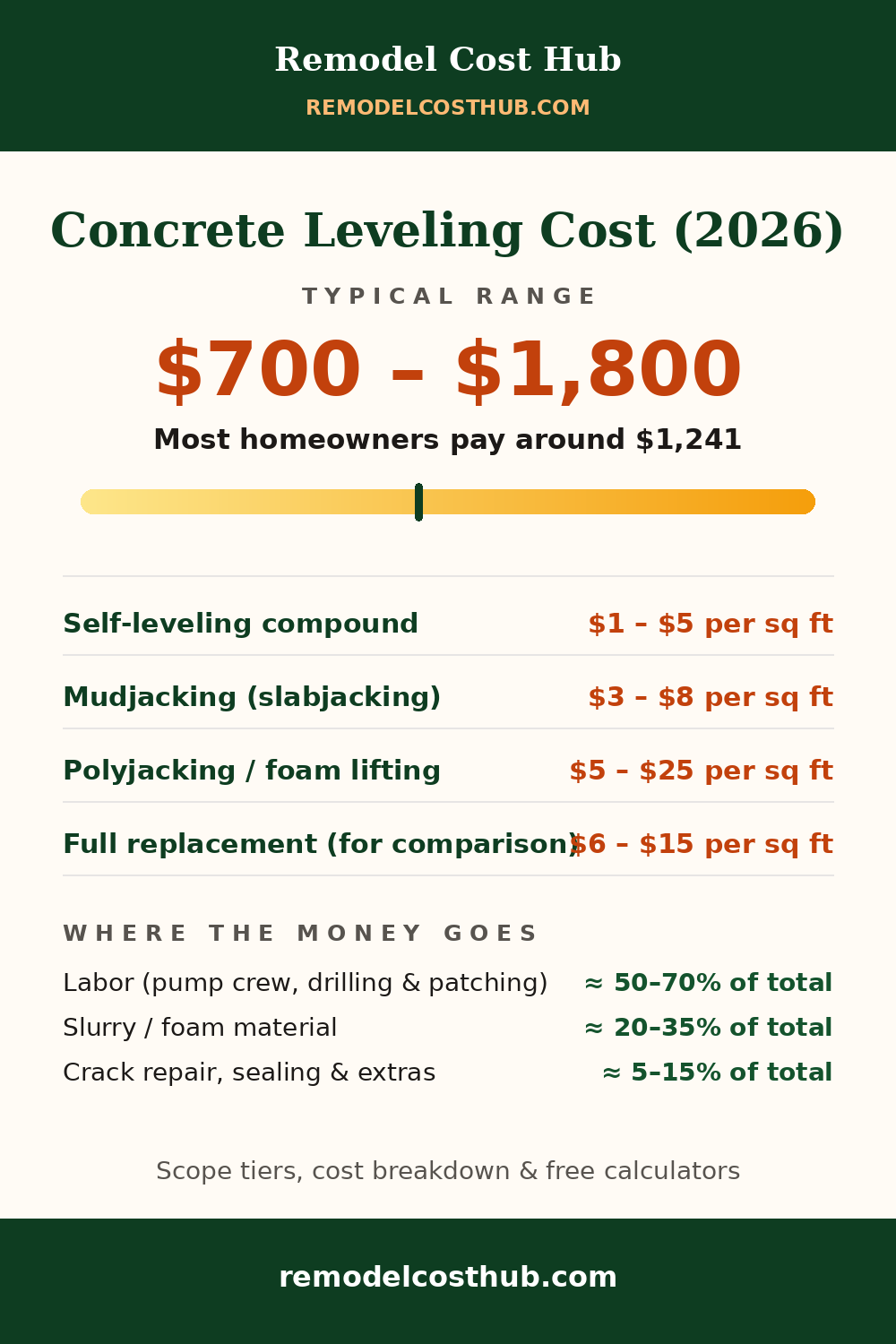
- Typical range: $700 – $1,800
- Most homeowners pay: around $1,241
- Prices vary most by: Labor (pump crew, drilling & patching) (≈ 50–70% of the budget)
Cross-checked against two published sources for this project. Sources used for this page: the Angi mudjacking and concrete leveling cost guides (August/September 2026, 2,631 verified projects), Fixr's concrete leveling cost data and BK Concrete Experts' contractor-authored mudjacking pricing guide. Sources last checked: October 2026 — Fixr, Angi. How we calculate these costs
Cost by scope
| Scope | Typical cost | What it includes |
|---|---|---|
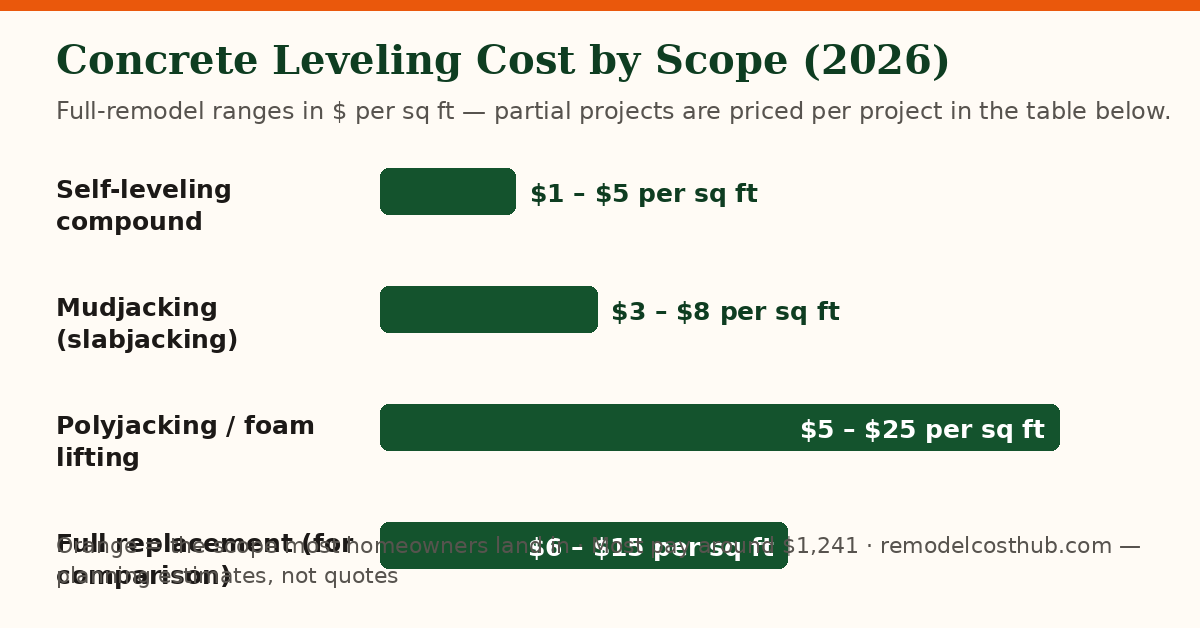
| Self-leveling compound | $1 – $5 per sq ft | Thin interior overlays and small dips — the only universally DIY-endorsed method in the guides, and only where the slab has sunk less than an inch |
| Mudjacking (slabjacking) | $3 – $8 per sq ft | The standard pro route — slurry pumped through 1–2 inch holes lifts the slab back to grade; the typical project lands $700–$1,800 |
| Polyjacking / foam lifting | $5 – $25 per sq ft | Polyurethane foam through roughly 5/8-inch holes — cures in about 15 minutes against 24 hours for slurry; BK Concrete puts the average foam project at $1,200–$3,000 |
| Full replacement (for comparison) | $6 – $15 per sq ft | What leveling avoids — Angi prices replacement at about $10 a square foot against leveling’s $4 average, and Fixr says a new slab runs 50–70% more than leveling |
Where the money goes
| Part of the job | Share | Note |
|---|---|---|
| Labor (pump crew, drilling & patching) | ≈ 50–70% of total | The largest line — Angi and BK Concrete both put labor at 50–70% of the bill; Angi prices skilled crew time at $45–$70 an hour |
| Slurry / foam material | ≈ 20–35% of total | Mudjacking slurry $100–$400 a job in Angi; polyurethane foam $300–$900 — the method choice moves this line most |
| Crack repair, sealing & extras | ≈ 5–15% of total | Crack repair $100–$400 in Angi; sealing $1–$3+ a square foot in HomeGuide; permits $50–$200 where required |
What moves the price most
Slab size sets the per-square-foot math. Angi’s size table drops from $12–$14 a square foot on a 50 sq ft patch to $3.50–$5 at 800 sq ft — small jobs are priced by the minimum charge ($150–$500 across the guides), not the per-foot rate. Method is the next lever: self-leveling compound under $5 a foot, mudjacking $3–$8, foam $5–$25. Access matters — Fixr notes slabs more than 200–250 feet from the pump, or hard to reach, cost more. Damage severity decides whether leveling is even the answer: Angi warns against mudjacking badly cracked or split slabs. And the root cause — soil settlement, drainage, tree roots — determines whether the lift lasts 5–10+ years (HomeGuide’s band) or needs re-leveling at $300–$800.
Worked example: how a typical concrete leveling budget breaks down
Take the typical job — a 250 sq ft settled driveway section lifted by mudjacking: drill the pattern, pump the slurry, patch the holes, seal the joints. Here is a realistic $1,241 version of that invoice, at Angi’s 2026 national average: The budget below totals $1,241 — the "most homeowners pay around" figure from the top of this page — split using this page's own cost breakdown. It shows how a real quote at that level is usually composed; every line is built from the ranges on this page, and it is an illustration, not a quote for your project.
| Line item | Example budget |
|---|---|
| Pump crew labor (drilling, pumping, patching) | $745 |
| Slurry material | $310 |
| Crack repair & joint sealing | $186 |
| Total | $1,241 |
What most people get wrong
- Leveling a slab that is still moving. Mudjacking does not fix the cause — Fixr is explicit that settling from bad drainage or unstable soil means re-leveling at $300–$800. Fix the water first, lift second.
- Mudjacking a badly cracked or split slab. Angi warns against it: cracked-through slabs should be replaced, not lifted. A cheap lift on a failed slab is the most expensive option on this page.
- Paying foam prices where mudjacking would do. The method ladder is $1–$5 (self-leveling), $3–$8 (mudjacking), $5–$25 (foam) a square foot — foam’s smaller holes and 15-minute cure are real advantages, but not every driveway needs them.
- Comparing quotes on the per-square-foot rate alone. Minimum and trip charges run $150–$500 across the guides — on a small sidewalk job the minimum IS the price, and the per-foot math never gets used.
Costs in your city
Concrete leveling is pump-crew pricing around commodity slurry: Angi prices skilled crew time at $45–$70 an hour, so the same 250 sq ft lift quotes near the bottom of the band where crew rates are low and toward the top in a high-cost metro, while the material costs the same everywhere. Soil is the local multiplier — expansive clay soils (Texas and much of the South) re-settle faster than stable ground, and freeze-thaw cycles in the North heave slabs that were fine in October. Markets with older housing stock price more small sidewalk and stoop jobs at the minimum charge. Get the method, the per-square-foot rate, the minimum charge and the hole-patching named in writing before comparing quotes.
How we got these numbers
Cross-checked against the Angi mudjacking cost guide — read in full this run, August 2026 (national average $1,241 across 2,631 verified projects; most homeowners paying $662–$1,883; mudjacking $3–$8 a square foot; slurry material $100–$400, foam $300–$900; labor 50–70% of the total at $45–$70 an hour; minimum charge about $500) and its companion concrete leveling guide — read in full this run, September 2026 (same $1,241 average; method table: self-leveling $1–$5, mudjacking $3–$6, polyjacking $5–$25 a square foot; leveling about $4 a square foot against about $10 for replacement), Fixr’s concrete leveling cost data — read in full this run, updated January 2025 (100 sq ft patio average $1,500; range $500–$1,700; replacement 50–70% more than leveling) and BK Concrete Experts’ contractor-authored mudjacking pricing guide — read in full this run (average mudjacking $500–$1,800; $3–$8 a square foot; foam $5–$25 with the average foam project $1,200–$3,000; labor 50–70% of the total; 25–50% saving vs replacement), with HomeGuide’s concrete leveling cost guide (Angi Inc family — not counted as an independent source) as context ($700–$5,000 average band; lifespan 5–10+ years). Genuine disagreements are published as-is: the national averages ($1,241 vs $1,500 vs $500–$1,800), the mudjacking per-foot band (Angi’s own $3–$6 method table vs its $3–$8 project section vs HomeGuide’s $4–$9), DIY mudjacking (Angi: possible for experienced homeowners vs Fixr: not a DIY project) and warranties (Fixr: none vs Angi: many companies offer them). No source publishes a full percentage cost split, so the breakdown shares are derived from the guides’ published labor shares and dollar figures and are labelled as derived on the page. Checked October 2026. Full method: How We Estimate Costs.
Frequently asked questions
How much does mudjacking cost per square foot?
$3–$8 a square foot in Angi and in BK Concrete’s contractor-authored guide (Angi’s own method table says $3–$6 while its project section runs $3–$8 — the page publishes both). Polyjacking runs $5–$25, self-leveling compound $1–$5.
Is mudjacking or polyjacking (foam lifting) better?
Foam costs more but drills smaller holes (about 5/8 inch vs 1–2 inches) and cures in roughly 15 minutes against 24 hours for slurry. HomeGuide gives professionally leveled concrete 5–10+ years with foam lasting longest; mudjacking and stone slurry typically 5–7 years with proper drainage.
How long does concrete leveling last?
5–10+ years in HomeGuide — provided the cause of the settling is fixed. Mudjacking that ignores bad drainage or unstable soil is the job that needs re-leveling at $300–$800 in Angi.
Is it cheaper to level concrete or replace it?
Leveling, by a wide margin: Angi averages leveling at about $4 a square foot against about $10 for replacement; BK Concrete puts the saving at 25–50%; Fixr says a new slab costs 50–70% more than leveling the old one.
Can I mudjack my own concrete?
The guides disagree and the page says so: Angi says experienced homeowners can DIY at $500–$1,200 in rental and materials; Fixr says flatly that mudjacking is not a DIY project. Self-leveling compound on small interior dips is the one method every source endorses for DIY.
Do concrete leveling companies offer warranties?
Another published disagreement: Fixr states mudjacking and surface leveling do not come with warranties, while Angi says many mudjacking companies do offer them. Whatever the brochure says, get the warranty — or its absence — in writing before the crew drills.