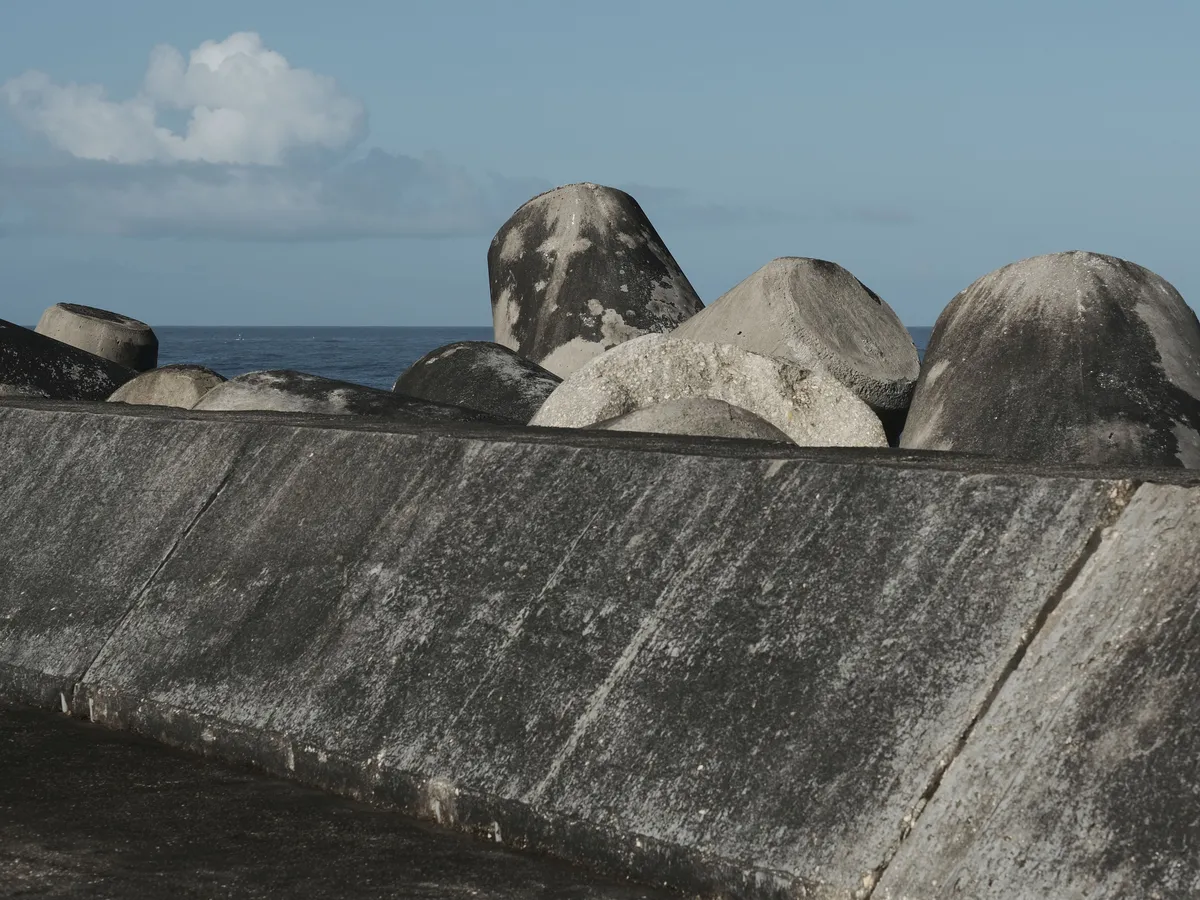
Seawall Installation cost at a glance
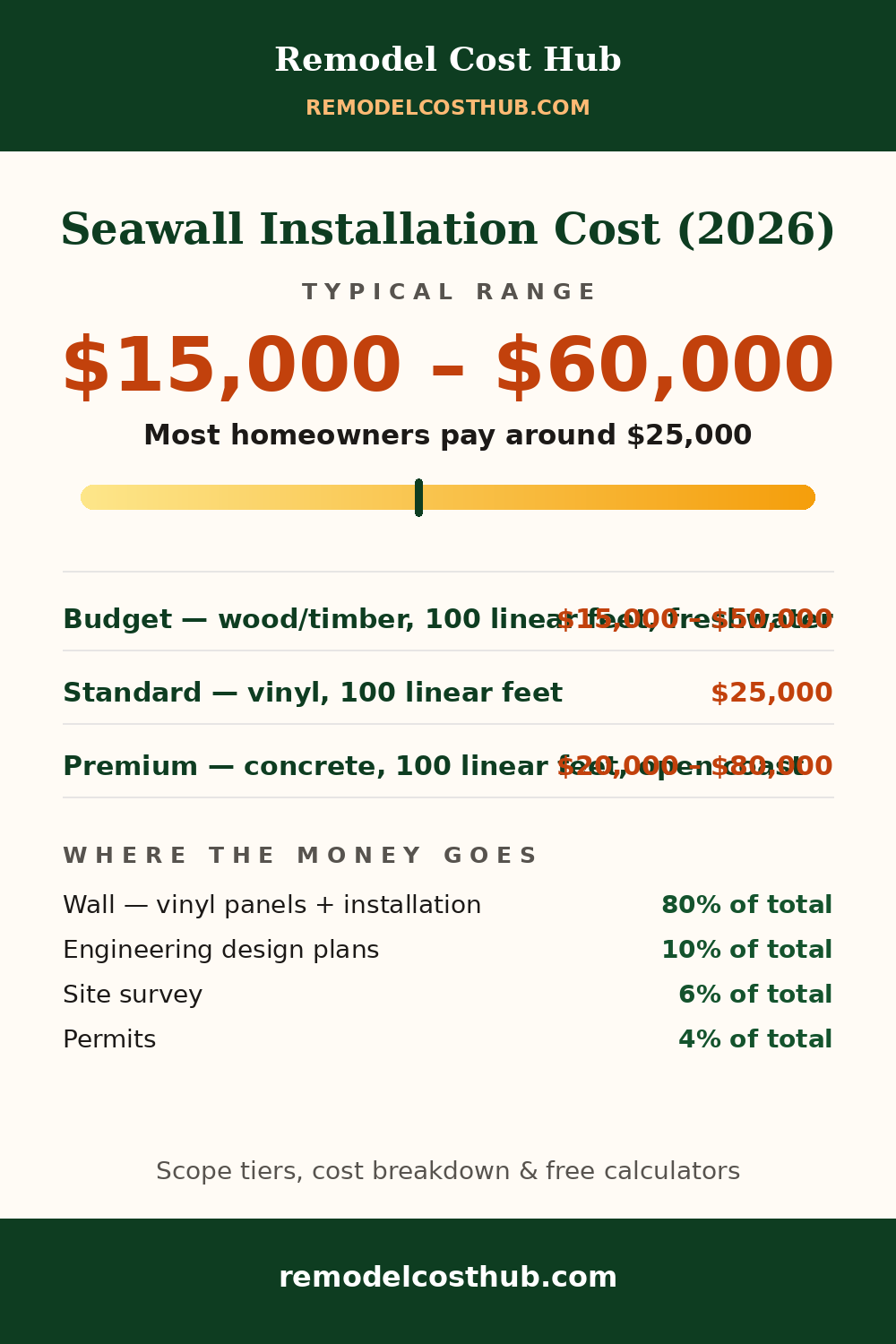
- Typical range: $15,000 – $60,000
- Most homeowners pay: around $25,000
Cross-checked against two published sources for this project. Sources used for this page: Angi, 'How Much Does It Cost to Build a Seawall? [2026 Data]', updated Jul 9, 2026 — national average $25,000; typical $15,000–$60,000; $100–$800 per linear foot, complex projects sometimes $2,000+ per linear foot; by material per linear foot (vinyl $200–$600; steel $250–$700; concrete $200–$800; wood $150–$500; riprap $70–$400); by length, wood / concrete (100 linear feet $15,000–$50,000 / $20,000–$80,000; 150 $22,500–$75,000 / $30,000–$120,000; 225 $33,750–$112,500 / $45,000–$160,000; 300 $45,000–$150,000 / $60,000–$240,000; 700 $105,000–$350,000 / $140,000–$560,000); wall height 4–5 ft to 15–20+ ft; labour $40–$100 per hour, up to $300 per hour for heavy equipment (bulldozers/cranes); site survey $800–$5,500; permits $150–$2,500; environmental impact assessment $2,000–$15,000+ (more for large/commercial); saltwater seawalls cost about 2x freshwater (corrosion-resistant materials, taller walls, more complex permits); replacing costs about 80% more than repairing; lifespan (built correctly over 30 years, sometimes closer to 100; steel and wood shorter-lived than concrete); timeline (construction a few weeks to a few months, prep before work can take just as long); maintenance (visual inspection first, clean plant growth, remove lodged debris; wood needs most maintenance). HomeGuide, '2026 Seawall Costs — Bulkhead & Lake Seawall Costs Per Foot' (title says 2026 but page metadata says Published 2022-10-08, Updated 2023-04-05 — figures are older than the title suggests) — $150–$600 per linear foot or $15,000–$60,000 average residential project; commercial/high-erosion $700–$2,000 per linear foot; national average $35,000 (100 ft wall); minimum $5,000; maximum $100,000; by length (25 ft $3,800–$15,000; 50 ft $7,500–$30,000; 100 ft $15,000–$60,000; 150 ft $22,500–$90,000; 200 ft $30,000–$120,000); by material per linear foot (steel $200–$600; vinyl $200–$550; concrete $200–$600; wood $150–$500; riprap rock/boulders $50–$200; living shoreline $50–$350; Truline $500–$1,200); by complexity per linear foot including materials & labour (Standard $150–$400: easy access, shoreline-only, new installs, reinforcing old wall, vinyl/wood/riprap, riverside/lakeside; Medium $400–$600: basic replacement, limited land access, barge work, steel/reinforced vinyl/concrete; Complex $600–$1,000: complex replacements, hard access, barge work, large backfills, clay/rocky soil, open-ocean-facing, riprap+steel/concrete combos); reinforcing an existing seawall costs HALF the price of building new; old seawall removal $50–$150 per linear foot; structural engineering design-plan fees for permit $2,000–$3,000 (certified marine engineer); permits $100–$400 average; French drain $10–$35 per linear foot; dock addition $3,500–$20,000 ($15–$40 per sq ft); repair (non-structural $100–$250 per linear foot; replacement $150–$600 per linear foot); inspection $200–$600 per visit (marine structural engineers should check every 5–6 years and during real estate transactions); vinyl height limit 6–7 ft max (taller walls need concrete or steel); concrete tallest type 10–20 ft high; lakeside bulkhead/canal wall 3–6 ft deep, concrete seawall 8–20 ft deep; lifespans (steel 25–35 years; vinyl 50–60; concrete 30–50; wood 10–40; Truline 75+ years); most new seawalls take 1–3 weeks to install; Michigan $150–$450 per linear foot; wood best for freshwater, rots faster in saltwater; steel rusts quickly in saltwater without protective coating; seawalls mandatory before building next to river/canal/lake/beach in most places. Shore Protect Construction, 'Waterfront Seawalls — Coastal Shoreline Protection & Cost', last updated July 2026 (independent Gulf Coast + inland Midwest marine contractor; prices are their real quoted installed ranges, BEFORE demolition and backfill) — installed $150–$1,000+ per linear foot by material/wave energy/height/access; by material per linear foot (CCA timber $150–$450, sheltered low-energy, freshwater; marine-grade vinyl $200–$800; steel sheet pile $300–$900; cast-in-place concrete $300–$1,000+; riprap revetment $150–$500); lifespans (cast-in-place concrete 50–100+ years; marine-grade vinyl 40–50+; steel sheet pile 40–50 years with corrosion protection; CCA timber 15–25 years, far less on open saltwater); saltwater always runs higher than freshwater (marine-grade hardware, heavier corrosion protection); cost drivers (wave energy, wall height, water depth, toe-scour protection, equipment access, old-wall removal); permits (work at/below high-water line almost always requires permits — federal USACE Section 10/404 plus state + local); process (design to wave/surge, drive/pour to deeper embedment, toe-scour apron, tie-backs + deadman anchors, cap + return walls); maintenance (walk the wall yearly — cap, joints, weep holes, toe scour; professional inspection every 3–5 years and always after a named storm/major surge); replacement beats repair once scour reaches footing or more than about 30% of wall compromised; a sound seawall keeps the lot insurable/buildable, a failing one scares off buyers and lenders. PPH Seawalls and Docks (Pasco Seawalls and Docks), 'Seawall Repair vs Replacement Cost (2026)' (independent Florida marine contractor, Pasco/north Pinellas canals; page crawled 2026-11-10, no explicit publish date shown) — non-structural repair (cracks, joints, small voids) $100–$300 per linear foot of affected wall only; structural repair (panels, tiebacks) $400–$700 per linear foot of affected wall; cap replacement $200–$600 per linear foot; rip-rap at toe $150–$400 per linear foot; new vinyl wall with concrete cap $450–$700 per linear foot whole run; new concrete wall $500–$900 per linear foot whole run; inspection $250–$500 per visit; worked 80 linear foot canal lot (non-structural repair whole run $8,000–$24,000; structural repair on failed half, 40 linear feet, $16,000–$28,000; new cap only $16,000–$48,000; rip-rap along toe $12,000–$32,000; new vinyl wall + cap $36,000–$56,000; new concrete wall $40,000–$72,000); structural repair on half the wall already costs roughly half to three-quarters of the low end of replacing all of it; typical 60–100 linear foot canal lot vinyl $30,000–$65,000; lift set back onto existing pilings $12,000–$18,000, pile replacement $2,000–$3,500 per pile; permits (repair can stay on lighter path — Florida DEP Rule 62-330.051 exempts cap/batter/king piles used only to stabilize/repair; F.S. 403.813(1)(e) exempts restoring a wall at old location or up to 18 in waterward from state environmental permit; Port Richey drops DEP + Army Corps step for size-for-size repair, new wall needs both + engineered plans); Pinellas Sec. 58-573 (replacement without county dredge-and-fill permit if new face up to 1 ft in front of old); Pasco LDC Sec. 1001.5.E (new wall no farther out than lesser of neighbours' walls or property line); Category I wetlands (new seawall prohibited, repair/rebuild may be allowed); replacement is the only chance to raise cap height (repair keeps existing height); NOAA relative sea-level trend Clearwater Beach 1.72 inches per decade (May 1973–Dec 2025); Hurricane Helene Sep 2024 Clearwater gauge 6.67 ft above mean higher high water (record). NOTE: Angi and HomeGuide are both Angi Inc. — they count as ONE independent family, not two. Independent families in this entry: (1) Angi Inc. (Angi + HomeGuide), (2) Shore Protect Construction, (3) PPH Seawalls and Docks. Disagreements published, not averaged: national average $25,000 (Angi) vs $35,000 (HomeGuide, for a 100-ft wall) — different bases; concrete per linear foot Angi $200–$800 vs HomeGuide $200–$600 vs Shore Protect $300–$1,000+ (Shore Protect excludes demolition/backfill; Angi/HomeGuide include materials+install; Shore Protect is Gulf open-coast work, higher energy); steel per linear foot Angi $250–$700 vs HomeGuide $200–$600 vs Shore Protect $300–$900; vinyl per linear foot Angi $200–$600 vs HomeGuide $200–$550 vs Shore Protect $200–$800; riprap per linear foot Angi $70–$400 vs HomeGuide $50–$200 vs Shore Protect $150–$500 (widest spread — HomeGuide counts loose-rock revetment, Shore Protect counts engineered toe armour); permits Angi $150–$2,500 vs HomeGuide $100–$400 (Angi likely bundles multi-agency permits including environmental; HomeGuide is the local permit only); concrete lifespan HomeGuide 30–50 years vs Shore Protect 50–100+ years vs Angi 'over 30, sometimes ~100' (Shore Protect = cast-in-place on engineered jobs; HomeGuide = panel/slab average); vinyl lifespan HomeGuide 50–60 years vs Shore Protect 40–50+ years; wood lifespan HomeGuide 10–40 years vs Shore Protect (CCA timber) 15–25 years; repair per linear foot HomeGuide $100–$250 vs Pasco non-structural $100–$300 (Pasco is Florida canal pricing); inspection HomeGuide $200–$600 vs Pasco $250–$500; Florida canal/coastal replacement ($450–$900 per linear foot Pasco) runs well above the national $150–$600 residential band — regional premium, not a contradiction. NOT verified (no opened source): % breakdown shares (materials vs labour vs engineering as % of total) — no opened source publishes a percentage split, so the page prices dollar line items instead; labour share % (Angi gives hourly rates only); excavation/dredging cost as a standalone line (bundled into per-foot rates); backfill cost (no standalone dollar figure in opened sources); Truline lifespan/cost beyond HomeGuide ($500–$1,200 per linear foot, 75+ years) — single source, flagged as such; living shoreline $50–$350 per linear foot — HomeGuide only. Breakdown shares are derived from the worked example below. Checked November 2026.. Sources last checked: October 2026 — HomeGuide, Angi. How we calculate these costs
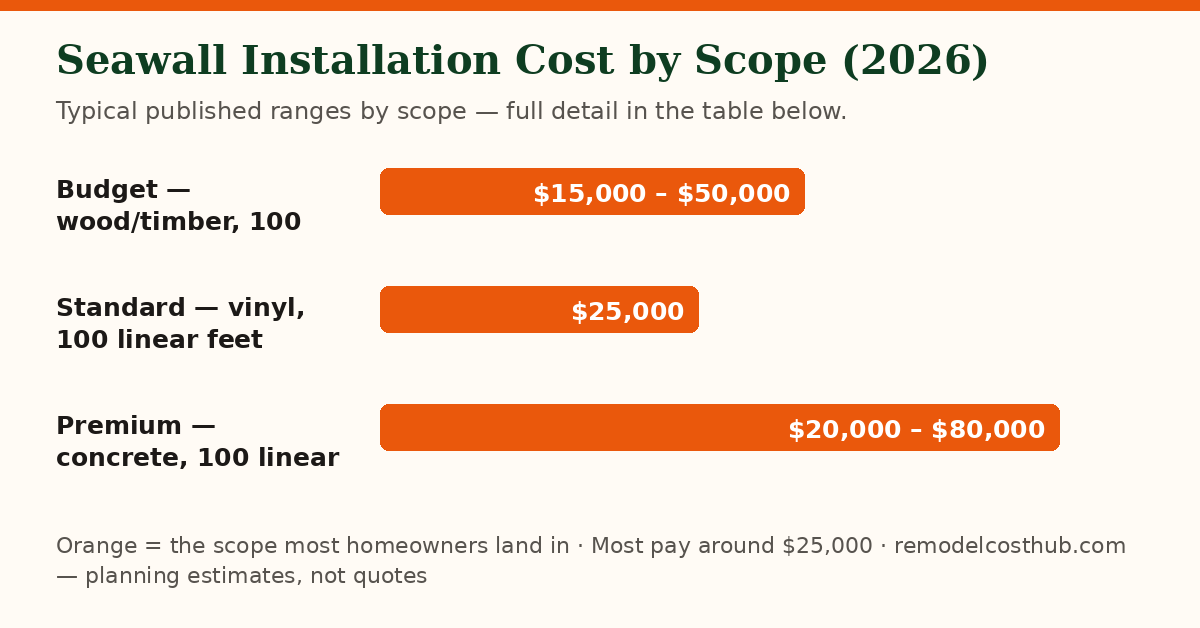
Cost by scope
| Scope | Typical cost | What it includes |
|---|---|---|
| Budget — wood/timber, 100 linear feet, freshwater | $15,000 – $50,000 | A timber seawall on a calm freshwater shoreline. Angi's band for a 100 linear foot wood wall is $15,000–$50,000 ($150–$500 per linear foot). Wood needs the most maintenance and rots faster in saltwater. |
| Standard — vinyl, 100 linear feet | $25,000 | The most-pay tier — the worked example below: a 100 linear foot vinyl seawall with a concrete cap at $250 per linear foot. HomeGuide prices a 100 ft wall at $15,000–$60,000 all-in; Angi's national average is $25,000. |
| Premium — concrete, 100 linear feet, open coast | $20,000 – $80,000 | A cast-in-place concrete wall for open-coast or high-energy water. Angi's band for a 100 linear foot concrete wall is $20,000–$80,000 ($200–$800 per linear foot); Florida canal contractors price new concrete walls at $500–$900 per linear foot (PPH Seawalls and Docks). |
Where the money goes
| Part of the job | Share | Note |
|---|---|---|
| Wall — vinyl panels + installation | 80% of total | $20,000 for the vinyl wall itself — materials plus installation at $200 per linear foot, at the floor of Angi's $200–$600 per linear foot vinyl band and inside HomeGuide's $150–$400 standard-complexity band. Includes panels, cap, tie-backs and deadman anchors. Share derived from the worked example below. |
| Engineering design plans | 10% of total | $2,500 for structural engineering design plans for the permit — inside HomeGuide's $2,000–$3,000 band (a certified marine engineer). Share derived from the worked example below. |
| Site survey | 6% of total | $1,500 for a site survey — inside Angi's $800–$5,500 band (soil type and density, tide levels over at least a month, distance from the property to the wall). Share derived from the worked example below. |
| Permits | 4% of total | $1,000 for permits — inside Angi's $150–$2,500 band; the local permit alone runs $100–$400 (HomeGuide). Work at or below the high-water line also needs federal and state review (USACE Section 10/404). Share derived from the worked example below. |
What moves the price most
Worked example — $25,000 most-pay wall (100 linear feet, vinyl, standard complexity, canal or lake shoreline): wall materials and installation $20,000 (80%) + engineering design plans $2,500 (10%) + site survey $1,500 (6%) + permits $1,000 (4%) = $25,000, or $250 per linear foot — inside the published $150–$600 per linear foot residential band (Angi and HomeGuide agree). Every line sits inside its published band; the breakdown bar rounds the shares to whole numbers. No percentage split of materials vs labour is published by any opened source, so this page prices dollar line items instead. An environmental impact assessment ($2,000–$15,000+, Angi) is NOT in this example — it applies mainly to large or commercial walls. Where sources disagree: the national average — Angi $25,000 vs HomeGuide $35,000 for a 100 ft wall (different bases); concrete per linear foot — Angi $200–$800 vs HomeGuide $200–$600 vs Shore Protect $300–$1,000+ for open-coast cast-in-place work (Shore Protect excludes demolition and backfill); riprap — Angi $70–$400 vs HomeGuide $50–$200 vs Shore Protect $150–$500 (loose rock vs engineered toe armour); permits — Angi $150–$2,500 vs HomeGuide $100–$400 (Angi bundles multi-agency permits, HomeGuide is the local permit alone); concrete lifespan — HomeGuide 30–50 years vs Shore Protect 50–100+ years for cast-in-place on engineered jobs. Angi and HomeGuide are the same data family (Angi Inc.) — they count as one source here; Shore Protect Construction and PPH Seawalls and Docks are the independent cross-checks. HomeGuide's page title says 2026 but its metadata shows an April 2023 update, so Angi and Shore Protect (both 2026) carry the headline bands. Timeline: installation 1–3 weeks for most new residential walls (HomeGuide), but survey, engineering and permits stretch the total to a few weeks to a few months (Angi). Saltwater walls cost about twice freshwater walls (Angi). Repair vs replace: repair runs $100–$250 per linear foot for non-structural work (HomeGuide); replacing costs about 80% more than repairing (Angi), and reinforcing an existing wall costs about half of building new (HomeGuide). Related costs: retaining wall installation, french drain installation, foundation repair, concrete driveway and pool installation.
Costs in your city
Labor is the biggest variable in any remodel, and labor is local — the same bathroom can price very differently in Houston than in Boston. We are adding city editions metro by metro, each with its own labor index, permit notes and climate factors, written for that city rather than copied from this page. Wave 1: Houston, Dallas–Fort Worth, Phoenix, Atlanta, Miami–South Florida, Orlando, Tampa, Charlotte, Austin and San Antonio. Until your city's page is live, use the national range here and weight it the way contractors do: Sun Belt labor often prices near or below the national middle, while coastal California and the Northeast metros often price well above it.
Frequently asked questions
How much does a seawall cost?
Most homeowners pay $15,000–$60,000, with Angi's 2026 national average at $25,000. Standard residential walls run $150–$600 per linear foot; complex or high-erosion walls run $700–$2,000. HomeGuide's national average for a 100 ft wall is $35,000.
Do I need a permit to build a seawall?
Almost always — and more than one. A local permit runs $100–$400 (HomeGuide) or $150–$2,500 all-in (Angi); work at or below the high-water line also needs federal USACE Section 10/404 plus state review. Repair-only work can stay on a lighter path in some states (Florida DEP exemptions).
How long does it take to build a seawall?
Installation takes 1–3 weeks for most new residential walls (HomeGuide), but the full job — survey, engineering, permits — runs a few weeks to a few months (Angi). Preparation before work starts can take as long as construction.
Which seawall material should I choose?
Freshwater, calm water: wood ($150–$500 per linear foot) or vinyl ($200–$600) are cheapest. Saltwater or open coast: concrete ($200–$800) or steel ($250–$700) — wood rots and steel rusts without protection, and saltwater walls cost about twice freshwater ones (Angi). Vinyl walls top out at 6–7 ft high; concrete goes tallest, 10–20 ft (HomeGuide).
Should I repair or replace my seawall?
Repair when the panels are plumb and the soil is holding: non-structural repair runs $100–$250 per linear foot on the damaged section only (HomeGuide). Replace when the wall is leaning, losing fill, tiebacks have failed, or more than about 30% is compromised — and replacement is the only chance to raise the cap height (Shore Protect, PPH).
How long does a seawall last?
Vinyl 50–60 years, concrete 30–50 years (50–100+ for cast-in-place on engineered jobs), steel 25–35 years (40–50 with corrosion protection), wood 10–40 years, Truline 75+ years (HomeGuide, Shore Protect). Poorly installed or unmaintained walls can need repairs after 10–20 years.