Leak Detection cost at a glance
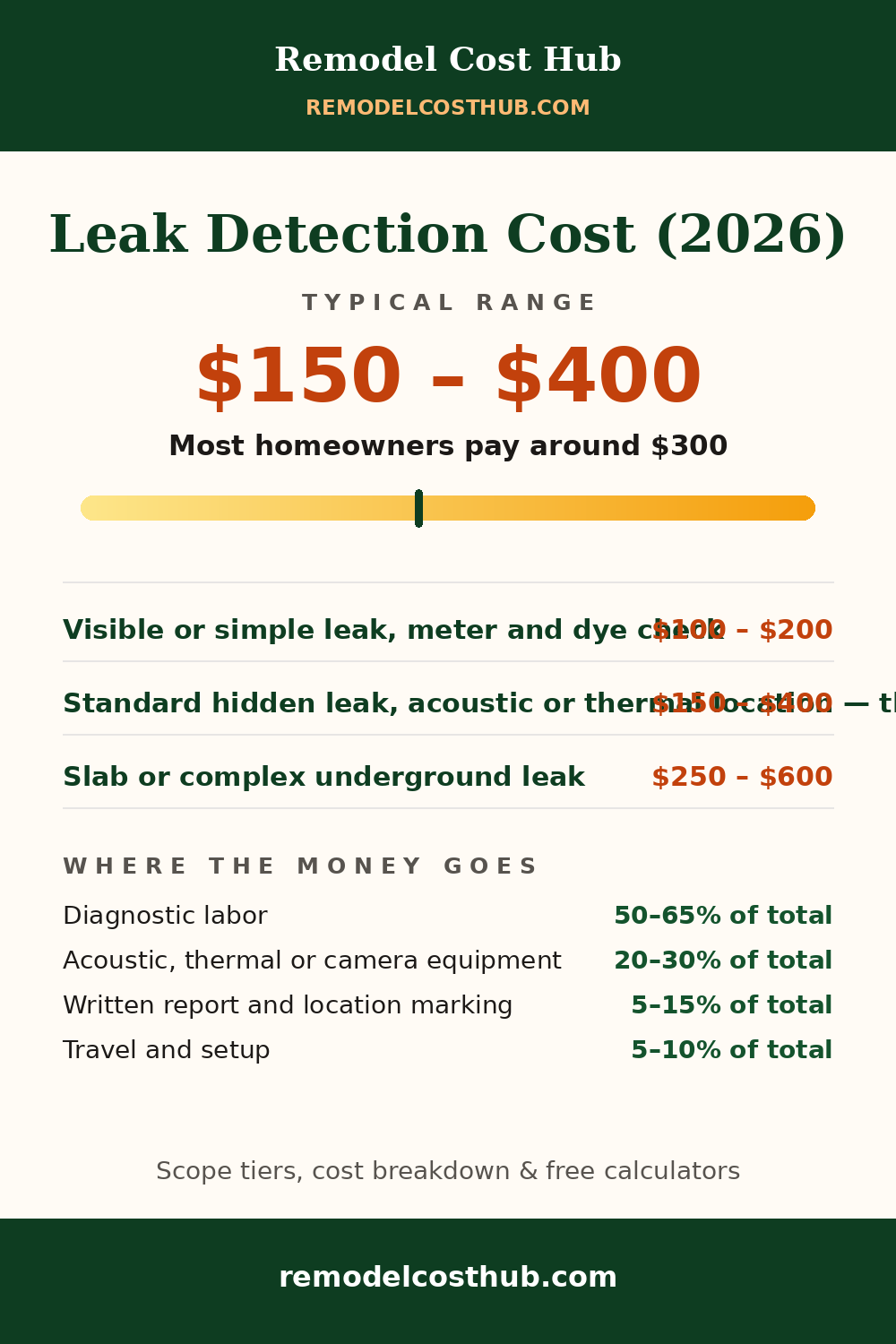
- Typical range: $150 – $400
- Most homeowners pay: around $300
- Prices vary most by: Diagnostic labor (50–65% of the budget)
Cross-checked against three published sources for this project. Sources used for this page: Angi's water leak detection guidance, updated July 15, 2026 (professional water leak detection $100–$500, by severity, location and method), HomeGuide's water-bill guide (a plumber's leak detection test $100–$400; DIY meter test free; smart water monitors $150–$500) and Benjamin Franklin Plumbing of Fort Worth's 2026 leak detection guide (professional detection $75–$500 for most homes; water leaks $75–$350; slab detection $125–$400; gas leaks $150–$500), with Bluebot's 2026 method table as method context (pressure test $150–$300, electronic detection $250–$500, comprehensive detection $400–$750). The page's typical band is the Angi–HomeGuide overlap at $150–$400, and its $300 most-pay figure sits inside all three guides' bands. Sources last checked: October 2026 — Benjamin Franklin Plumbing, HomeGuide, Angi. How we calculate these costs
Cost by scope
| Scope | Typical cost | What it includes |
|---|---|---|
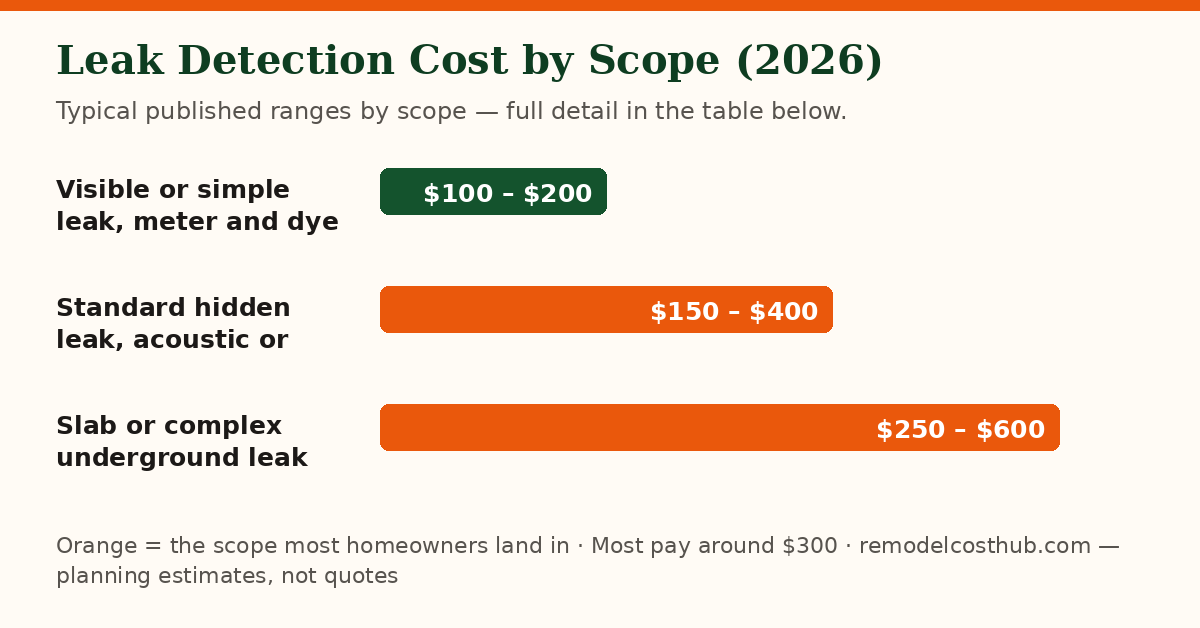
| Visible or simple leak, meter and dye check | $100 – $200 | The cheap end: a meter test and visual or dye checks locate an obvious leak — HomeGuide's $100–$400 band starts here, and a free DIY meter check can confirm a leak exists before any paid visit |
| Standard hidden leak, acoustic or thermal location — the typical job | $150 – $400 | The shared band: Angi's $100–$500 against HomeGuide's $100–$400 and Benjamin Franklin's $75–$350 water-leak band — listening device, moisture meter or thermal camera, pinpointed location and a written report |
| Slab or complex underground leak | $250 – $600 | The expensive end: Benjamin Franklin prices slab detection at $125–$400, and complex tracer-gas or multi-zone cases run higher in local guides — pressure testing, correlation and camera work |
Where the money goes
| Part of the job | Share | Note |
|---|---|---|
| Diagnostic labor | 50–65% of total | The largest share: detection is technician time with equipment, typically 1–3 hours on a standard visit — the visit, not the tool, is the bill |
| Acoustic, thermal or camera equipment | 20–30% of total | The listening gear, moisture meters and cameras that separate detection from a visual check; Bluebot's method table prices electronic detection at $250–$500 as a standalone method |
| Written report and location marking | 5–15% of total | The marked location and report the repair quote is built from — without it, the next plumber starts over |
| Travel and setup | 5–10% of total | The service-call element of the visit; some plumbers credit part of the fee toward the repair if you move forward with them |
What moves the price most
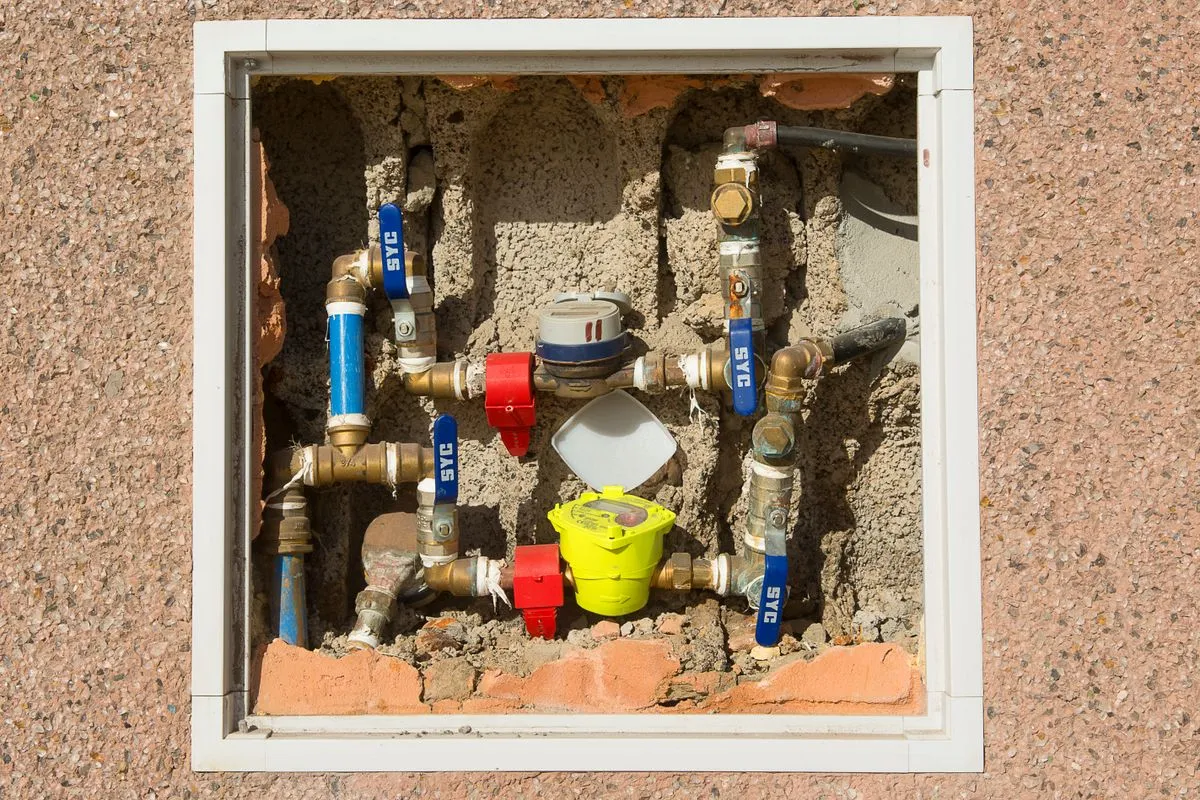
Location is first: a visible leak needs a repair quote, not a location fee, while a leak under a slab or underground needs pressure testing and correlation and prices at the top of the band. Method is second: acoustic listening, thermal imaging, moisture meters and pressure testing each suit a different leak — Bluebot's method table prices pressure testing at $150–$300 and electronic detection at $250–$500 — and a quote that never names its method cannot be compared with one that does. Access is third: buried lines, finished walls and slab foundations all add time, and slab work is the most common reason a standard visit becomes a complex one. Timing is fourth: plumber guides price emergency or after-hours visits at a 50–100% premium over standard rates, so a non-urgent drip found on a weekday prices below the same leak found at midnight. For the damage a leak leaves behind, see our water damage restoration guide, and for blocked lines that mimic leak symptoms, see our drain cleaning guide.
Worked example: how a typical leak detection budget breaks down
Take the typical job — a hidden leak in a single-family home: meter check, acoustic listening and a moisture-meter survey, the leak pinpointed and marked, written report for the repair quote. Here is a realistic $300 version of that invoice: The budget below totals $300 — the "most homeowners pay around" figure from the top of this page — split using this page's own cost breakdown. It shows how a real quote at that level is usually composed; every line is built from the ranges on this page, and it is an illustration, not a quote for your project.
| Line item | Example budget |
|---|---|
| Diagnostic labor | $180 |
| Acoustic and thermal equipment use | $70 |
| Written report and location marking | $30 |
| Travel and setup | $20 |
| Total | $300 |
What most people get wrong
- Paying for detection on a visible leak — if you can see the pipe spraying, you need a repair quote, not a location fee, and the detection visit buys nothing.
- Comparing a detection-only quote with a detection-plus-repair quote on the total — the repair is a separate job, and only the scope list makes the two comparable.
- Skipping the meter test first — a free DIY meter check confirms a leak exists before paying for location, and a meter that never moves means the problem is elsewhere.
- Treating the detection fee as the repair budget — plumber guides price slab repairs at $1,500–$4,000 once found, separate from the $150–$400 detection visit.
Costs in your city
Leak detection is plumber-labor pricing around diagnostic equipment: the same hidden leak quotes near the bottom of the band where crew rates are low and toward the top in a high-cost metro, while the listening gear travels with the technician. Housing stock travels with the city — older homes with galvanized or copper lines leak more often, and slab-foundation markets in the Sun Belt push more jobs to slab detection at the top of the band. Freeze climates add a seasonal burst-pipe pattern, and emergency timing adds a premium everywhere. Ask each bidder for the detection method named in writing, and whether the fee credits toward the repair.
Frequently asked questions
How much does leak detection cost?
Angi prices water leak detection at $100–$500, and HomeGuide prices a plumber's leak detection test at $100–$400. This page's typical band is $150–$400, with about $300 the figure most standard visits land near.
Does leak detection include the repair?
No. Detection locates the leak and reports it; the repair is a separate quote once the location is known. Some plumbers credit part of the detection fee toward the repair if you hire them for it.
How do plumbers find a hidden leak?
By method matched to the leak: acoustic listening devices for pressurized lines, thermal cameras for temperature differences, moisture meters for damp areas, pressure testing to isolate sections, and cameras for buried lines.
How much does slab leak detection cost?
Benjamin Franklin prices slab detection at $125–$400, and complex tracer-gas or multi-zone cases run higher in local guides. This page tiers slab and complex underground work at $250–$600.
Will insurance cover leak detection?
Policies typically cover sudden and accidental water damage, not slow gradual leaks or the detection visit itself. Check the policy before booking — the detection report is still the document a claim is built from.