Dryer Vent Installation cost at a glance
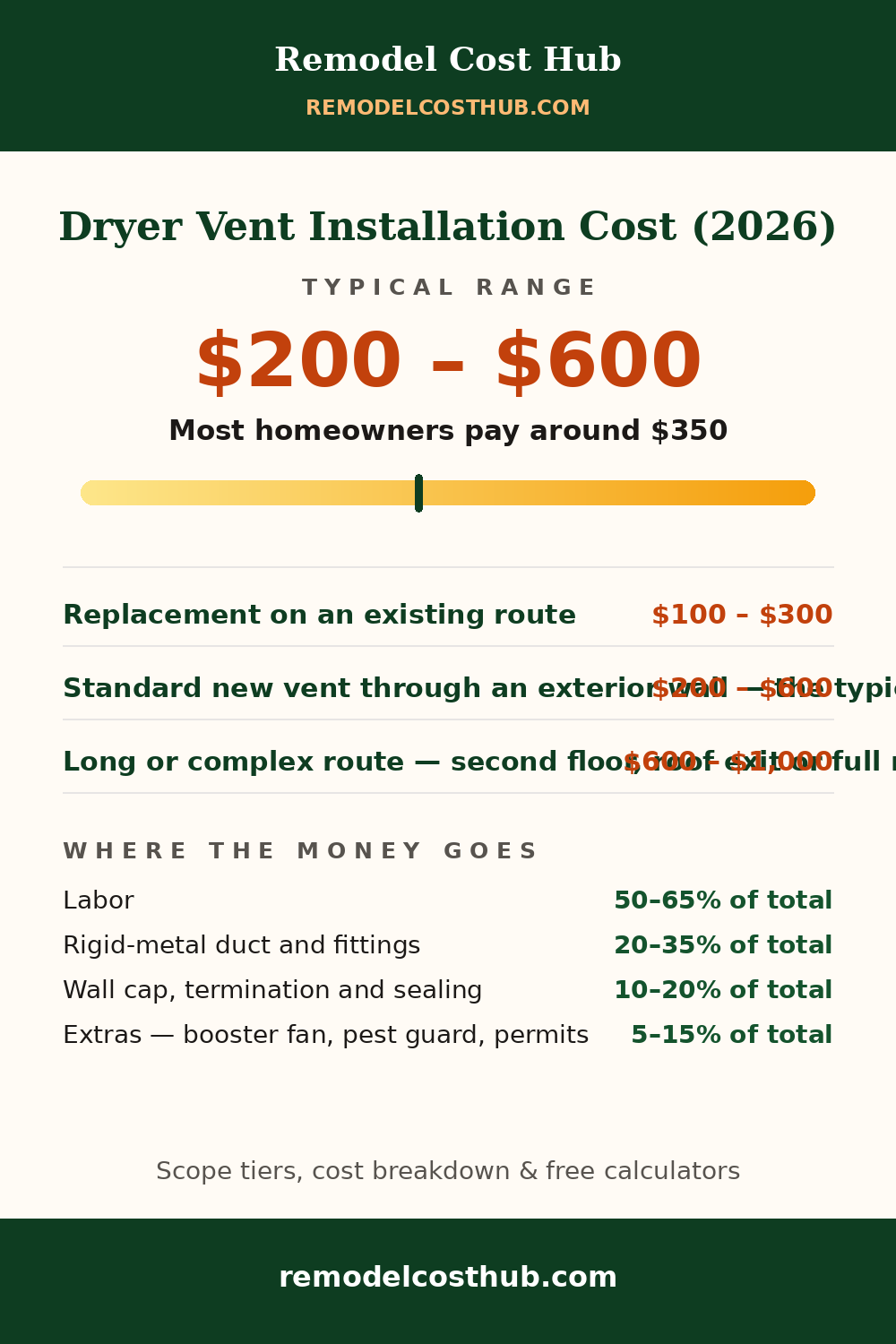
- Typical range: $200 – $600
- Most homeowners pay: around $350
- Prices vary most by: Labor (50–65% of the budget)
Cross-checked against two published sources for this project. Sources used for this page: Angi's dryer vent cost guide, updated September 10, 2026 (national average $200, most $140–$600; direct exterior-wall run $150–$300, complex and lengthy reroutes up to $1,000; metal vent about $250 installed, plastic about $175, PVC about $125; indoor vent box $100–$175; professional jobs typically two to four hours), HomeGuide's dryer vent installation cost guide (new outdoor vent $200–$800; replacement of existing ductwork $100–$300; installation labor $70–$200; vents $10–$20 per linear foot installed; indoor vent $65–$120, typically not code-compliant in most places) and Bob Vila's dryer vent installation cost guide ($80–$1,000 for labor and materials; metal vents $200–$300, plastic $150–$200). The page's typical band is the three guides' overlap at $200–$600, and its $350 most-pay figure sits inside that overlap. Sources last checked: October 2026 — HomeGuide, Angi. How we calculate these costs
Cost by scope
| Scope | Typical cost | What it includes |
|---|---|---|
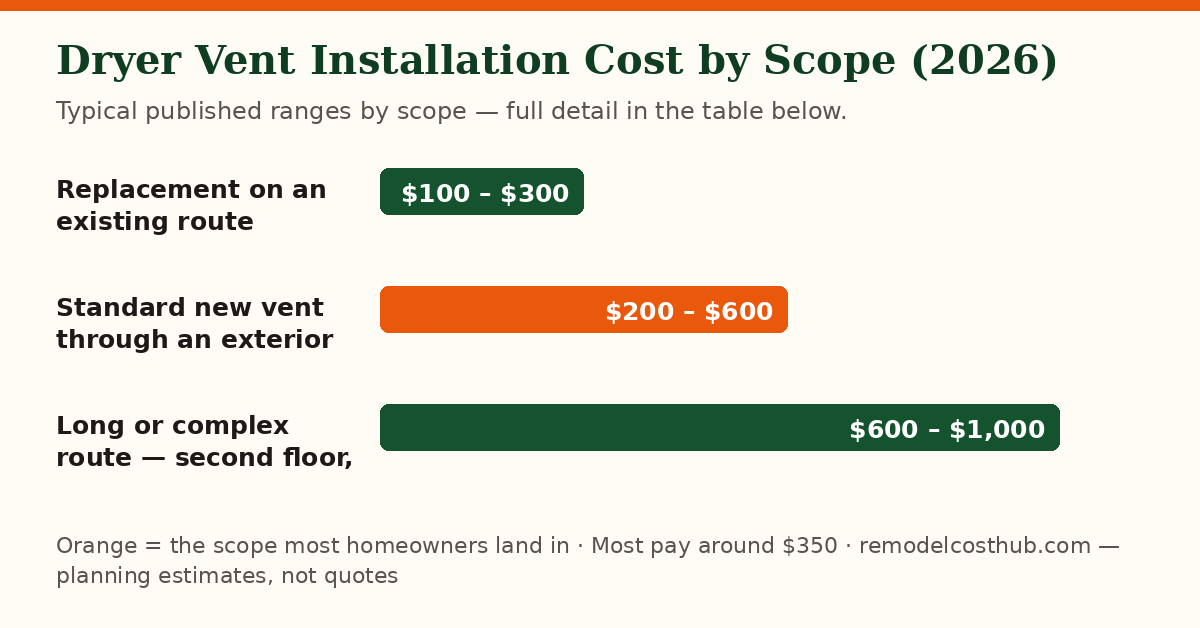
| Replacement on an existing route | $100 – $300 | The cheap end: HomeGuide prices replacing existing ductwork at $100–$300, with labor at $70–$200 — the route, wall hole and cap already exist |
| Standard new vent through an exterior wall — the typical job | $200 – $600 | The shared band: Angi's $140–$600 band against HomeGuide's $200–$800 new-vent band, for a short rigid-metal run, a new wall cap and sealed joints |
| Long or complex route — second floor, roof exit or full reroute | $600 – $1,000 | The expensive end: Angi prices complex and lengthy reroutes up to $1,000, and Bob Vila's guide runs to $1,000 for labor and materials on the hardest routes |
Where the money goes
| Part of the job | Share | Note |
|---|---|---|
| Labor | 50–65% of total | The largest share on a standard job: HomeGuide prices installation labor at $70–$200, and a second-floor or roof route adds hours, not materials |
| Rigid-metal duct and fittings | 20–35% of total | HomeGuide prices vents at $10–$20 per linear foot installed; rigid metal is the code-compliant choice, and length is what moves this line |
| Wall cap, termination and sealing | 10–20% of total | HomeGuide prices replacing a vent cover at $50–$100; a new cap, damper and exterior sealing are in every new-vent price on this page |
| Extras — booster fan, pest guard, permits | 5–15% of total | Angi prices a vent booster fan at $150–$400 and pest guards at $75–$135 each in its city guides; long runs over 25 feet are where a booster enters the quote |

What moves the price most
Route length is first: Angi prices a direct exterior-wall run at $150–$300 and a complex, lengthy reroute up to $1,000 — every bend and every extra foot is labor and duct. Material is second: Angi prices a metal vent at about $250 installed against about $175 for plastic, and plastic gets brittle with heat exposure, which is why rigid metal is the only material this page prices for a new run. Exit location is third: a ground-floor wall exit is the cheapest job in every guide; a roof exit or a second-floor dryer adds roof work, longer duct and a second person. Code is fourth: HomeGuide notes an indoor vent at $65–$120, but it is typically not code-compliant in most places because of fire and mold risk — the outdoor vent on this page is the compliant job, not the cheapest workaround. For keeping an existing vent clear, see our dryer vent cleaning guide.
Worked example: how a typical dryer vent installation budget breaks down
A typical job: a new rigid-metal vent for a dryer standing against an exterior wall — a short straight duct run, a new wall cap, sealed joints, and the old flexible hose removed. The budget below totals $350 — the "most homeowners pay around" figure from the top of this page — split using this page's own cost breakdown. It shows how a real quote at that level is usually composed; every line is built from the ranges on this page, and it is an illustration, not a quote for your project.
| Line item | Example budget |
|---|---|
| Rigid-metal duct and fittings | $80 |
| Installation labor (2–4 hours) | $200 |
| Wall cap, termination and sealing | $70 |
| Total | $350 |
What most people get wrong
- Reusing the old flexible foil hose on a new vent — the hose is the fire risk the rigid duct replaces, and keeping it keeps the risk while paying for the new run.
- Choosing the shortest-looking route through a roof or second floor instead of the direct wall exit — Angi prices the direct wall run at $150–$300 and complex routes up to $1,000, so the route decision is the budget decision.
- Comparing a $65–$120 indoor vent quote with an outdoor vent quote as if they were the same job — HomeGuide notes the indoor vent is typically not code-compliant, so the cheaper number buys a different, riskier job.
- Skipping the wall cap and sealing to shave the bill — the cap keeps pests and weather out, and an unsealed penetration is a draft and moisture path for the life of the vent.
Costs in your city
Dryer vent pricing is installer pricing: the same short wall run costs near the bottom of the band where handyperson and HVAC rates are low and well above it in high-rate metros, while the duct and cap are national retail items. Housing stock travels with the city — older homes with plaster walls, finished basements or second-floor laundry rooms take longer to route than a ground-floor dryer on an exterior wall, which is why two quotes in the same city can still differ by the route alone. Ask each bidder for the route drawing, the material (rigid metal, not foil), and whether the cap and sealing are inside the number.

Frequently asked questions
How much does it cost to install a dryer vent through a wall?
A standard new vent through an exterior wall runs $200–$600 on this page, the overlap of Angi's $140–$600 band and HomeGuide's $200–$800 new-vent band. A direct run alone is $150–$300 in Angi's guide.
What vent material should I use?
Rigid metal. Angi prices a metal vent at about $250 installed against about $175 for plastic, and notes plastic gets brittle with heat exposure; flexible foil and vinyl hoses are the fire risk that rigid duct replaces.
Can I vent my dryer indoors instead?
HomeGuide prices an indoor vent at $65–$120, but notes it typically is not code-compliant in most places because it dumps warm, damp air — and lint — into the home, with fire and mold risk. This page prices the outdoor vent only.
How long does a dryer vent installation take?
Angi puts most professional jobs at two to four hours for a standard run. Roof exits, second-floor routes and reroutes through multiple walls are the jobs that run past that.
Is replacing an old vent cheaper than a new one?
Yes — HomeGuide prices replacing existing ductwork at $100–$300, against $200–$800 for a new vent, because the wall hole, route and cap already exist and only the duct itself changes.