Wheelchair Ramp Installation cost at a glance
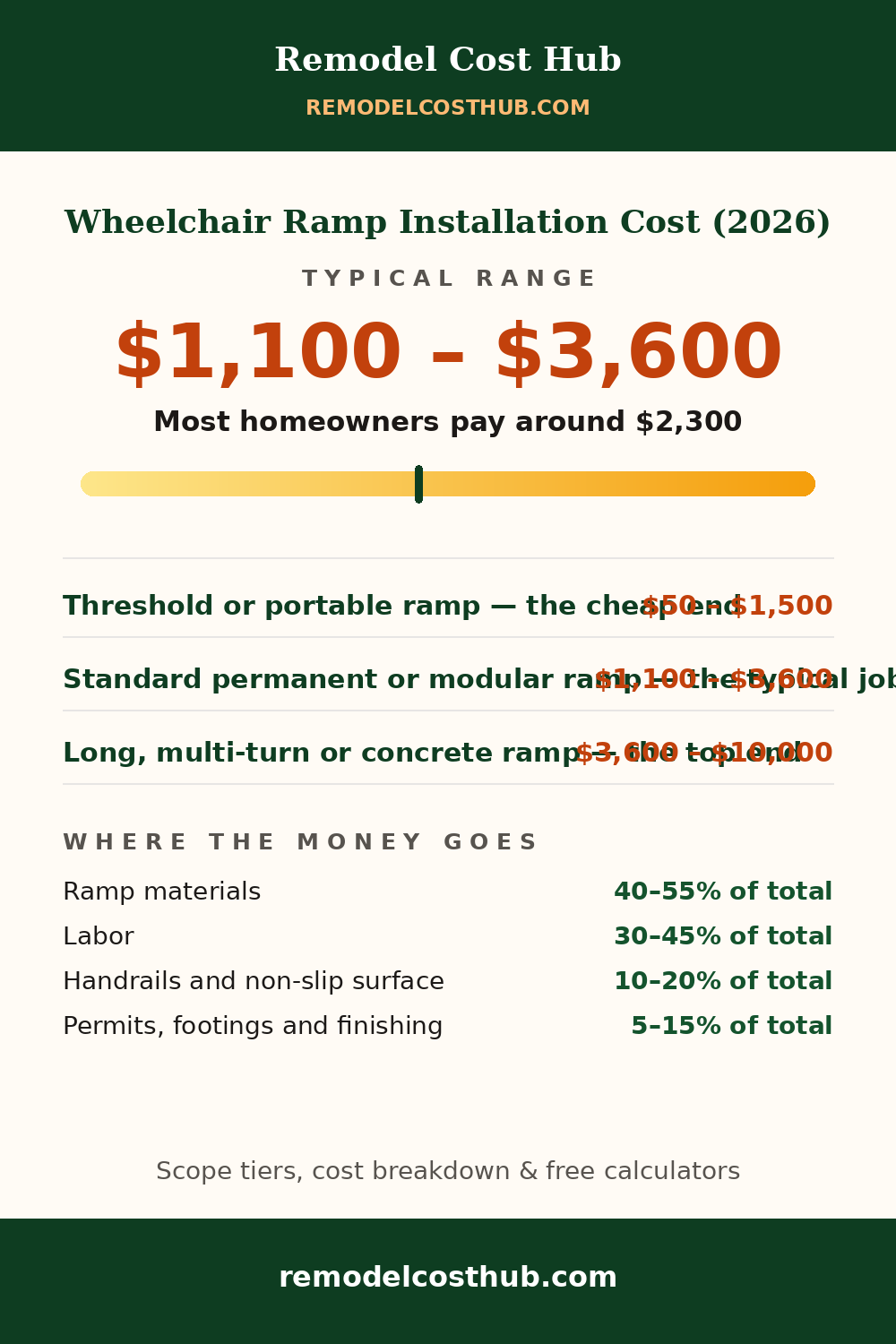
- Typical range: $1,100 – $3,600
- Most homeowners pay: around $2,300
- Prices vary most by: Ramp materials (40–55% of the budget)
Cross-checked against three published sources for this project. Sources used for this page: Angi's wheelchair ramp cost guide (updated September 11, 2026, 860 verified projects: average $2,294, most $1,123–$3,588, $100–$250 per linear foot; permits $50–$300; labor $50–$100 per hour or $50–$120 per linear foot; handrails $20–$50 per linear foot; non-slip surfaces $5–$20 per foot; sizes 6 ft $600–$1,000, 12 ft $1,200–$2,500, 24 ft $2,400–$5,000, 36+ ft $3,600–$7,500; permanent $2,000–$5,500, modular $1,500–$4,000, portable $100–$1,500, threshold $50–$500, custom $3,000–$7,500; DIY materials $500–$2,000), Mr. Handyman's wheelchair ramp guide (standard residential $1,000–$10,000; wood $1,000–$2,500, aluminum $2,000–$5,000, concrete $3,000–$10,000; commercial $3,000–$20,000 or more; 1:12 slope) and HomeAdvisor's wheelchair ramp guide (average $2,294, range $400–$6,000, $55–$275 per linear foot — the same published average as Angi, counted once, not as a second independent average; materials concrete $220–$275, wood $110–$275, aluminum $165–$220, prefabricated aluminum $110–$165, rubber $55–$165, composite $165–$220 per linear foot; permanent $1,100–$6,600, modular $440–$5,500, portable $110–$2,200; carpenters $38–$110 per hour, handyperson $66–$72 per hour; permits $30–$130; rental $110–$308 per month plus $330–$880 installation) with Fixr's porch-addition guide (wheelchair ramp section: ramp must conform to ADA guidelines, no more than 30 feet long, no more than 30 inches high at the top, $1,400–$3,000 on average). Sources last checked: October 2026 — HomeAdvisor, Fixr, Angi. How we calculate these costs
Cost by scope
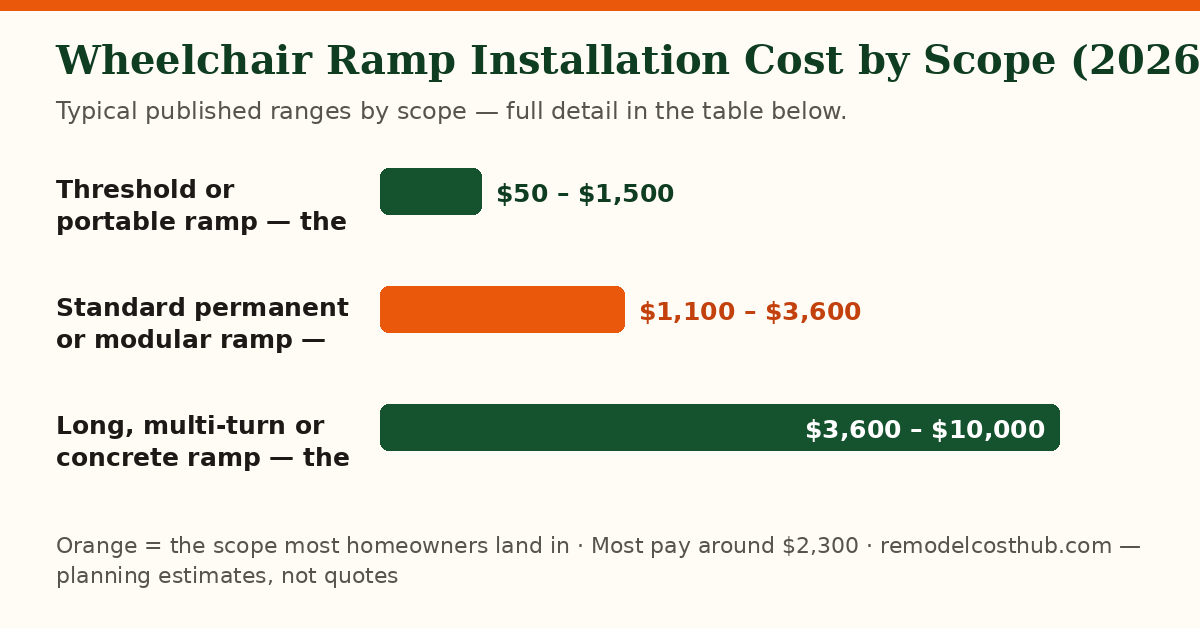
| Scope | Typical cost | What it includes |
|---|---|---|
| Threshold or portable ramp — the cheap end | $50 – $1,500 | The low end: Angi prices threshold ramps at $50–$500 and portable ramps at $100–$1,500, and HomeAdvisor prices portable ramps at $110–$2,200 — a short ramp over one step or a threshold, no footings, no handrails, which is why it prices as an accessory rather than a build |
| Standard permanent or modular ramp — the typical job | $1,100 – $3,600 | The shared band itself: Angi prices permanent ramps at $2,000–$5,500 and modular ramps at $1,500–$4,000, and its most-common band of $1,123–$3,588 is the band this page is built on — a wood or aluminum ramp up to a front door, with handrails and a non-slip surface, which is the common job |
| Long, multi-turn or concrete ramp — the top end | $3,600 – $10,000 | The expensive end: Angi prices custom ramps at $3,000–$7,500 and sizes 36 feet and up at $3,600–$7,500, while Mr. Handyman prices concrete ramps at $3,000–$10,000 and commercial work at $3,000–$20,000 or more — a high entry, a switchback with landings, or a poured-concrete ramp is what carries a job past the typical band |
Where the money goes
| Part of the job | Share | Note |
|---|---|---|
| Ramp materials | 40–55% of total | The decking and structure are the biggest line: Mr. Handyman prices wood ramps at $1,000–$2,500, aluminum at $2,000–$5,000 and concrete at $3,000–$10,000, while HomeAdvisor prices materials per linear foot at $110–$275 for wood, $165–$220 for aluminum and $220–$275 for concrete — length times material rate is the material bill |
| Labor | 30–45% of total | Angi prices labor at $50–$100 an hour or $50–$120 per linear foot, and HomeAdvisor prices carpenters at $38–$110 an hour and a handyperson at $66–$72 an hour — a straight wood ramp is a short build, while a concrete ramp or a switchback with footings and landings is several days of it |
| Handrails and non-slip surface | 10–20% of total | Angi prices handrails at $20–$50 per linear foot and non-slip surfaces at $5–$20 per foot — a ramp without handrails is cheaper and, for most users, unusable, so this line belongs in every realistic quote, not just the premium ones |
| Permits, footings and finishing | 5–15% of total | Angi prices permits at $50–$300 and HomeAdvisor at $30–$130, and footings, a landing pad and edge protection sit in this line — a portable or threshold ramp skips it entirely, while a permanent ramp with footings does not |
What moves the price most
Length is the first driver, and slope sets it: every guide uses the 1:12 slope — one foot of run for every inch of rise — so a 24-inch entry needs a 24-foot ramp before any landing, and Angi prices ramps at $100–$250 per linear foot while HomeAdvisor prices $55–$275. Material is second: Mr. Handyman prices wood at $1,000–$2,500, aluminum at $2,000–$5,000 and concrete at $3,000–$10,000, and HomeAdvisor's per-foot material rates rank the same way. Turns and landings are third: Fixr notes a ramp run of no more than 30 feet and no more than 30 inches of rise at the top, and HomeAdvisor notes a landing after 30 feet or 30 inches of rise — a high entry that needs a switchback pays for landings as well as length. Handrails and surface are fourth: Angi prices handrails at $20–$50 per linear foot and non-slip surfaces at $5–$20 per foot, and a ramp in a wet climate needs both. Permits are fifth: Angi prices them at $50–$300 and HomeAdvisor at $30–$130, and a permanent ramp in a jurisdiction that requires one cannot skip the line. Finally, rental versus build: HomeAdvisor prices rental at $110–$308 a month plus $330–$880 installation, so a temporary need can price below a permanent build.
Costs in your city
Labor is the biggest variable in any remodel, and labor is local — the same bathroom can price very differently in Houston than in Boston. We are adding city editions metro by metro, each with its own labor index, permit notes and climate factors, written for that city rather than copied from this page. Wave 1: Houston, Dallas–Fort Worth, Phoenix, Atlanta, Miami–South Florida, Orlando, Tampa, Charlotte, Austin and San Antonio. Until your city's page is live, use the national range here and weight it the way contractors do: Sun Belt labor often prices near or below the national middle, while coastal California and the Northeast metros often price well above it.
Frequently asked questions
How much does wheelchair ramp installation cost?
Typically $1,100–$3,600 for a standard permanent or modular ramp, with about $2,300 the figure most jobs land near. Angi averages $2,294 across 860 verified projects with most jobs at $1,123–$3,588, Mr. Handyman prices a standard residential ramp at $1,000–$10,000, and Fixr prices a ramp added to a porch job at $1,400–$3,000 — the three guides agree on the typical band.
How long does a wheelchair ramp need to be?
Twelve feet of run for every foot of rise: every guide uses the 1:12 slope, so a 24-inch entry needs a 24-foot ramp before any landing, and a 36-inch entry needs 36 feet. That is why a high front door prices above a low one — length is the bill, at $100–$250 per linear foot on Angi — and why a high entry often needs a switchback with landings rather than one straight run.
Wood, aluminum or concrete — which ramp material is cheapest?
Wood, on purchase price: Mr. Handyman prices wood ramps at $1,000–$2,500, aluminum at $2,000–$5,000 and concrete at $3,000–$10,000, and HomeAdvisor's per-foot material rates rank the same way. Wood needs sealing and board replacement over time, aluminum is lighter and lower-maintenance, and concrete lasts longest but needs footings and curing time — the cheapest material is not always the cheapest ramp over its life.
Do I need a permit for a wheelchair ramp?
For a permanent ramp, usually yes and cheaply: Angi prices permits at $50–$300 and HomeAdvisor at $30–$130. A portable or threshold ramp needs no permit in most jurisdictions because it is not a structure — but a permanent ramp with footings is, so check with the building department before the build, not after.
Can I build a wheelchair ramp myself?
A short wood ramp, sometimes: Angi prices DIY materials at $500–$2,000, against $1,100–$3,600 for a typical professional job. The DIY saving is the labor line, but the slope, landing and handrail rules still apply — a ramp that is too steep, too narrow or missing handrails is a hazard, not a bargain, so a long, high or concrete ramp is pro work.
Does Medicare pay for a wheelchair ramp?
The guides disagree, so this page does not promise it: HomeAdvisor notes Medicare may reimburse a ramp when it is medically necessary and that some Medicare Advantage plans cover it, while other guidance says standard Medicare generally does not pay for home modifications. Check the specific plan and get the answer in writing before budgeting around a reimbursement that may not come.