Retaining Wall Repair cost at a glance
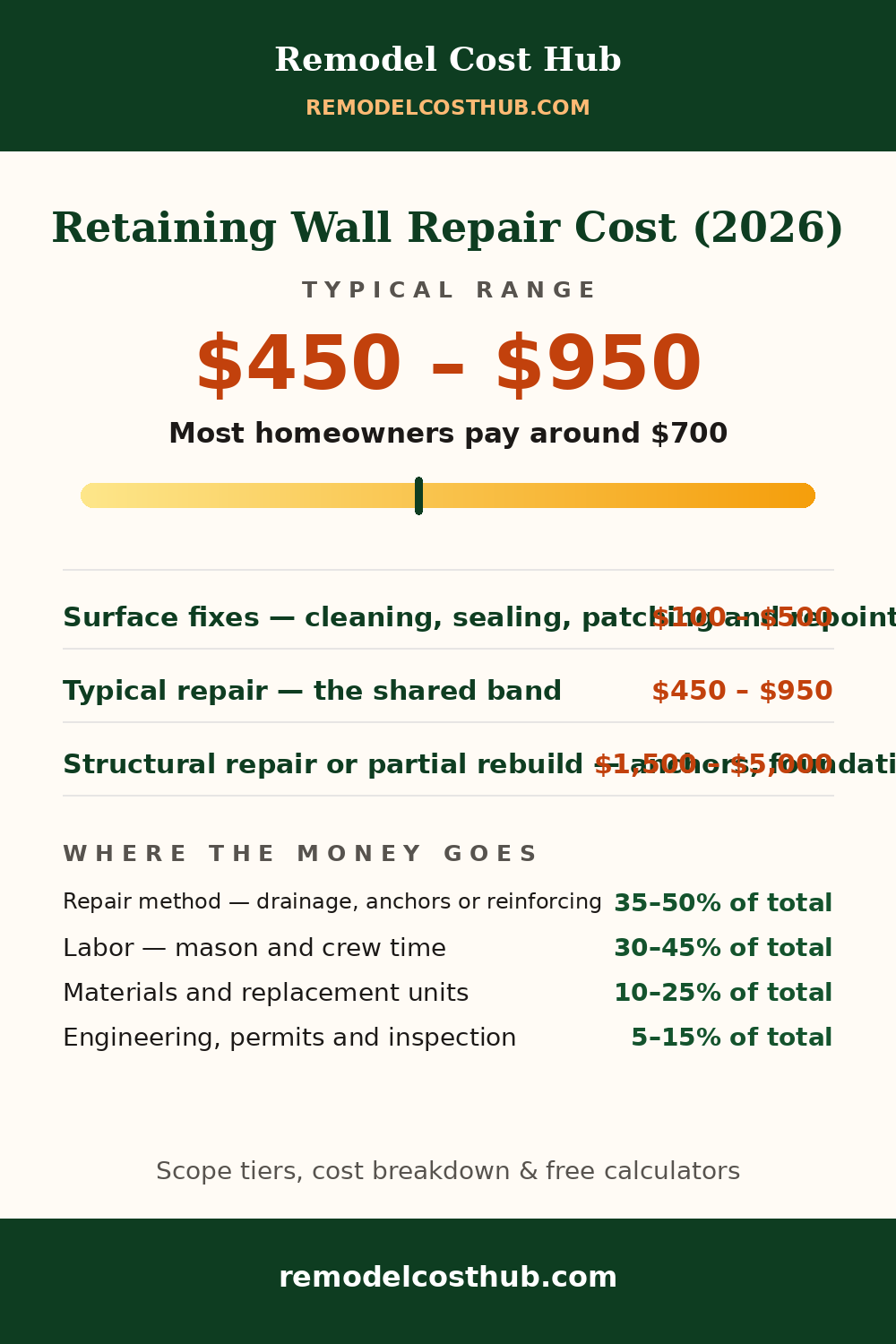
- Typical range: $450 – $950
- Most homeowners pay: around $700
- Prices vary most by: Repair method — drainage, anchors or reinforcing (35–50% of the budget)
Cross-checked against two published sources for this project. Sources used for this page: Angi's retaining wall repair cost guide (national average $700, most homeowners $450–$950; by problem efflorescence $220–$480, leaking or seeping $220–$990, cracking and crumbling $335–$1,100, shifted foundation $650–$1,200, bowing or leaning $275–$1,200; drainage pipes $50–$80 per square foot, weep holes $60–$75, backfill $6–$25 per cubic yard, base thickening $60–$90, anchoring $60–$80, bowing correction $65–$85 per square foot, rebar $2.50–$5 per square foot, footings $18–$50 per linear foot, engineer $100–$220 per hour, demolition $10–$20 per linear foot or $2,200–$4,500; repair beats replacement when repairs run 50–75% less than a new build; new wall $3,203–$9,208), HomeGuide's retaining wall repair cost guide (repairs $100–$1,500 total, $10–$150 per square foot; leaning or bowing $200–$1,500, leaking or seeping $100–$1,000, cracking or crumbling $150–$1,000, efflorescence $150–$800, foundation $40–$75 per linear foot; by material wood $10–$40, stone $10–$85, block $15–$55, metal $15–$150, concrete or cinder block $20–$45, brick $30–$60 per square foot; drainage $50–$80, anchors $60–$80, reinforcing and straightening $50–$80 per square foot; footings $18–$55 per linear foot, rebar $2.50–$5 or more per square foot, delivery $30–$100 per truckload, backfill $5–$25 per cubic yard, permits $50–$450, inspection $150–$300, labor $50–$75 per hour, engineer $100–$220 per hour; rebuild $6,000–$14,000 for a 50-foot by 4-foot wall, demolition $2,000–$4,000, new wall $4,000–$10,000) and EngineerFix's retaining wall repair guide (moderate repair average around $700; minor sealing, patching or tuckpointing $150–$500; drainage system $70–$90 per square foot of wall face or $800–$2,500 for a comprehensive system; helical anchors $60–$80 per linear foot, severe bowing $1,500–$5,000; partial rebuild $70–$250 per linear foot or $1,500–$4,000 per section; labor $50–$200 per hour; replacement $3,500–$12,000 or more; replacement threshold when repair approaches 50–75% of a new wall; cracks wider than a quarter-inch or lean over six inches suggest the wall is beyond repair. Sources last checked: October 2026 — HomeGuide, Angi. How we calculate these costs
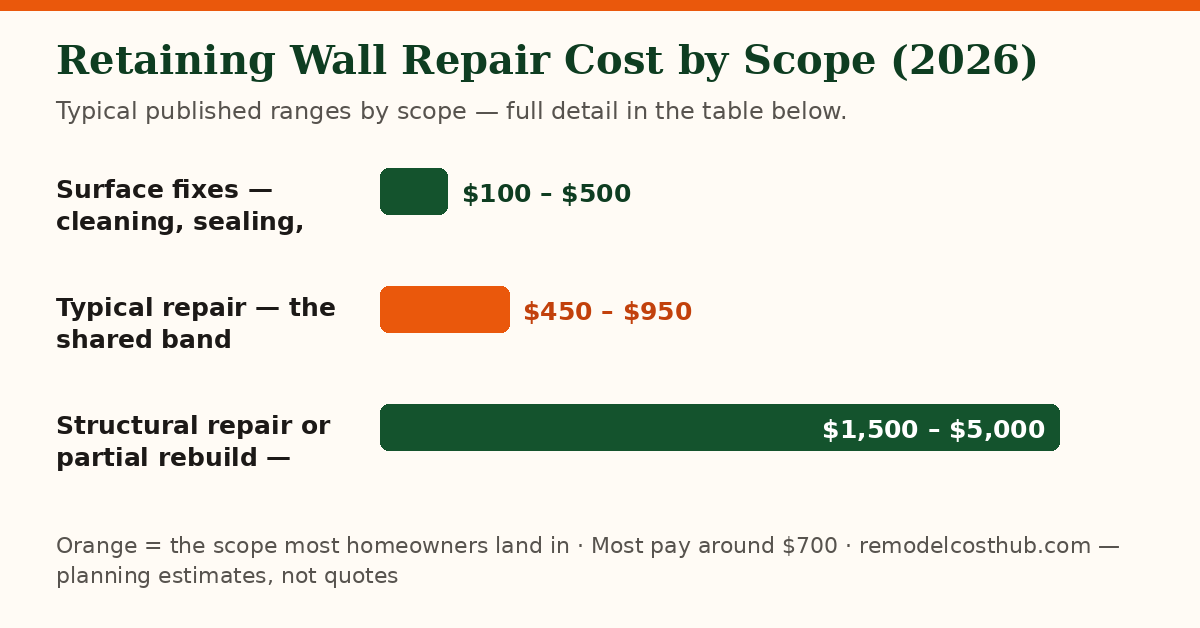
Cost by scope
| Scope | Typical cost | What it includes |
|---|---|---|
| Surface fixes — cleaning, sealing, patching and repointing | $100 – $500 | The cheap end: HomeGuide prices minor repairs from $100 and EngineerFix prices sealing, patching or tuckpointing at $150–$500, with Angi pricing efflorescence treatment at $220–$480 and surface cleaning from $18–$35 |
| Typical repair — the shared band | $450 – $950 | The shared band itself: Angi's most-pay band with a $700 average, covering a localized drainage, crack or leaning repair on a standard residential wall |
| Structural repair or partial rebuild — anchors, foundation work, section replacement | $1,500 – $5,000 | The expensive end: EngineerFix prices severe bowing work at $1,500–$5,000 and a localized section rebuild at $1,500–$4,000, while a full demolition and rebuild runs $6,000–$14,000 at HomeGuide — a different job, priced separately |
Where the money goes
| Part of the job | Share | Note |
|---|---|---|
| Repair method — drainage, anchors or reinforcing | 35–50% of total | HomeGuide prices adding drainage, anchors and reinforcing each at $50–$80 per square foot, and Angi prices drainage pipes at $50–$80 and anchoring at $60–$80 per square foot — the fix follows the diagnosis, not the budget |
| Labor — mason and crew time | 30–45% of total | HomeGuide prices mason and wall-contractor labor at $50–$75 per hour, and EngineerFix prices professional labor at $50–$200 per hour — height, length and access set the hours |
| Materials and replacement units | 10–25% of total | Angi prices wall materials per square foot at $15–$45 for natural stone, $18–$50 for block stone, $8–$18 for brick and $11–$29 for concrete or cinder block, and rebar at $2.50–$5 per square foot |
| Engineering, permits and inspection | 5–15% of total | Angi prices a structural engineer at $100–$220 per hour and permits at $50–$200 where they apply, and HomeGuide prices permits at $50–$450 with inspections at $150–$300 every 3–5 years |

What moves the price most
Damage type is the first driver: Angi prices efflorescence at $220–$480, leaking at $220–$990, cracking at $335–$1,100, a shifted foundation at $650–$1,200 and bowing at $275–$1,200, and HomeGuide prices the same problems at $150–$800, $100–$1,000, $150–$1,000, $40–$75 per linear foot and $200–$1,500 — surface problems are cheap, movement is not. Material is second, and the guides disagree: Angi prices brick repair at $8–$18 and concrete at $11–$29 per square foot while HomeGuide prices brick at $30–$60 and concrete at $20–$45 — both agree stone and metal span widest, at $10–$85 and $15–$150 at HomeGuide. Drainage is the root cause most often: HomeGuide and Angi both price adding drainage at $50–$80 per square foot, and EngineerFix prices a comprehensive drainage system at $800–$2,500 — waterlogged soil weighs up to 50% more than dry soil, so a wall repaired without drainage fails again. Height, length and access close the bill: walls over 4 feet usually need engineering and permits, and EngineerFix warns that a crack wider than a quarter-inch or a lean over six inches usually means the wall is beyond repair.
Costs in your city
Labor is the biggest variable in any remodel, and labor is local — the same bathroom can price very differently in Houston than in Boston. We are adding city editions metro by metro, each with its own labor index, permit notes and climate factors, written for that city rather than copied from this page. Wave 1: Houston, Dallas–Fort Worth, Phoenix, Atlanta, Miami–South Florida, Orlando, Tampa, Charlotte, Austin and San Antonio. Until your city's page is live, use the national range here and weight it the way contractors do: Sun Belt labor often prices near or below the national middle, while coastal California and the Northeast metros often price well above it.
Frequently asked questions
How much does retaining wall repair cost?
Typically $450–$950, with about $700 the most-pay figure. Angi puts the national average at $700 with most homeowners paying $450–$950, and HomeGuide publishes a wider $100–$1,500 band covering everything from minor patches to foundation work.
How much does it cost to fix a leaning retaining wall?
Angi prices bowing or leaning repairs at $275–$1,200 overall and anchoring at $60–$80 per square foot, while EngineerFix prices helical anchors at $60–$80 per linear foot and severe bowing work at $1,500–$5,000. A slight lean can be anchored; EngineerFix warns a lean over six inches usually means rebuild, not repair.
How much does fixing retaining wall drainage cost?
HomeGuide and Angi both price adding drainage at $50–$80 per square foot, covering drain pipes or weep holes, while EngineerFix prices a comprehensive drainage system at $800–$2,500. Drainage is usually the root cause: water behind the wall is what pushed it out of shape.
When should a retaining wall be replaced instead of repaired?
When repair approaches 50–75% of a new wall, per EngineerFix, or when Angi's test fails — repairs should run 50–75% less than a new build to be worth doing. HomeGuide prices a full demolition and rebuild at $6,000–$14,000 for a 50-foot by 4-foot wall, against $450–$950 for a typical repair.
Do I need a permit to repair a retaining wall?
Usually not for a repair. HomeGuide notes most cities require a permit only for a new wall over four feet, and Angi prices repair permits at $50–$200 where they apply — but a repair that changes the footprint, height or structure can trigger one, so check before work starts.
Can I repair a retaining wall myself?
HomeGuide says minor repairs are possible for an experienced owner, but insists an expert examine the wall first, since inadequate repairs cost more later. EngineerFix adds that block walls are the most DIY-friendly while poured concrete and natural stone need specialist patching and repointing — and any leaning wall needs an engineer before anyone digs.