Pool Fence Installation cost at a glance
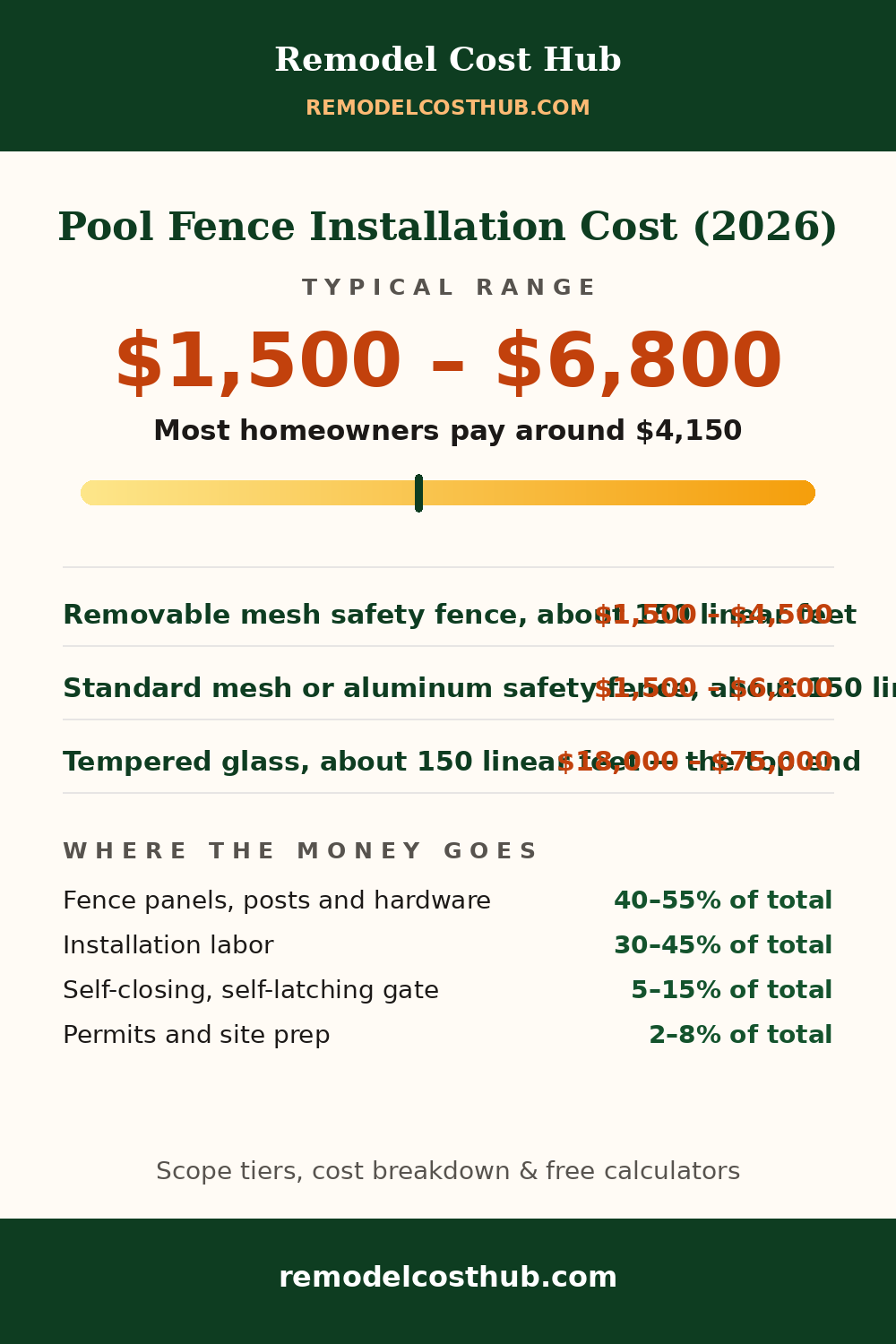
- Typical range: $1,500 – $6,800
- Most homeowners pay: around $4,150
- Prices vary most by: Fence panels, posts and hardware (40–55% of the budget)
Cross-checked against three published sources for this project. Sources used for this page: HomeGuide's pool fence cost guide (average $10–$45 per linear foot installed, national average $7,800, average range $2,000–$13,500 for 200–300 linear feet; 150 feet $1,500–$6,800, 100 feet $1,000–$4,500, 300 feet $3,000–$13,500; mesh $10–$30, black chain link $10–$29, galvanized steel $10–$15, wood $20–$40, aluminum $30–$45, vinyl $30–$45, plexiglass $25–$40, wrought iron $50–$85, tempered glass $120–$500 per linear foot; gates $200–$800; permit $40–$150; most fences 4–5 feet tall, 48 inches most common, no more than 4 inches under the bottom rail; install 2 hours to 2 days), Bob Vila's pool fence cost guide, citing HomeAdvisor and Angi (typical $1,500–$10,000, national average $6,500) and HomeGnome's pool fence cost guide ($17–$34 per linear foot, average $25.50; mesh $8–$15, aluminum $23–$40; budget $1,700–$5,100, premium $3,400–$10,200) — the page's typical band is HomeGuide's 150-foot table, and its $4,150 most-pay figure is the midpoint of that band, stated as such. Sources last checked: October 2026 — HomeAdvisor, HomeGuide, Angi. How we calculate these costs
Cost by scope
| Scope | Typical cost | What it includes |
|---|---|---|
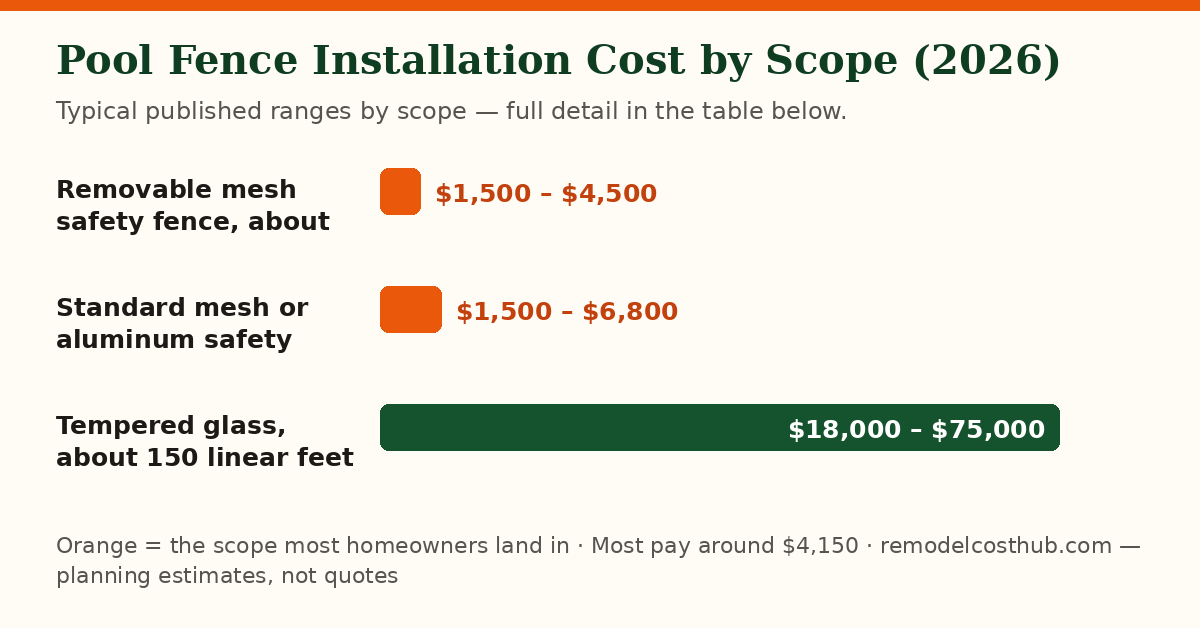
| Removable mesh safety fence, about 150 linear feet | $1,500 – $4,500 | The cheap end: HomeGuide prices mesh at $10–$30 per linear foot installed, or $1,500–$4,500 for 150 feet — soft, hard to climb, removable, and the most common child-safety choice |
| Standard mesh or aluminum safety fence, about 150 linear feet — the typical job | $1,500 – $6,800 | The shared band itself: HomeGuide's 150-foot table at $10–$45 per linear foot — mesh at the low end, aluminum at $30–$45 and vinyl at $30–$45 at the top, with a self-closing gate and code height included |
| Tempered glass, about 150 linear feet — the top end | $18,000 – $75,000 | The expensive end: HomeGuide prices tempered glass at $120–$500 per linear foot installed, or $18,000–$75,000 for 150 feet — a clear view and a hard-to-climb panel, at several times the aluminum price |
Where the money goes
| Part of the job | Share | Note |
|---|---|---|
| Fence panels, posts and hardware | 40–55% of total | The material: HomeGuide's per-foot table runs from mesh at $10–$30 to aluminum at $30–$45 and glass at $120–$500 — material choice alone moves this line more than any other factor |
| Installation labor | 30–45% of total | The work: setting posts and anchors, hanging panels and fitting gates — HomeGuide puts a straightforward install at 2 hours to 2 days, with concrete work, regrading or custom materials pushing it longer |
| Self-closing, self-latching gate | 5–15% of total | The safety hardware: HomeGuide prices a magnetic self-closing, self-locking gate at $200–$800 when it is not already included in the estimate — the latch, not the panel, is what keeps the barrier compliant |
| Permits and site prep | 2–8% of total | The paperwork and ground: HomeGuide prices a fence permit at $40–$150, and grading at $500–$5,000 when the ground needs leveling before posts go in |
What moves the price most
Material is the first fork. HomeGuide's table spans mesh at $10–$30, black chain link at $10–$29, aluminum at $30–$45, vinyl at $30–$45 and tempered glass at $120–$500 per linear foot installed — the same 150 feet can cost $1,500 or $75,000 on material alone. Code height is the second fork: most pool fences must be 4 to 5 feet tall with no more than 4 inches between the bottom of the fence and the ground, and 48 inches is the most common height in HomeGuide's guide — a short guardrail is not a compliant barrier. Gates are the third fork: a self-closing, self-latching gate is a code item, not an accessory, and HomeGuide prices it at $200–$800 when it is not bundled. Finally, length is the multiplier: HomeGuide's size table runs from $1,000–$4,500 for 100 feet to $3,000–$13,500 for 300 feet, so measuring the true perimeter — not the pool's edge — is what sets the total.
Costs in your city
Labor is the biggest variable in any remodel, and labor is local — the same bathroom can price very differently in Houston than in Boston. We are adding city editions metro by metro, each with its own labor index, permit notes and climate factors, written for that city rather than copied from this page. Wave 1: Houston, Dallas–Fort Worth, Phoenix, Atlanta, Miami–South Florida, Orlando, Tampa, Charlotte, Austin and San Antonio. Until your city's page is live, use the national range here and weight it the way contractors do: Sun Belt labor often prices near or below the national middle, while coastal California and the Northeast metros often price well above it.
Frequently asked questions
Do I legally need a fence around my pool?
In HomeGuide's guide, all states except Alaska, Colorado and Delaware require one, and some waive it only with a pool cover or a fenced yard — height and latch rules still vary by city, so check local codes before building.
How tall must a pool fence be?
Most pool fences are 4 to 5 feet tall in HomeGuide's guide, with 48 inches the most common height, and no more than 4 inches of space between the bottom of the fence and the ground.
What fence material is best for a pool?
It depends on the priority in HomeGuide's guide: mesh and tempered glass are hardest to climb, mesh, chain link, wood and galvanized steel are cheapest, and aluminum is the standard permanent choice at $30–$45 per linear foot.
How long does pool fence installation take?
2 hours to 2 days in HomeGuide's guide — a mesh fence on a finished deck is the fast end, and concrete work, regrading or custom materials push it to the slow end.
How much does a pool fence gate cost?
$200–$800 for a magnetic self-closing, self-locking gate in HomeGuide's guide when it is not included in the installer's estimate.
Mesh or aluminum for a pool fence?
Mesh at $10–$30 per linear foot in HomeGuide is removable, soft and hard to climb but less durable; aluminum at $30–$45 is permanent, easy to install and the material contractors prefer to fit while a concrete pool deck is being poured.