Air Duct Cleaning cost at a glance
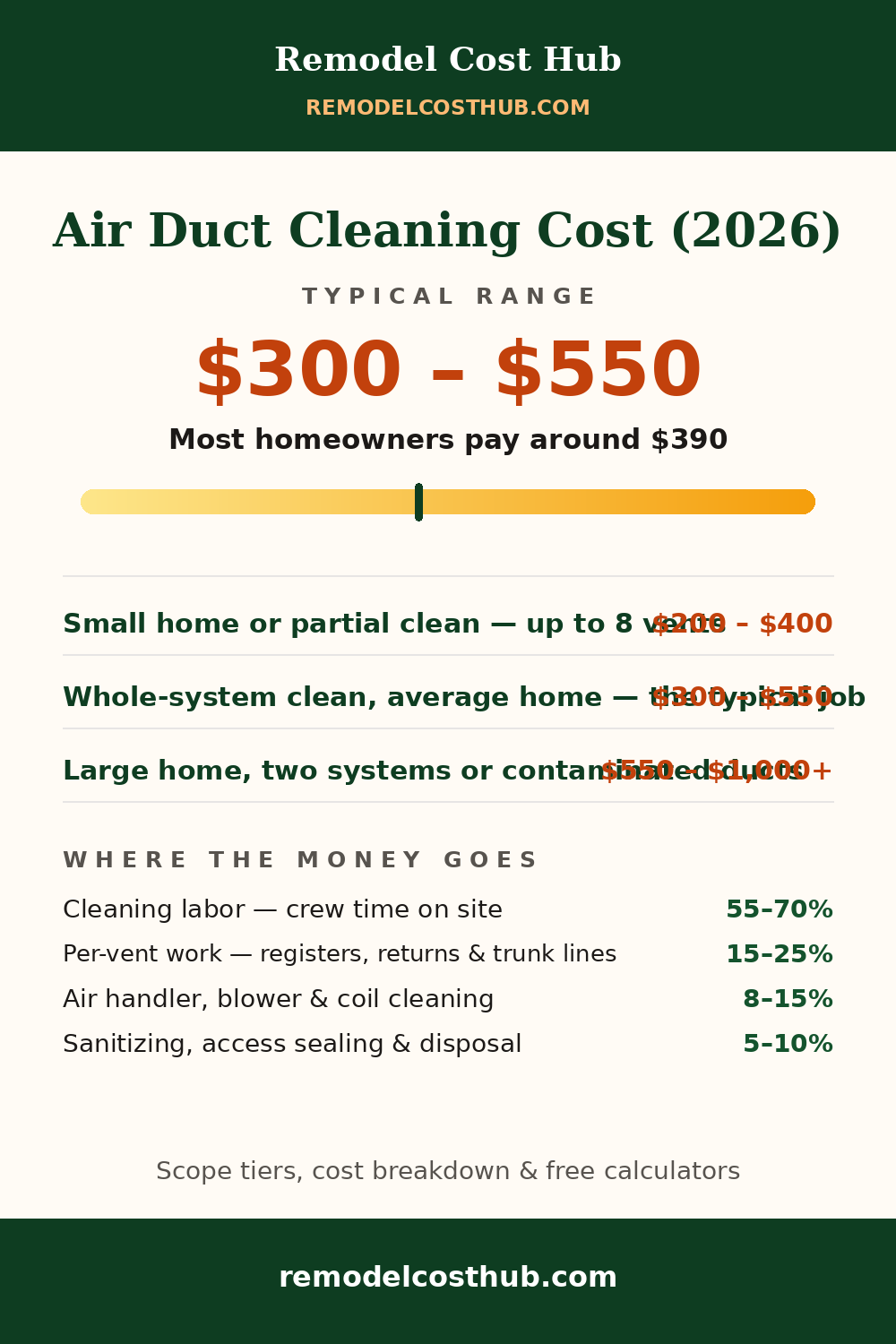
- Typical range: $300 – $550
- Most homeowners pay: around $390
- Per square foot: $0.15 – $0.30 per sq ft
- Prices vary most by: Cleaning labor — crew time on site (55–70% of the budget)
Cross-checked against three published sources for this project. Sources used for this page: the Angi air duct cleaning cost guide, HomeGuide's air duct cleaning cost data and Thumbtack's air duct cleaning cost guide. Sources last checked: October 2026 — HomeGuide, Angi, Thumbtack. How we calculate these costs
Cost by scope
| Scope | Typical cost | What it includes |
|---|---|---|
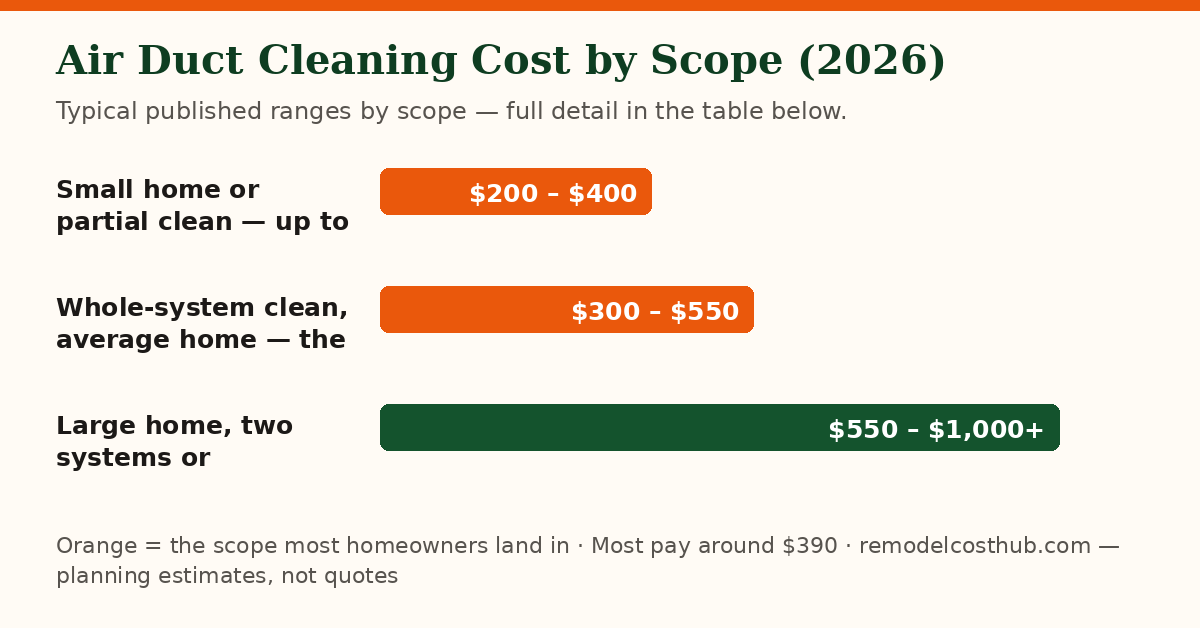
| Small home or partial clean — up to 8 vents | $200 – $400 | Angi prices 8 vents at $200–$400 and a 1,000 sq ft home at $140–$250, and Thumbtack's low end runs to $109 for the smallest jobs. Fewer vents and a single system are what keep this tier low. |
| Whole-system clean, average home — the typical job | $300 – $550 | The typical project on this page. Angi averages about $380–$389 with most homeowners paying $270–$500; HomeGuide prices the average house at $300–$700; Thumbtack ranges $225–$619 with most people paying around $374. |
| Large home, two systems or contaminated ducts | $550 – $1,000+ | HomeGuide runs to $1,000 for larger homes or heavier contamination and Thumbtack's high end reaches $1,244. A second air handler, mold treatment or post-renovation debris is what is being bought in this tier. |
Where the money goes
| Part of the job | Share | Note |
|---|---|---|
| Cleaning labor — crew time on site | 55–70% | Angi prices duct-cleaning labor at $90–$125 an hour, and a thorough whole-system job takes three to eight hours — the crew, the negative-pressure vacuum and the agitation brushes are the product being bought |
| Per-vent work — registers, returns & trunk lines | 15–25% | The unit every guide prices: about $35 a vent in Angi, inside a $25–$50 band there and $25–$45 in HomeGuide. Return vents sit at the top of the band because they carry the heaviest dust load |
| Air handler, blower & coil cleaning | 8–15% | Thumbtack's scope for a full service includes the coils, drain pan, blower and motor assembly — a ducts-only quote that skips the handler leaves the dirtiest component in the system untouched |
| Sanitizing, access sealing & disposal | 5–10% | Optional antimicrobial treatment, sealing and re-insulating the access holes the crew cuts, and hauling out what the vacuum collected — the lines to itemize before you sign, not after |
What moves the price most
Vent count is the quote. Angi prices about $35 per vent inside a $25–$50 band and HomeGuide $25–$45, so a 12-vent home and a 20-vent home are different jobs before anything else is discussed — count your registers and returns before you compare bids. Square footage reconciles it: Angi prices $0.15–$0.30 per square foot of living space and HomeGuide $0.15–$0.25, with Angi's size table running from $140–$250 at 1,000 sq ft to $450–$900 at 3,000. Contamination reprices everything — mold, vermin or renovation dust turns a maintenance clean into remediation, which is why HomeGuide's band runs to $1,000. Access is the quiet adder: flex ducts need gentler equipment than rigid metal, and ducts buried in finished ceilings or crawlspaces add labor hours at $90–$125. And the honest frequency note: the EPA does not recommend duct cleaning as routine maintenance — it is worth its price when there is visible mold, infestation or heavy debris, not as an annual ritual.
Worked example: how a typical air duct cleaning budget breaks down
Take the typical job — a whole-system clean of an average two-story home with about 12 vents and one air handler. Here is a realistic $390 version of that invoice, inside every dataset's average cluster: The budget below totals $390 — the "most homeowners pay around" figure from the top of this page — split using this page's own cost breakdown. It shows how a real quote at that level is usually composed; every line is built from the ranges on this page, and it is an illustration, not a quote for your project.
| Line item | Example budget |
|---|---|
| Whole-system cleaning labor — crew, vacuum & brushes | $250 |
| Air handler, blower & coil cleaning | $70 |
| Sanitizing treatment | $40 |
| Access sealing, filters & disposal | $30 |
| Total | $390 |
What most people get wrong
- Buying the $99 whole-house special. Thumbtack's low end is $109 and Angi's labor alone runs $90–$125 an hour for a three-to-eight-hour job — a sub-$100 quote is a vent-face wipe with an upsell attached, not a system clean.
- Counting only the supply vents. Returns carry the dust load and price higher — $40–$75 each in the published per-vent data against $25–$50 for supplies. A quote counted on supplies alone is undercounted by design.
- Booking it as a yearly ritual. The EPA does not recommend routine duct cleaning; HomeGuide's interval is every three to seven years with a reason — mold, vermin or renovation debris. Paying annually buys the truck's visit, not cleaner air.
- Letting the crew skip the air handler. Thumbtack's full scope includes coils, blower and drain pan. Ducts cleaned into a dirty handler re-contaminate on the first cycle.
Costs in your city
Duct cleaning is labor at $90–$125 an hour, so it tracks local HVAC wages more than materials: the same 12-vent system prices near Angi's $270 floor in low-wage markets and toward HomeGuide's $700 top in the big coastal metros. House stock matters the same way — older Northeastern and Midwestern homes with long metal trunk lines clean slower than newer Sun Belt homes with short flex runs, and flex itself needs gentler, slower equipment. Humid-climate cities add the mold question: a Gulf Coast quote that includes antimicrobial treatment is not padding, it is the local scope. Everywhere, the vent count is the vent count — count yours, multiply by roughly $35, and any quote far from that product owes you an explanation in writing.
How we got these numbers
Cross-checked against the Angi air duct cleaning cost guide (most homeowners paying $270–$500, averages about $380–$389; about $35 per vent inside $25–$50; $0.15–$0.30 per square foot; labor $90–$125 an hour), HomeGuide's air duct cleaning cost data (average house $300–$700, up to $1,000; $25–$45 per vent; $0.15–$0.25 per square foot) and Thumbtack's air duct cleaning cost guide (national range $225–$619, most people paying around $374, high end $1,244). The typical band published here is the overlap of the three; the most-pay figure sits between Angi's and Thumbtack's averages. Checked October 2026. Full method: How We Estimate Costs.
Frequently asked questions
How much does air duct cleaning cost on average?
Angi averages about $380–$389 with most homeowners paying $270–$500, Thumbtack averages around $374 inside a $225–$619 national range, and HomeGuide prices the average house at $300–$700. Three datasets land in the same place: budget about $390 for a whole-system clean of an average home.
How much does duct cleaning cost per vent?
About $35 per vent in Angi, inside a $25–$50 per-vent band; HomeGuide prices $25–$45 per vent. Return vents cost more than supplies — Thumbtack-era and This Old House data put returns at $40–$75 — because they pull the room's dust back through the system.
How often should air ducts be cleaned?
Every three to seven years is the interval HomeGuide's HVAC guides publish, and only when there is a reason: visible mold, vermin, excessive dust blowing from vents, or after a renovation. The EPA explicitly does not recommend routine cleaning on a fixed schedule — a cleaner who insists your ducts need it every year is selling, not advising.
How long does a duct cleaning take?
Three to eight hours for a thorough whole-system job at Angi's $90–$125 hourly labor band, depending on vent count, system size and access. A whole house quoted at under an hour is a vent-face wipe, not a system clean — the negative-pressure vacuum and brush work cannot physically run faster.
Is duct cleaning worth it?
When the trigger is real — mold growth, a rodent or insect problem, or post-renovation debris — yes: those are the cases the EPA itself names. As a routine air-quality upgrade with none of those present, the honest answer from the same EPA guidance is that benefits are unproven, and your money usually does more in filters, sealing and a tune-up.