Tree Removal cost at a glance
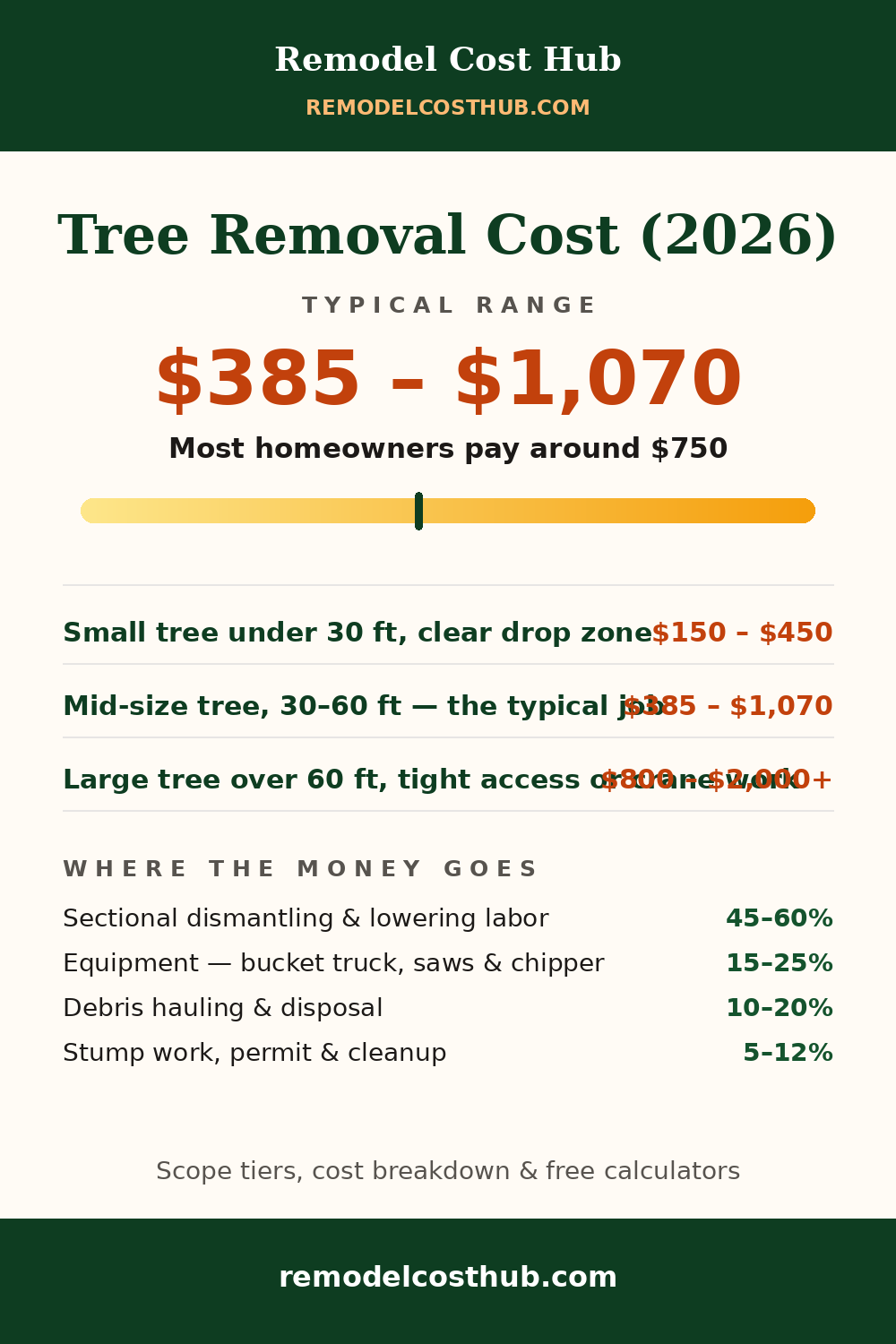
- Typical range: $385 – $1,070
- Most homeowners pay: around $750
- Prices vary most by: Sectional dismantling & lowering labor (45–60% of the budget)
Cross-checked against three published sources for this project. Sources used for this page: the Angi tree service cost guide, HomeGuide's tree removal cost data and LawnStarter's tree removal pricing data. Sources last checked: October 2026 — HomeGuide, Angi, LawnStarter. How we calculate these costs
Cost by scope
| Scope | Typical cost | What it includes |
|---|---|---|
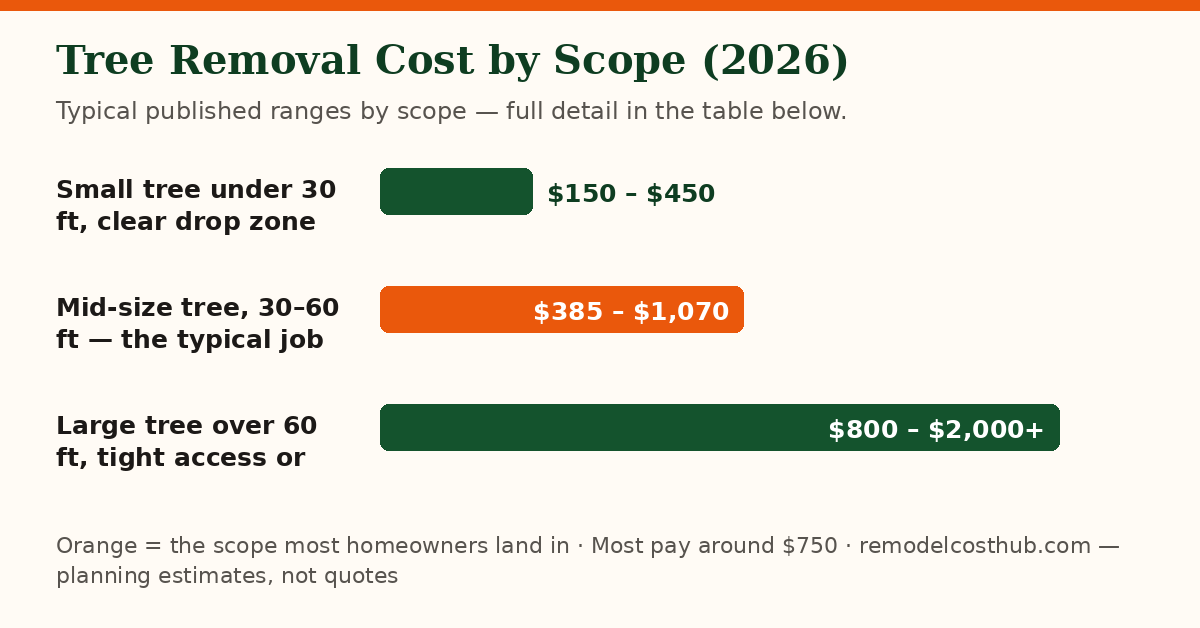
| Small tree under 30 ft, clear drop zone | $150 – $450 | Angi's size ladder prices trees under 30 ft at $150–$450 and HomeGuide at $150–$500 — a straight fell or a short rig-down with room to work, cut up and hauled away in a single visit. |
| Mid-size tree, 30–60 ft — the typical job | $385 – $1,070 | The typical project on this page. LawnStarter's typical range runs $385–$1,070 with a $630 national average; Angi reports an average near $750 across its tree service data, with most jobs inside $200–$2,000; HomeGuide puts 30–80 ft trees at $300–$2,000. Sectional dismantling over a yard is what is being bought at this tier. |
| Large tree over 60 ft, tight access or crane work | $800 – $2,000+ | Angi's ladder prices 60–80 ft trees at $800–$1,500 and trees over 80 ft at $1,000–$2,000 or more, with a crane adding roughly $500. Bucket-truck or crane access, power-line proximity and a trunk that cannot be dropped in pieces of any size are what is being bought here. |
Where the money goes
| Part of the job | Share | Note |
|---|---|---|
| Sectional dismantling & lowering labor | 45–60% | The climber or bucket operator and the ground crew rigging the tree down piece by piece — HomeGuide prices tree crews at $65–$140 an hour, and rigging time, not saw time, is what a careful takedown spends |
| Equipment — bucket truck, saws & chipper | 15–25% | The truck, chipper and saw fleet the crew brings with it; chipping brush on site is what keeps the debris line small, and a crane day prices this share far higher |
| Debris hauling & disposal | 10–20% | Loading, hauling and dump fees for the trunk wood and brush that do not go through the chipper — keeping the firewood or taking the mulch is the usual way this line shrinks |
| Stump work, permit & cleanup | 5–12% | Stump grinding is a separate machine visit — Angi adds $100–$150 for stump removal and HomeGuide prices grinding at $2–$6 per inch of diameter — plus any city permit and the final rake-out |
What moves the price most
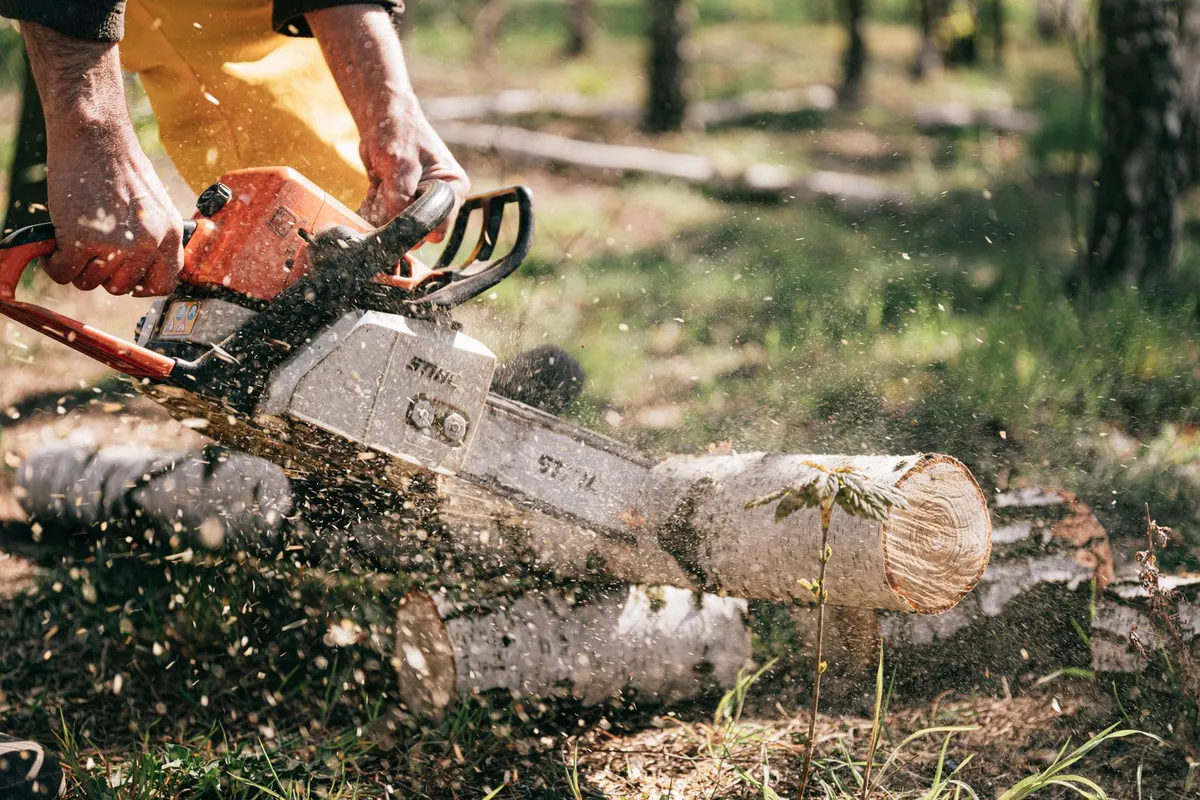
Height is the first price. HomeGuide prices removal at $5–$25 per foot of height and LawnStarter at $10–$14, which is why the same crew quotes a 25 ft ornamental and a 60 ft oak in different leagues. Access and the drop zone decide the method: a tree that can be felled whole is the cheapest job in the book; one hanging over a roof, fence or power line is rigged down in sections or lifted out by crane at roughly $500 more in Angi. Trunk diameter and species set the ground work — hardwood trunks are heavier to cut, load and split, and a wide stump grinds at $2–$6 per inch in HomeGuide. Condition cuts both ways: a dead or hollow tree is lighter but unpredictable, and crews price the risk, not the saving. The stump is a separate decision — leaving it is free, grinding it is $100–$150 in Angi and $175–$516 in LawnStarter, and digging it out entirely costs more than either. When the job grows past a few trees, per-tree pricing stops making sense — a wooded lot is priced by the acre and by vegetation density instead: see land clearing.
Worked example: how a typical tree removal budget breaks down
Take the typical job — a 45 ft oak in a fenced backyard, too close to the house to fell whole, rigged down in sections over one day and hauled away. Here is a realistic $750 version of that invoice, Angi's published average: The budget below totals $750 — the "most homeowners pay around" figure from the top of this page — split using this page's own cost breakdown. It shows how a real quote at that level is usually composed; every line is built from the ranges on this page, and it is an illustration, not a quote for your project.
| Line item | Example budget |
|---|---|
| Sectional dismantling & lowering — climber and ground crew | $415 |
| Bucket truck, saws & chipper | $165 |
| Debris hauling & disposal | $120 |
| Permit & site cleanup | $50 |
| Total | $750 |
What most people get wrong
- Leaving the stump out of the quote. Angi adds $100–$150 for stump removal and HomeGuide prices grinding at $2–$6 per inch — a stump discovered after the crew leaves is a second minimum charge, not a line item.
- Comparing per-foot quotes without a height. HomeGuide's $5–$25 per foot and LawnStarter's $10–$14 per foot only reconcile when both bids measured the same tree — a quote that never names a height cannot be compared.
- Taking the bid that fells it whole. A tree over a roof or fence must come down in sections; the cheap whole-fell bid is priced for a drop zone your yard does not have, and the difference arrives as damage or a mid-job renegotiation.
- Skipping the disposal question. Hauling is 10–20% of the invoice — if you want the firewood or the mulch, say so before the quote, because wood already on the truck is wood already billed.
Costs in your city
Tree removal follows crew rates and disposal costs, and both are local. HomeGuide's $65–$140 hourly crew band is widest because a two-person crew in a rural county and a bucket-truck crew in a coastal metro are different businesses; cities with protected-tree ordinances add the permit line and sometimes an arborist report before any saw starts. Hurricane and ice-storm regions pay a seasonal premium after storm events, when every crew in the county is booked — the same tree quoted in a quiet month can cost half the post-storm price. Measure your tree's height before you call: every dataset on this page prices from height, and the homeowner who can state it gets comparable quotes.
How we got these numbers
Cross-checked against the Angi tree service cost guide (average near $750, size ladder $150–$2,000+), HomeGuide's tree removal cost data (30–80 ft trees $300–$2,000, $5–$25 per foot, stump grinding $2–$6 per inch) and LawnStarter's tree removal pricing data (typical range $385–$1,070, average $630, fallen-tree removal $85–$300). Where the three disagree, this page publishes the overlap and says so.
Frequently asked questions
How much does tree removal cost on average?
LawnStarter's typical range is $385–$1,070 with a $630 national average, and Angi reports an average near $750 across its tree service data. HomeGuide puts trees of 30–80 ft at $300–$2,000. Budget about $750 for one mid-size yard tree taken down in sections and hauled away.
How much does tree removal cost per foot of height?
HomeGuide prices removal at $5–$25 per foot of height and LawnStarter at $10–$14 per foot — the per-foot figure rises with diameter and difficulty, so a short, thick hardwood can cost more per foot than a tall, slim pine.
Is stump removal included in the price?
Usually not. Angi adds $100–$150 for stump removal on top of the takedown, HomeGuide prices stump grinding separately at $2–$6 per inch of diameter with $80–$160 minimums, and LawnStarter puts stump removal at $175–$516. Get the stump written into the quote as its own line before the crew arrives.
How much does it cost to remove a fallen tree?
Much less — the dangerous half of the job is already done. LawnStarter prices fallen-tree removal at $85–$300, since the work is cutting up and hauling rather than climbing and rigging. A fallen tree resting on a roof or fence is priced as damage work, not as a simple pickup.
Can keeping the firewood lower the bill?
Often, yes. Hauling and disposal run 10–20% of a typical invoice on this page, and a crew that only has to cut and stack — leaving you the rounds and the mulch — has less to load and less to dump. Ask before the quote is written; once the wood is on the truck, the saving is gone.