Solar Panel Installation cost at a glance
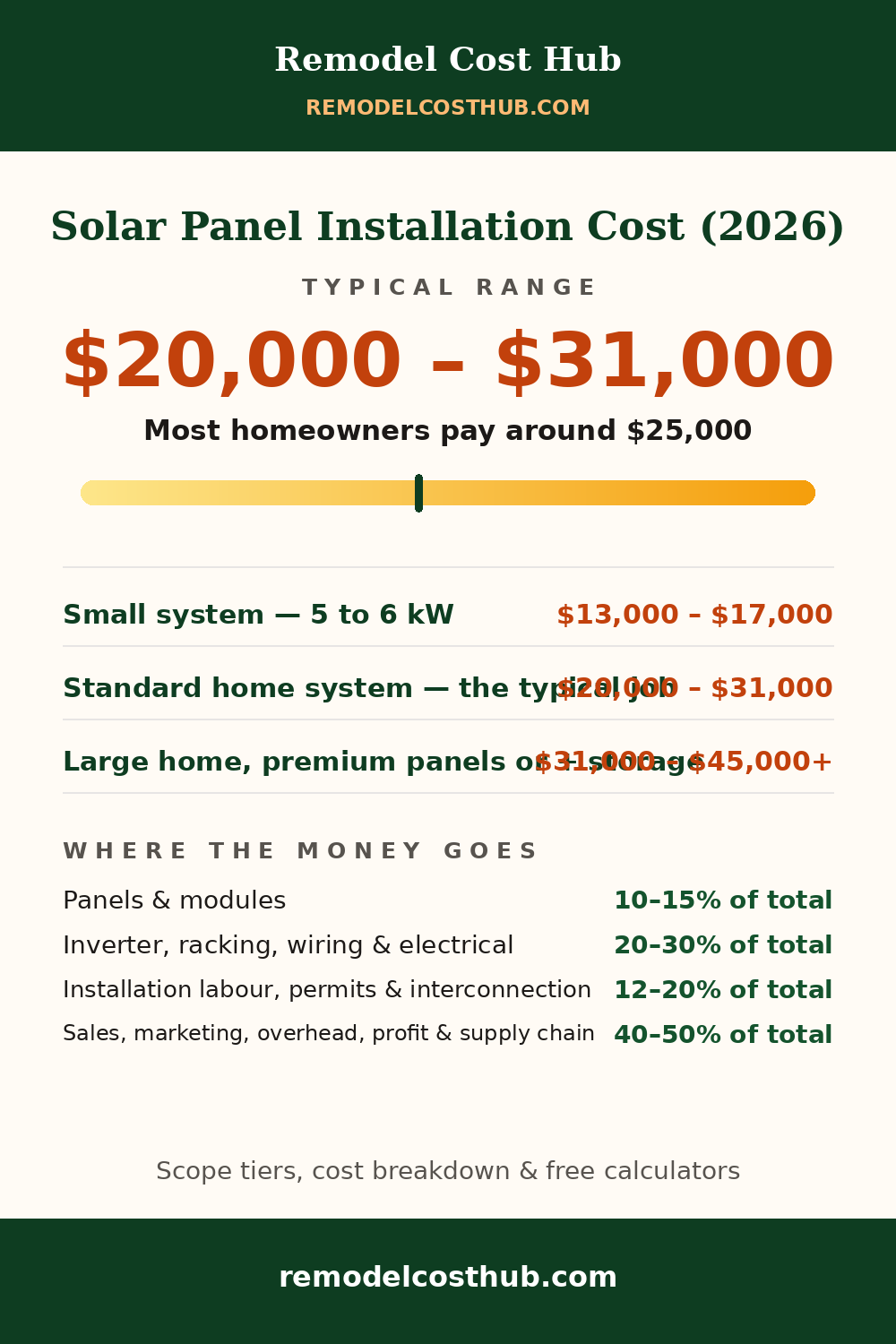
- Typical range: $20,000 – $31,000
- Most homeowners pay: around $25,000
- Prices vary most by: Sales, marketing, overhead, profit & supply chain (40–50% of the budget)
Cross-checked against three published sources for this project. Sources used for this page: EnergySage's 2026 residential solar cost data, Angi's 2026 solar installation cost guide and Forbes Home's solar panel cost data. Sources last checked: October 2026 — Forbes Home, Angi, EnergySage. How we calculate these costs
Cost by scope
| Scope | Typical cost | What it includes |
|---|---|---|
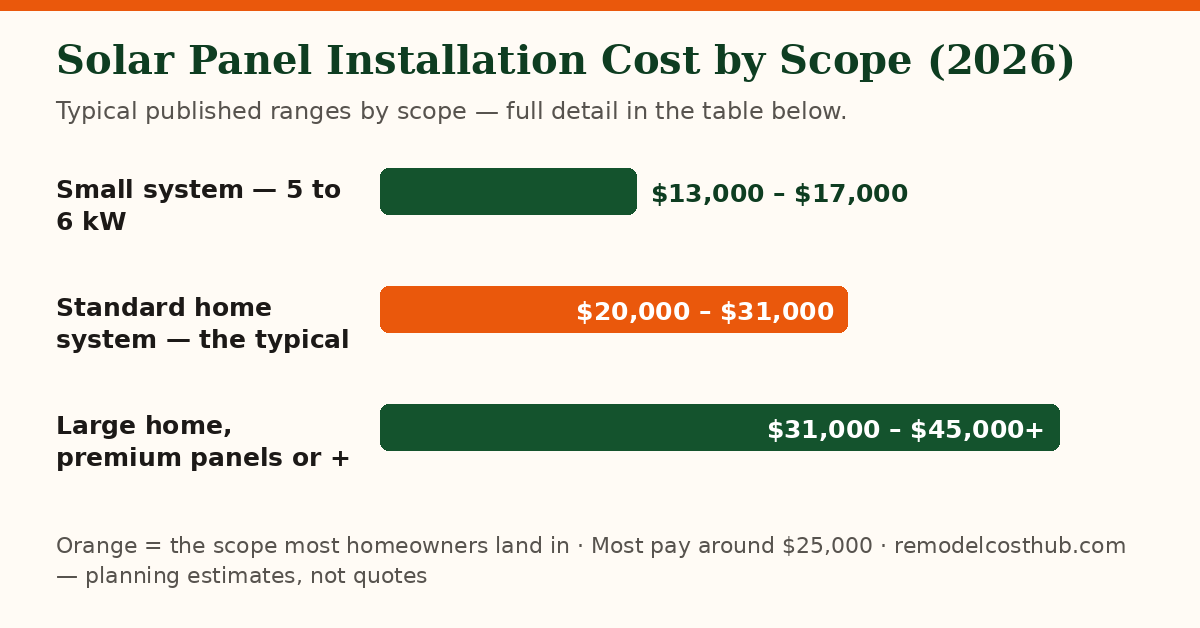
| Small system — 5 to 6 kW | $13,000 – $17,000 | EnergySage prices a 5 kW system at about $13,900 and a 6 kW system at $16,080 in its 2026 marketplace data — the low-use, small-roof or partially shaded band. |
| Standard home system — the typical job | $20,000 – $31,000 | EnergySage's 8 kW average is $20,960, its 10 kW $25,800 and its 12 kW $31,135, all before incentives; Forbes Home prices an 8 kW system at $24,800. Berkeley Lab's median installed US system is 7.7 kW — the middle of the market sits squarely in this band. |
| Large home, premium panels or + storage | $31,000 – $45,000+ | 12 kW and up, premium-efficiency panels, or a home battery added to the system — storage is its own five-figure line that installers quote separately, and roof complexity and panel upgrades move the top of the band. |
Where the money goes
| Part of the job | Share | Note |
|---|---|---|
| Panels & modules | 10–15% of total | On a typical 12 kW system the panels themselves are only about 12% of the price in EnergySage's breakdown — the equipment is not the bill, and identical panels can sit in quotes that differ by thousands |
| Inverter, racking, wiring & electrical | 20–30% of total | The inverter or microinverters, rails and mounts, wiring, and any main-panel upgrade — the electrical half of the hardware |
| Installation labour, permits & interconnection | 12–20% of total | Crew time on the roof plus permits and utility interconnection — EnergySage puts install labour at 7% and permitting and interconnection at 8%; Angi prices labour separately at $0.50–$1.00 a watt |
| Sales, marketing, overhead, profit & supply chain | 40–50% of total | The soft-cost block is the largest share of the system — EnergySage prices sales and marketing at 18%, overhead and profit at 11% each — which is why two quotes with identical panels can differ by thousands |
What moves the price most
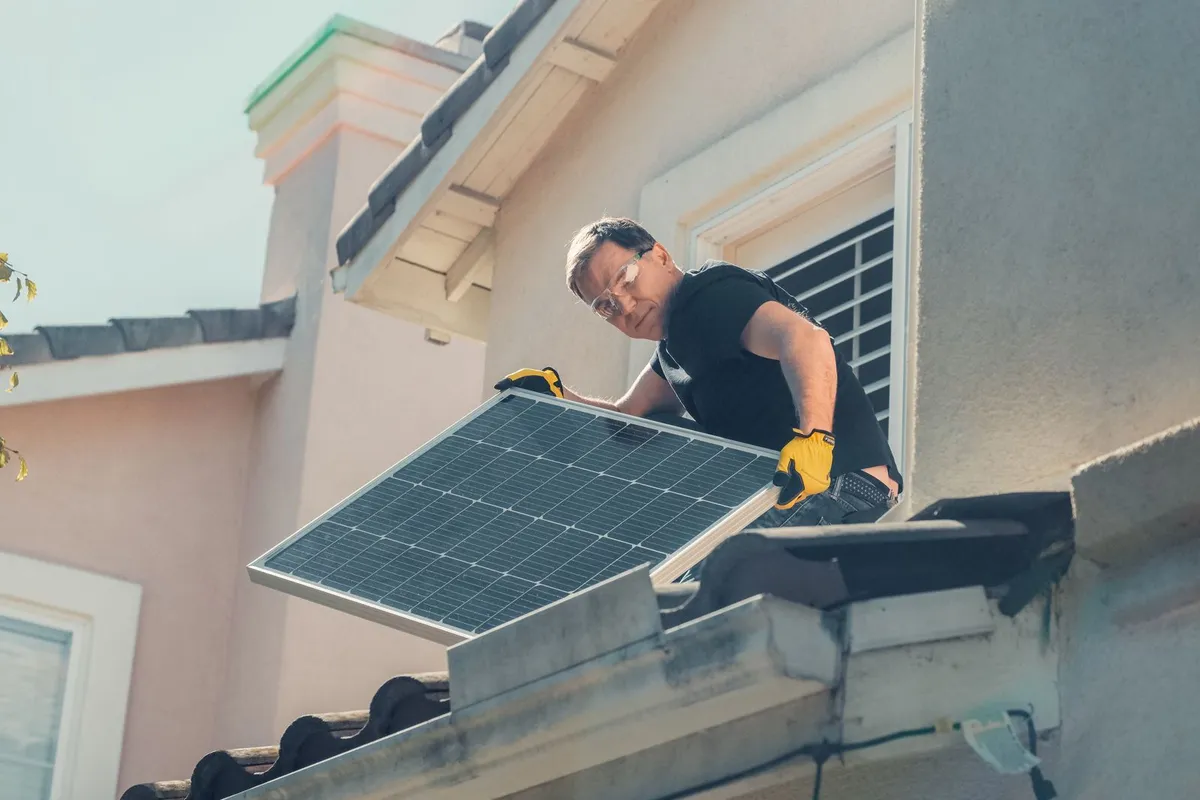
System size is set in kilowatts, and kilowatts are set by your electric bill. The median US installed system is 7.7 kW (Berkeley Lab); a 2,000 sq ft home using 10,000–11,000 kWh a year points to a 6–8 kW system. Square footage is a weak guide — size from twelve months of usage. Cost per watt is the comparison unit: $2.50–$3.25 a watt before incentives is the 2026 benchmark (EnergySage's marketplace runs $2.56–$2.62), so divide every quote by its watts before comparing anything. Roof complexity and electrical work move real quotes — a steep roof, a long trench, or a main-panel upgrade are legitimate reasons to sit above the per-watt band; vague equipment fees are not. And the installer matters as much as the panel brand: the workmanship warranty deserves the same scrutiny as the hardware spec.
Worked example: how a typical solar panel installation budget breaks down
Take the typical job — a 10 kW roof-mount system on a standard asphalt roof: panels racked and wired to an inverter, permitting and utility interconnection handled, no main-panel upgrade needed. Here is a realistic $25,000 version of that invoice, at EnergySage's $25,800 10 kW average: The budget below totals $25,000 — the "most homeowners pay around" figure from the top of this page — split using this page's own cost breakdown. It shows how a real quote at that level is usually composed; every line is built from the ranges on this page, and it is an illustration, not a quote for your project.
| Line item | Example budget |
|---|---|
| Panels & modules — 10 kW | $3,000 |
| Inverter, racking, wiring & electrical | $5,750 |
| Installation labour, permits & interconnection | $4,000 |
| Sales, marketing, overhead, profit & supply chain | $12,250 |
| Total | $25,000 |
What most people get wrong
- Budgeting with the 30% federal credit still in the maths. The residential credit ended for systems placed in service after December 31, 2025 — a 2026 purchase is budgeted at the full price, or the quote is compared on a lease/PPA route that still carries the commercial credit.
- Sizing from the floor plan instead of the electric bill. Kilowatts follow kilowatt-hours, not square feet — twelve months of bills sets the system, and a 2,000 sq ft home can land anywhere from 6 to 8 kW.
- Comparing quotes on the monthly payment alone. A low loan payment can hide enough interest and fees to erase the bill savings it was meant to create — compare the cash price and the total loan cost, not the payment.
- Ignoring the panel-upgrade line. A main-panel upgrade is a legitimate reason a quote sits above the per-watt band; vague equipment fees with no line item are not.
Costs in your city
Location is the biggest single factor in a solar price. Installer marketplace data puts Texas around $2.35–$2.84 a watt and New Hampshire above $3.15, with labour costs, permitting strictness and market competition writing most of the difference — California's average system sits near $22,600 before incentives. Net metering is the second local variable: what your utility pays for exported power decides whether a usage-sized system pays off quickly or slowly, and the rules are state and utility specific. Ask every installer for the $/W figure, the equipment list and the interconnection timeline, and city quotes become comparable.
How we got these numbers
Cross-checked against EnergySage's 2026 residential solar cost data — read in full this run (12 kW $31,135 before incentives, about $2.60 a watt; 5 kW $13,900; 8 kW $20,960; 10 kW $25,800; component split: panels 12%, inverter 10%, racking 3%, wiring 9%, install labour 7%, sales and marketing 18%, overhead and profit 11% each, permitting and interconnection 8%), Angi's 2026 solar installation cost guide — read in full this run (national average $27,104, range $18,268–$36,409 across 2,546 verified projects; 8 kW $15,000–$23,000; labour $0.50–$1.00 a watt; permits $200–$1,000; battery add-on $8,000+) and Forbes Home's solar panel cost data (8 kW system $24,800, national range $12,400–$37,200 — via independent reproductions). The typical band $20,000–$31,000 is the 8–12 kW overlap before incentives; the $25,000 most-pay figure sits at the 10 kW average and inside Angi's range. The 30% federal residential credit ended for systems placed in service after December 31, 2025 — every figure here is before incentives, and lease/PPA routes carry the commercial credit instead; note that some older guides (including Angi companion articles updated mid-2026) still show the credit as available, a framing the July 2025 legislation made stale. Breakdown shares follow EnergySage's component split and are labelled as derived on the page.
Frequently asked questions
How much do solar panels cost for an average house?
At EnergySage's H1 2026 median quote of $2.62 a watt, the Berkeley Lab median 7.7 kW system runs about $20,200 and an 8 kW system $20,960–$24,800, all before incentives. A 10 kW system averages $25,800. Your roof, state, equipment and any electrical work move the final quote — but $/W is the honest comparison across them.
Is the 30% federal solar tax credit still available?
Not for purchased systems placed in service after December 31, 2025 — the IRS states the residential credit is unavailable past that date. A 30% credit still exists on the commercial side (Section 48E) through at least 2027, so lease and power-purchase-agreement quotes can still carry it. If an installer still leads with the old credit for a 2026 purchase, slow down, not sign faster.
What does cost per watt mean?
Total installed price divided by system watts — a $26,200 quote for a 10 kW system is $2.62/W. It normalizes quotes of different sizes, which is exactly what you need when one bid is 8 kW and another is 10. It does not tell you whether two quotes contain the same equipment, scope or warranty — read the line items next.
How long until solar pays for itself?
EnergySage estimates many homeowners save $41,000–$155,000 over 25 years — a range that wide is a warning, not a promise. The honest check: take the net price after incentives you have verified in writing, divide by a conservative first-year bill-savings estimate, then ask how the answer changes if production runs 10% low. If it only works in the optimistic case, it deserves more scrutiny.
Should I size the system to my house’s square feet?
No — size it to your electricity use. A typical 2,000 sq ft home uses around 10,000–11,000 kWh a year, which usually points to a 6–8 kW system; an all-electric home with a heat pump and an EV can use far more. Pull twelve months of bills and let the kWh decide — the roof area matters far less than what you actually use.