Heated Driveway Installation cost at a glance
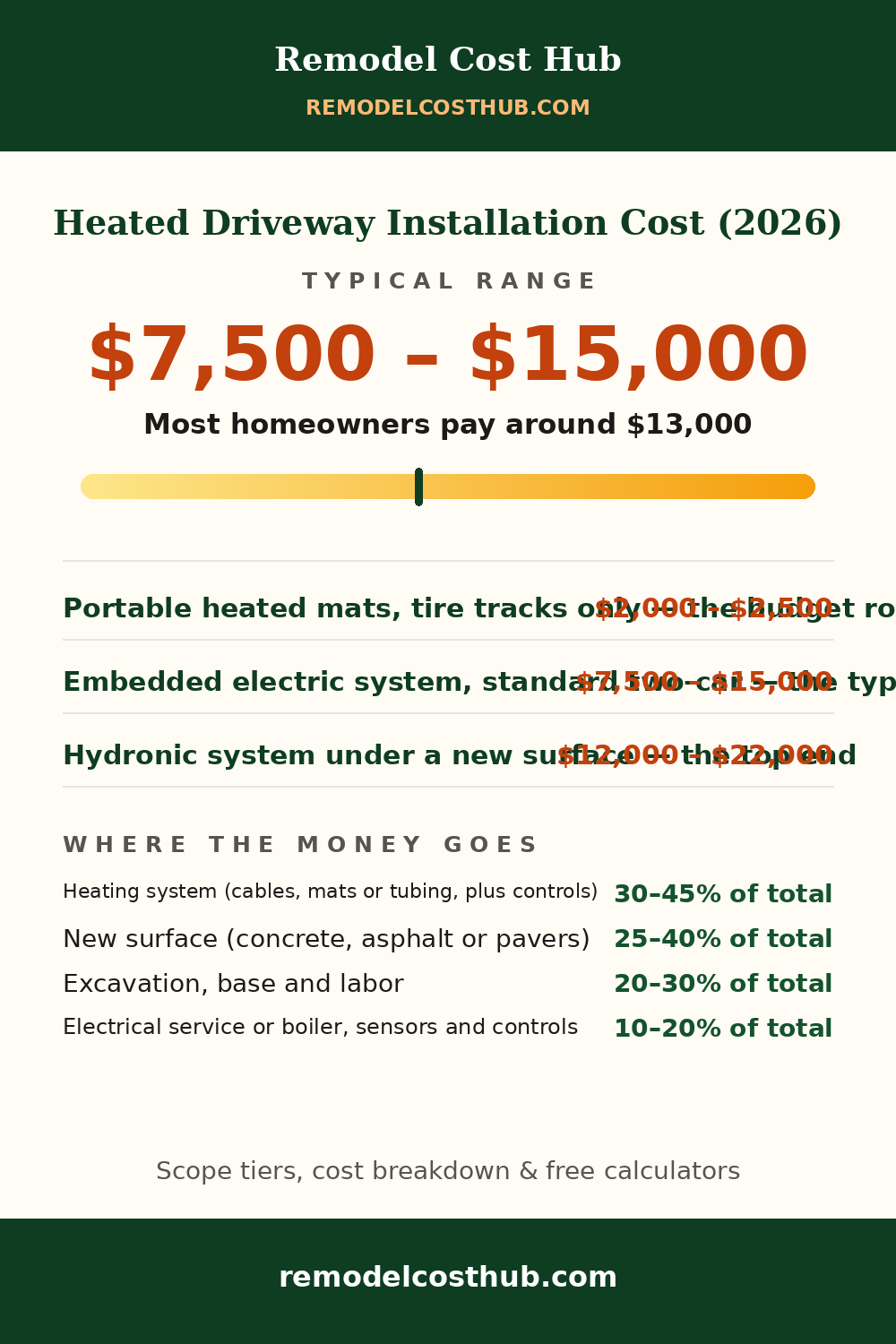
- Typical range: $7,500 – $15,000
- Most homeowners pay: around $13,000
- Per square foot: $12–$25 per sq ft
- Prices vary most by: Heating system (cables, mats or tubing, plus controls) (30–45% of the budget)
Cross-checked against two published sources for this project. Sources used for this page: Angi's heated driveway cost guide, updated Aug 3, 2026 (installation $12–$25 per sq ft; average around $13,000; range $3,600–$25,000; asphalt $12–$25, concrete $15–$30, pavers $20–$50 per sq ft; electric system components $3,200–$5,800 before excavation and panel upgrades; removal $1–$2 per sq ft; portable mats $5–$10 per sq ft, about $1,600 per mat), HomeGuide's heated driveway cost guide (heated concrete or asphalt $12–$28 per sq ft; national average $14,600; average range $6,900–$22,400; heated concrete $13–$28 per sq ft or $6,500–$17,000 for a 2-car driveway; asphalt $12–$27 or $6,000–$16,000; pavers $19–$50 or $11,000–$28,000; standard concrete $6–$15 per sq ft without heating), HouseDigest's heated driveway guide (cost $12–$28 per sq ft; two-car driveway up to about $16,000; electric installation $3,200–$5,800; hydronic $4,000–$8,700), with HeatTrak (electric coil two-car $4,800–$10,800; hydronic two-car $7,200–$15,000; mats $2,000–$2,500 a pair; operation $50–$300 a month) and EngineerFix (electric draw about 50 watts per sq ft) as scope checks.. Sources last checked: October 2026 — HomeGuide, Angi. How we calculate these costs
Cost by scope
| Scope | Typical cost | What it includes |
|---|---|---|
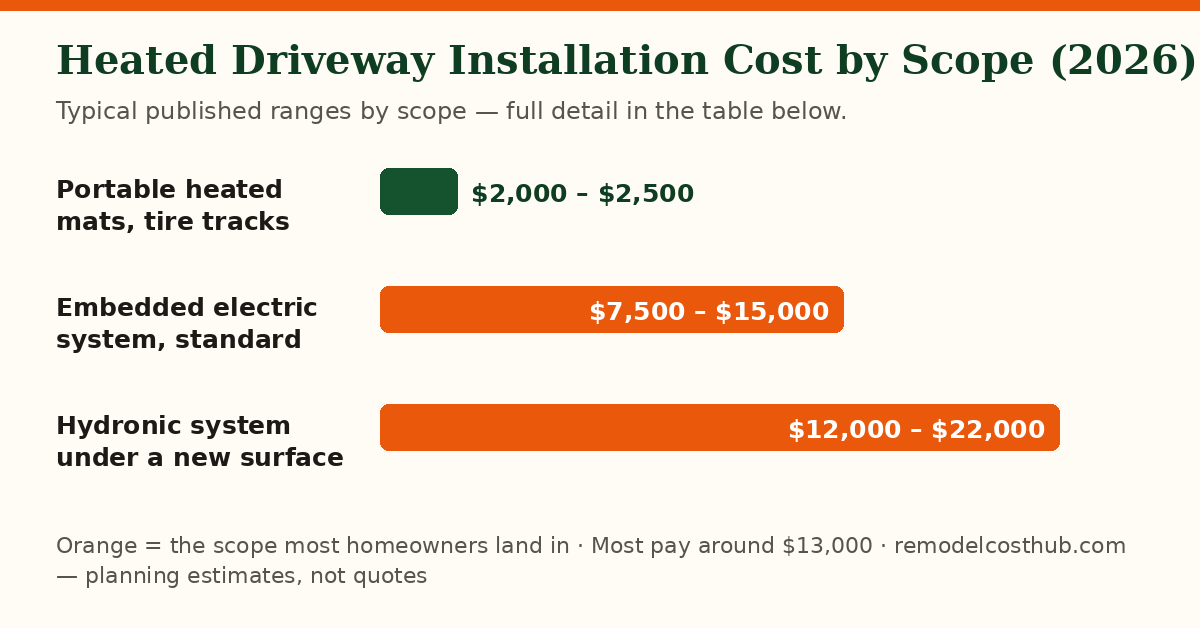
| Portable heated mats, tire tracks only — the budget route | $2,000 – $2,500 | The cheap end: HeatTrak prices a pair of tire-track mats at $2,000–$2,500 with no installation, and Angi prices portable mats at $5–$10 per sq ft, about $1,600 per mat — mats heat only the wheel paths, need an outdoor outlet, and leave the rest of the driveway to freeze, which is why they price far below an embedded system |
| Embedded electric system, standard two-car — the typical job | $7,500 – $15,000 | The shared band itself: Angi prices heated installation at $12–$25 per sq ft and HomeGuide at $12–$28, applied to a standard two-car driveway — electric cables or mats embedded under a new concrete or asphalt surface with a sensor and controller, which is the common job and the band this page is built on |
| Hydronic system under a new surface — the top end | $12,000 – $22,000 | The expensive end: HomeGuide's average range runs to $22,400, HouseDigest prices hydronic system components at $4,000–$8,700 against $3,200–$5,800 for electric, and HeatTrak prices a hydronic two-car install at $7,200–$15,000 for the system alone — a boiler or heat exchanger, manifold and pump station plus tubing, which is what pushes a job past the electric band, especially under pavers at $19–$50 per sq ft in HomeGuide |
Where the money goes
| Part of the job | Share | Note |
|---|---|---|
| Heating system (cables, mats or tubing, plus controls) | 30–45% of total | The largest portion on an electric job: Angi prices electric system components at $3,200–$5,800 before excavation and any panel upgrade, and HouseDigest prices hydronic components at $4,000–$8,700 — the cable or tube layout, sensor and controller are bought by the square foot, so area is the multiplier |
| New surface (concrete, asphalt or pavers) | 25–40% of total | The pavement over the system: Angi prices heated asphalt at $12–$25 per sq ft, concrete at $15–$30 and pavers at $20–$50, and HomeGuide prices heated concrete at $13–$28 and pavers at $19–$50 — pavers cost most because every paver is laid by hand over the tubing or mats |
| Excavation, base and labor | 20–30% of total | The groundwork: Angi adds $1–$2 per sq ft for removing an existing driveway, and a retrofit pays for excavation, base prep and the pour or lay on top of the system, while a new-construction install skips the removal line and usually lands lower in the band |
| Electrical service or boiler, sensors and controls | 10–20% of total | The power side: an electric system may need a panel upgrade where no spare capacity exists, a hydronic system needs a boiler or heat exchanger with a manifold and pump, and both need a snow sensor and controller — Angi notes panel upgrades as an additional cost on top of the system components |

What moves the price most
System type is the first driver: Angi prices electric systems at $3,200–$5,800 for components and hydronic higher, HouseDigest prices hydronic components at $4,000–$8,700, and HeatTrak prices a two-car electric install at $4,800–$10,800 against $7,200–$15,000 hydronic — electric is cheaper to install and dearer to run, hydronic the reverse, which is why the choice is a running-cost decision as much as a build decision. Surface material is second: Angi's per-sq-ft table runs from asphalt at $12–$25 through concrete at $15–$30 to pavers at $20–$50, and HomeGuide agrees on the order at $12–$27, $13–$28 and $19–$50 — the same heating system under pavers costs nearly twice the asphalt job. Area is third: every guide prices by the square foot, so a 600 sq ft two-car driveway and a 1,200 sq ft driveway with a turnaround are different jobs at the same rate, and most quotes heat only the apron and wheel paths unless the full slab is specified. Finally, retrofit versus new construction closes the bill: Angi adds $1–$2 per sq ft for removing an existing driveway, and a retrofit that also needs a panel upgrade or a boiler tie-in pays both lines, while a system laid during a planned repave skips the removal cost entirely. Running cost is separate from install cost: HeatTrak puts operation at $50–$300 a month in season, and EngineerFix notes electric mats draw about 50 watts per sq ft, so the winter bill depends on local electricity rates and how many hours the sensor calls for heat.
Costs in your city
Labor is the biggest variable in any remodel, and labor is local — the same bathroom can price very differently in Houston than in Boston. We are adding city editions metro by metro, each with its own labor index, permit notes and climate factors, written for that city rather than copied from this page. Wave 1: Houston, Dallas–Fort Worth, Phoenix, Atlanta, Miami–South Florida, Orlando, Tampa, Charlotte, Austin and San Antonio. Until your city's page is live, use the national range here and weight it the way contractors do: Sun Belt labor often prices near or below the national middle, while coastal California and the Northeast metros often price well above it.
Frequently asked questions
How much does a heated driveway cost per square foot?
About $12–$25 per sq ft installed for a standard system in Angi, and $12–$28 in HomeGuide for concrete or asphalt — the band on this page applied to a standard two-car driveway of about 600 sq ft gives the $7,500–$15,000 typical range. Pavers run higher in both guides, at $19–$50 per sq ft in HomeGuide.
Electric or hydronic — which heated driveway system costs less?
Electric, to install: Angi prices electric components at $3,200–$5,800 and HouseDigest prices hydronic components at $4,000–$8,700, while HeatTrak prices a two-car electric install at $4,800–$10,800 against $7,200–$15,000 hydronic. Hydronic usually costs less to run over a long winter, which is why cold-climate homes with a boiler already in place often choose it despite the higher build cost.
Does the per-square-foot price include the new driveway surface?
In HomeGuide's bands, yes — its $12–$28 per sq ft for concrete or asphalt and $19–$50 for pavers include installation of the heated system and the pavement. Angi's $3,200–$5,800 electric figure is components only, before excavation and any panel upgrade, so compare quotes on whether the surface and groundwork are inside the number.
Can I heat just the tire tracks instead of the whole driveway?
Yes, with portable mats: HeatTrak prices a pair of tire-track mats at $2,000–$2,500 with no installation, and Angi prices portable mats at $5–$10 per sq ft, about $1,600 per mat. You keep the walkway and the rest of the slab to shovel, but the car paths stay clear for a fraction of an embedded system.
How much does a heated driveway cost to run?
HeatTrak puts operation at $50–$300 a month during the heating season depending on system type, and EngineerFix notes electric systems draw about 50 watts per sq ft, so a 600 sq ft driveway draws about 30 kilowatts while running. A snow sensor that runs the system only during snowfall, rather than a manual switch left on, is what keeps the bill near the bottom of that band.