Concrete Countertop cost at a glance
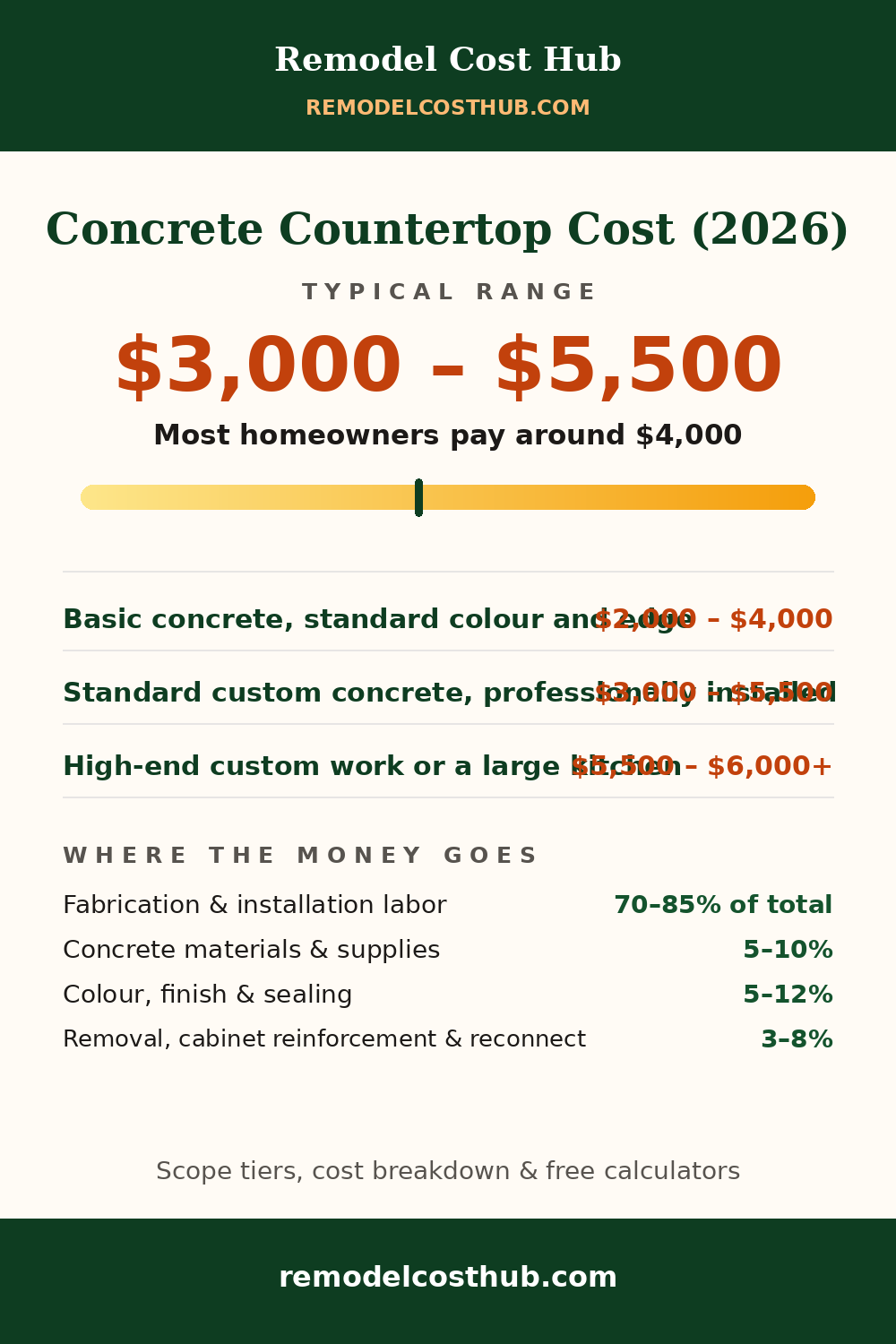
- Typical range: $3,000 – $5,500
- Most homeowners pay: around $4,000
- Per square foot: $75 – $135 per sq ft
- Prices vary most by: Fabrication & installation labor (70–85% of the budget)
Cross-checked against three published sources for this project. Sources used for this page: the Angi concrete countertop cost guide, HomeGuide's concrete countertop cost guide and Fixr's kitchen countertop replacement cost guide. Sources last checked: October 2026 — HomeGuide, Fixr, Angi. Last updated October 2026 · How we calculate these costs
Cost by scope
| Scope | Typical cost | What it includes |
|---|---|---|
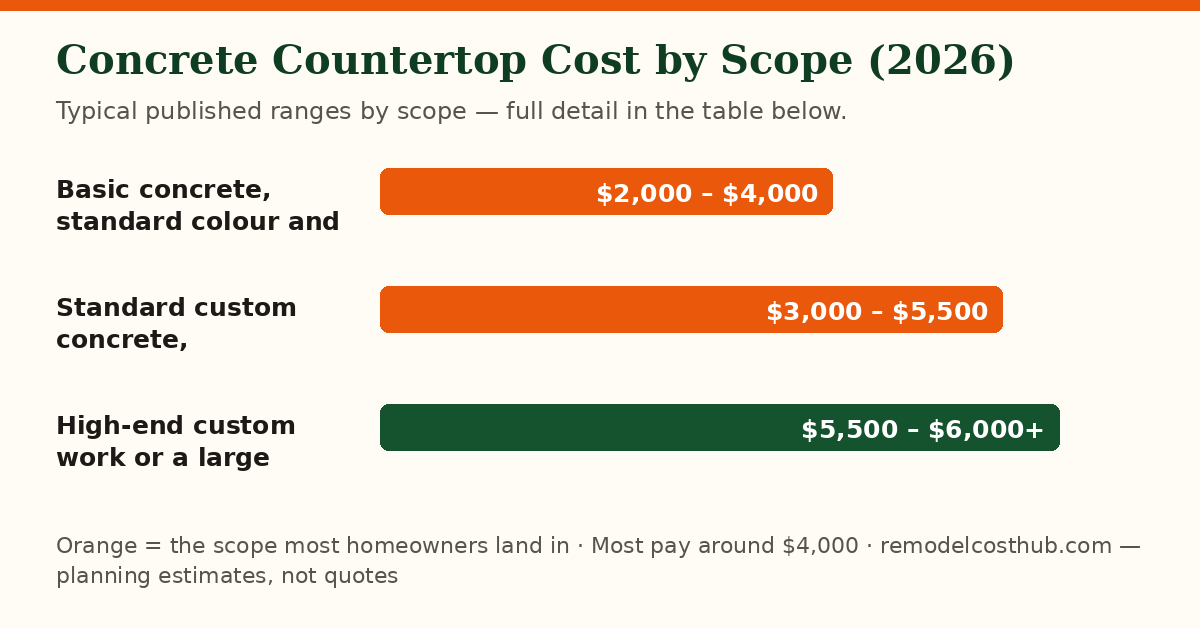
| Basic concrete, standard colour and edge | $2,000 – $4,000 | A basic design with straight edges and standard knockouts over about 40 sq ft — both Angi and HomeGuide price the basic level at $50–$100 per sq ft installed, with limited colour and finish options |
| Standard custom concrete, professionally installed | $3,000 – $5,500 | Where most concrete kitchens land: about 40 sq ft cast to template with a chosen colour and a stained or polished finish — Angi puts the average project at about $3,500 for 35 sq ft, and HomeGuide's mid-range level runs $100–$135 per sq ft |
| High-end custom work or a large kitchen | $5,500 – $6,000+ | Custom shapes and thickness, multi-colour work, specialised aggregates, inlays or an integrated drainboard — both guides top out at $135–$150 per sq ft, and Angi notes thicker 3-inch work slants to that high end |
Where the money goes
| Part of the job | Share | Note |
|---|---|---|
| Fabrication & installation labor | 70–85% of total | The artisan work of moulding, casting, curing and finishing: HomeGuide puts labor at $45–$135 per sq ft against $5–$15 of materials and states the split plainly — about 10% materials, 90% labor — and Angi prices labor at $55–$135 per sq ft |
| Concrete materials & supplies | 5–10% | The mix, reinforcement, pigments and mould materials: both guides put concrete materials at $5–$15 per sq ft — the cheapest material line on this site, attached to the most expensive labor line |
| Colour, finish & sealing | 5–12% | Pigments run $35–$40 per bag in HomeGuide, stains and dyes about $40 per quart, and the finish ladder is priced per foot in Angi — basic $50–$90, coloured $60–$100, stained or polished $100–$150 — with sealing part of every finished price |
| Removal, cabinet reinforcement & reconnect | 3–8% | Removing the old counter runs $50–$300 in Angi and $50–$400 in HomeGuide, plus reinforcing cabinets for a counter that weighs 18–20 lb per sq ft in Angi and reconnecting the sink |
What moves the price most
Labour is the concrete budget — almost all of it. Concrete is the one countertop where the material is nearly free: both Angi and HomeGuide put the concrete itself at $5–$15 per sq ft, and HomeGuide states the split outright — materials are about 10% of the installed price and the moulding, casting and finishing labour is the other 90%. That is why every concrete band is wide: you are not buying a slab, you are commissioning a piece of work, and fabricators price their time differently. Finish is the lever inside that labour: Angi ladders basic work at $50–$100 per sq ft, coloured at $60–$100 and stained or polished at $100–$150, and HomeGuide's levels run basic $50–$100, mid-range $100–$135 and high-end $135–$150. Cast in place versus precast comes next — precast counters are poured in the shop, cured under control and installed like stone, while cast-in-place work is seamless but keeps the kitchen out of action through the cure; HomeGuide notes poured-on-site work typically costs more for the crew and equipment it brings with it. Finally, weight and upkeep are real budget lines: at 18–20 lb per sq ft in Angi, cabinets may need reinforcement before the counter exists, and the finished surface is porous — annual sealing and routine waxing in HomeGuide's maintenance list are the price of the look.
Worked example: how a typical concrete countertop budget breaks down
A typical job: about 40 sq ft of custom concrete cast to template at standard thickness, one colour, a stained finish, sealed, old counters removed and cabinets checked for the weight. The budget below totals $4,000 — the "most homeowners pay around" figure from the top of this page — split using this page's own cost breakdown. It shows how a real quote at that level is usually composed; every line is built from the ranges on this page, and it is an illustration, not a quote for your project.
| Line item | Example budget |
|---|---|
| Fabrication and installation labor | $3,040 |
| Concrete materials and supplies | $320 |
| Colour, finish and sealing | $320 |
| Old counter removal, cabinet reinforcement and reconnect | $320 |
| Total | $4,000 |
What most people get wrong
- Choosing the fabricator on price alone — with about 90% of the cost in the labour, the cheap quote is cheap hands; ask to see cured work that is at least a year old, not fresh pours.
- Skipping the cabinet check — at 18–20 lb per sq ft the counter is the heaviest on this site relative to its thickness, and reinforcement discovered after the pour is priced at the worst moment.
- Treating sealing as optional — unsealed concrete is porous and takes stains permanently; the annual seal in the guides' maintenance lists is part of owning this counter, not an upsell.
- Planning the kitchen schedule around the pour date — curing takes days before sealing in both guides, and a remodel that needs the kitchen back the same week should be precast, not cast in place.
Costs in your city
Concrete pricing is artisan pricing: the material ships anywhere for the same few dollars a foot, so the entire local spread is how many concrete-counter fabricators work in your market and how booked they are. Design-led metros with several studios price standard custom work near the middle of the band; in markets with a single fabricator, expect the top of the band and a longer wait, because there is no stocked alternative to order instead. Travel cuts the other way than with stone — a fabricator casting in place brings the workshop to your kitchen, so distance shows up as crew days rather than slab freight. Ask each bidder whether they precast or cast in place; the answer predicts both the price shape and how long your kitchen is out of action.
Frequently asked questions
How much do concrete countertops cost for an average kitchen?
About $3,000–$5,500 installed is the typical band on this page for about 40 sq ft, with most projects landing around $4,000. Angi puts most projects at $1,500–$6,000 with an average of about $3,500 for 35 sq ft, and HomeGuide puts an average 30–40 sq ft kitchen at $1,500–$6,000.
How much do concrete countertops cost per square foot installed?
Angi and HomeGuide both put concrete at $50–$150 per sq ft installed, and Fixr at $50–$120. The level decides where you land: basic work at $50–$100 in both guides, mid-range at $100–$135 in HomeGuide, and high-end custom work at $135–$150.
Why is concrete so expensive if the material is cheap?
Because the price is labour, not material. Both guides put concrete materials at $5–$15 per sq ft; HomeGuide puts labour at $45–$135 per sq ft and states that about 90% of the installed cost is the work of moulding, fabricating and finishing. The DIY figures in the guides ($20–$30 per sq ft for materials with a forming system) show the same split from the other side.
Do concrete countertops crack and stain?
They can, and both guides list it plainly: HomeGuide lists cracks, chips and scratches among the cons and notes the surface is porous if not properly sealed, and Angi lists cracking among the reasons to hire an experienced fabricator. Sealed and waxed on schedule — yearly sealing in HomeGuide — the same guides describe a counter that lasts decades.
How heavy are concrete countertops? Will my cabinets hold them?
About 18–20 lb per sq ft in Angi — roughly 630–700 lb across an average 35 sq ft kitchen — at the standard 1½–2 inch thickness both guides describe. Factory cabinets may need added frame reinforcement or a plywood sub-top in HomeGuide; get the cabinet check in writing before the pour, not after it.