Porcelain Countertop cost at a glance
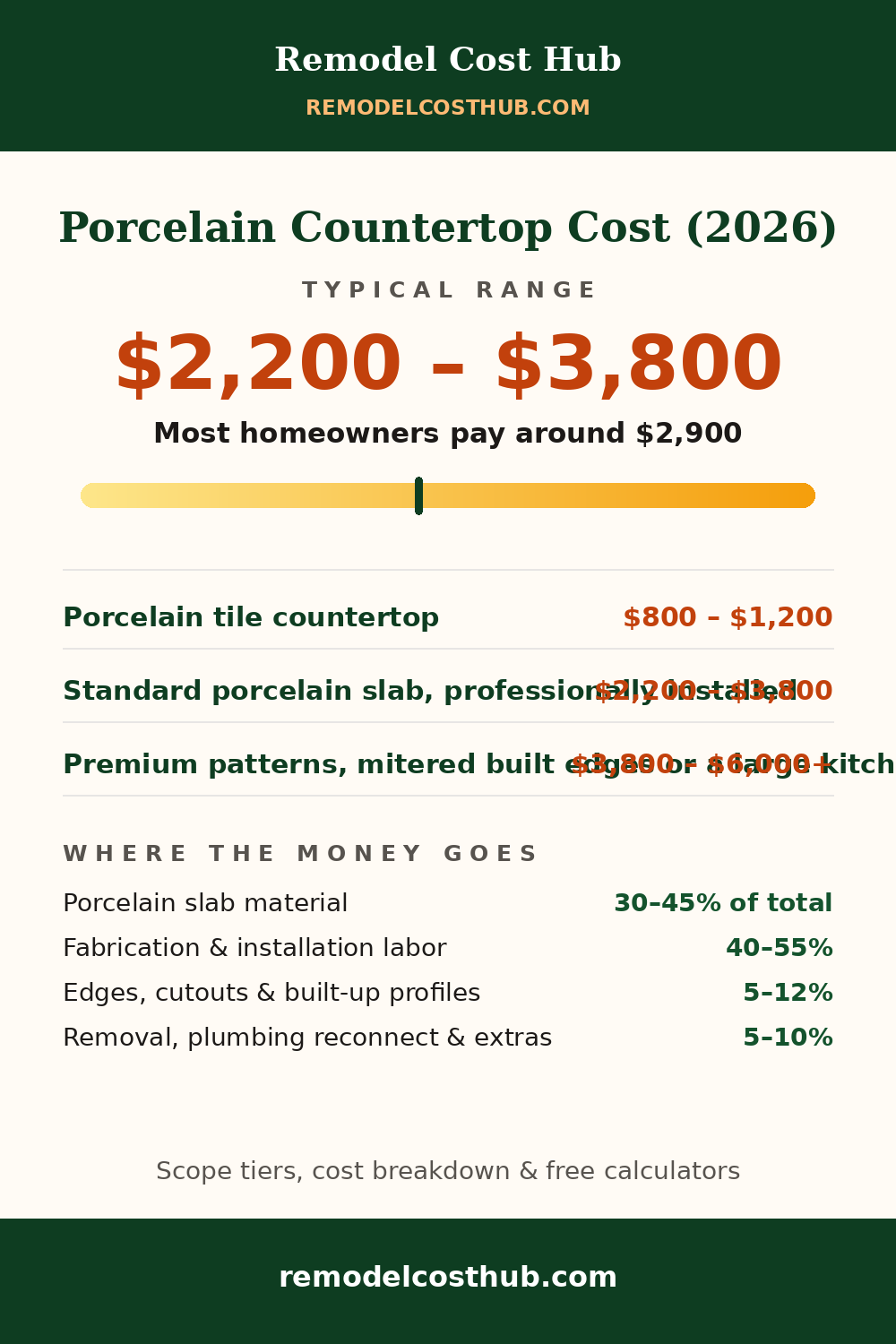
- Typical range: $2,200 – $3,800
- Most homeowners pay: around $2,900
- Per square foot: $55 – $95 per sq ft
- Prices vary most by: Fabrication & installation labor (40–55% of the budget)
Cross-checked against three published sources for this project. Sources used for this page: the Angi porcelain countertop cost guide, HomeGuide's countertop installation cost guide and Fixr's porcelain countertop cost guide. Sources last checked: October 2026 — HomeGuide, Fixr, Angi. Last updated October 2026 · How we calculate these costs
Cost by scope
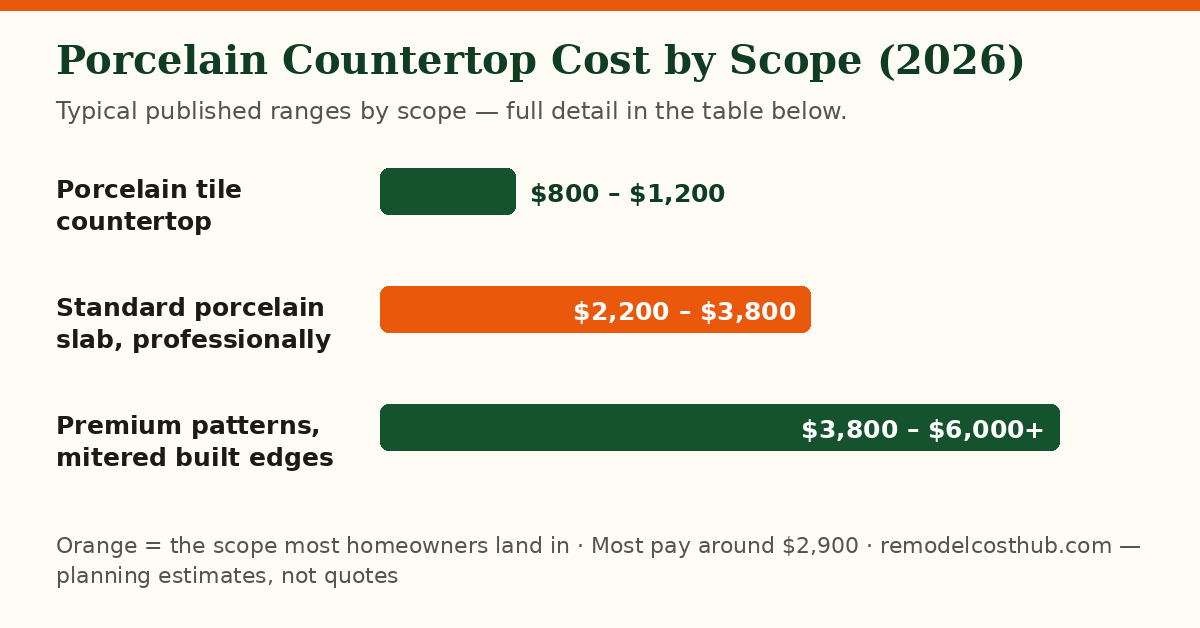
| Scope | Typical cost | What it includes |
|---|---|---|
| Porcelain tile countertop | $800 – $1,200 | The budget format: large porcelain tiles set on a prepared base over about 40 sq ft — Fixr puts porcelain tile counters at $20–$30 per sq ft all-in with labor at only $7–$10, because tile is set piece by piece instead of fabricated as a slab |
| Standard porcelain slab, professionally installed | $2,200 – $3,800 | Where most porcelain-slab kitchens land: about 40 sq ft of gauged slab templated, cut and installed — Angi puts most projects at $1,500–$3,800 with an average of $2,900, and an average 30–40 sq ft kitchen at $1,500–$2,800 |
| Premium patterns, mitered built edges or a large kitchen | $3,800 – $6,000+ | Book-matched veining, a built-up mitered edge that makes a thin slab read thick, or a large kitchen — HomeGuide and Fixr both run the installed band to $120 per sq ft, and Angi's high end reaches $8,000 on large or complex projects |
Where the money goes
| Part of the job | Share | Note |
|---|---|---|
| Porcelain slab material | 30–45% of total | The slab itself is the moderate line: HomeGuide puts porcelain material at $20–$60 per sq ft and Fixr puts polished slab material at $9–$12 in its finish table — porcelain is cheaper stone-for-stone than quartz or granite, which is exactly why labor dominates this budget |
| Fabrication & installation labor | 40–55% | Cutting, handling and setting a thin, brittle slab: Fixr puts slab fabrication-and-installation labor at $47–$108 per sq ft including templating, transport and cutouts, and notes the slabs chip easily until they are installed — you are paying for the care, not the weight |
| Edges, cutouts & built-up profiles | 5–12% | Sink and cooktop cutouts run $100–$200 each in Angi; a built edge that hides the slab's thinness runs $15–$25 per linear foot in Fixr against $10–$12 for a simple bevel or bullnose, and square or eased edges are usually included |
| Removal, plumbing reconnect & extras | 5–10% | Removing the old counter, disconnecting and reconnecting the sink, and the perfectly flat substrate a thin slab demands — levelling and shimming cabinets is real labor on this material, not a formality |
What moves the price most
Fabrication is the porcelain budget. Porcelain inverts the usual countertop maths: the material is comparatively cheap (HomeGuide $20–$60 per sq ft; Fixr's polished slab at $9–$12 material in its finish table) but the work is dear, because a 12mm slab is brittle until the moment it is set. Fixr puts slab labor at $47–$108 per sq ft all-in against $7–$10 for tile — the standard-slab overlap between the guides is the rate this page publishes as typical. Slab versus tile is the biggest single decision: Fixr puts a porcelain tile counter at $20–$30 per sq ft total, a third of slab money, bought with grout lines and a different look. Edge ambition is the third lever: the thin slab usually gets a mitered built edge to look substantial, at $15–$25 per linear foot in Fixr, while a plain square edge is free — decide if the thick look is worth a line item. Finally, upkeep is where porcelain claws money back: it is non-porous, needs no sealing ever, and Angi notes heat resistance that lets hot pans land directly — against granite's annual sealing bill, the lifetime cost gap is narrower than the install gap.
Worked example: how a typical porcelain countertop budget breaks down
A typical job: about 40 sq ft of standard porcelain slab, templated and fabricated, one sink cutout, a simple eased edge, old counters removed and cabinets levelled for the thin slab. The budget below totals $2,900 — the "most homeowners pay around" figure from the top of this page — split using this page's own cost breakdown. It shows how a real quote at that level is usually composed; every line is built from the ranges on this page, and it is an illustration, not a quote for your project.
| Line item | Example budget |
|---|---|
| Porcelain slab material | $1,160 |
| Fabrication and installation labor | $1,305 |
| Edge profile and sink cutout | $232 |
| Old counter removal, levelling and plumbing reconnect | $203 |
| Total | $2,900 |
What most people get wrong
- Choosing the fabricator on price alone — Fixr's labor band is wide because porcelain punishes inexperience; a shop cutting its first thin slab is practising on your counter, and a cracked slab is rarely chargeable to anyone but you.
- Skipping the flatness check — a 12mm slab telegraphs every dip in the cabinets under it; levelling discovered on install day is priced at the worst possible moment.
- Paying for a built mitered edge everywhere — it runs $15–$25 per linear foot in Fixr and only the visible edges need it; island overhangs and wall runs can stay simple.
- Assuming porcelain tile and porcelain slab quotes are the same product — Fixr puts them at $20–$30 versus $55–$120 per sq ft; a suspiciously cheap 'porcelain' quote is usually tile, with grout lines the slab quote does not have.
Costs in your city
Porcelain pricing follows fabricator experience, not material freight: the slabs ship nationally at similar money, so the local spread is how many shops near you cut thin porcelain regularly. Metros with several experienced porcelain fabricators price standard work near the middle of the band and break fewer slabs doing it; in markets where one stone shop 'also does porcelain', expect the top of the band — the breakage risk is priced into your quote whether it is named or not. Outdoor kitchens change the maths locally too: porcelain's UV resistance makes it the default outdoor counter in sunny, high-cost markets, and that demand keeps experienced crews booked. Ask each bidder how many porcelain slabs they installed last year; the answer predicts your price better than their hourly rate.
Frequently asked questions
How much do porcelain countertops cost for an average kitchen?
About $2,200–$3,800 installed is the typical band on this page for about 40 sq ft of slab, with most projects landing around $2,900. Angi puts most porcelain projects at $1,500–$3,800 with an average of $2,900, and HomeGuide's $50–$120 per sq ft installed band brackets the same project.
How much do porcelain countertops cost per square foot installed?
Angi puts porcelain at $50–$70 per sq ft on average (with a full span of $10–$120 by format), HomeGuide at $50–$120 installed, and Fixr's gauged-slab total at $55–$120. Standard slab work in an ordinary kitchen lands around $55–$95; porcelain tile counters are far cheaper at $20–$30 in Fixr.
Are porcelain countertops cheaper than quartz?
Usually yes at install, and by more over time. Angi's porcelain-versus-quartz comparison puts porcelain at $55–$120 per sq ft against quartz at $50–$200, and porcelain never needs sealing and shrugs off heat and UV that quartz dislikes — the saving is real, provided your fabricator is experienced with thin slabs.
Do porcelain countertops chip easily?
The edges can — Fixr is explicit that the thin slabs are easily chipped and damaged during fabrication, transport and installation, which is why its labor band is so high. Once installed the surface is very hard and durable; the practical defences are a fabricator who works in porcelain regularly and care with heavy pans at exposed edges.
Can I install a porcelain slab countertop myself?
The slab, no — it needs specialist cutting gear, suction handling equipment and experience the guides all assume when they price labor at $47–$108 per sq ft in Fixr. A porcelain tile counter is the realistic DIY-adjacent route (Fixr labor $7–$10 per sq ft), and even there the substrate has to be dead flat.