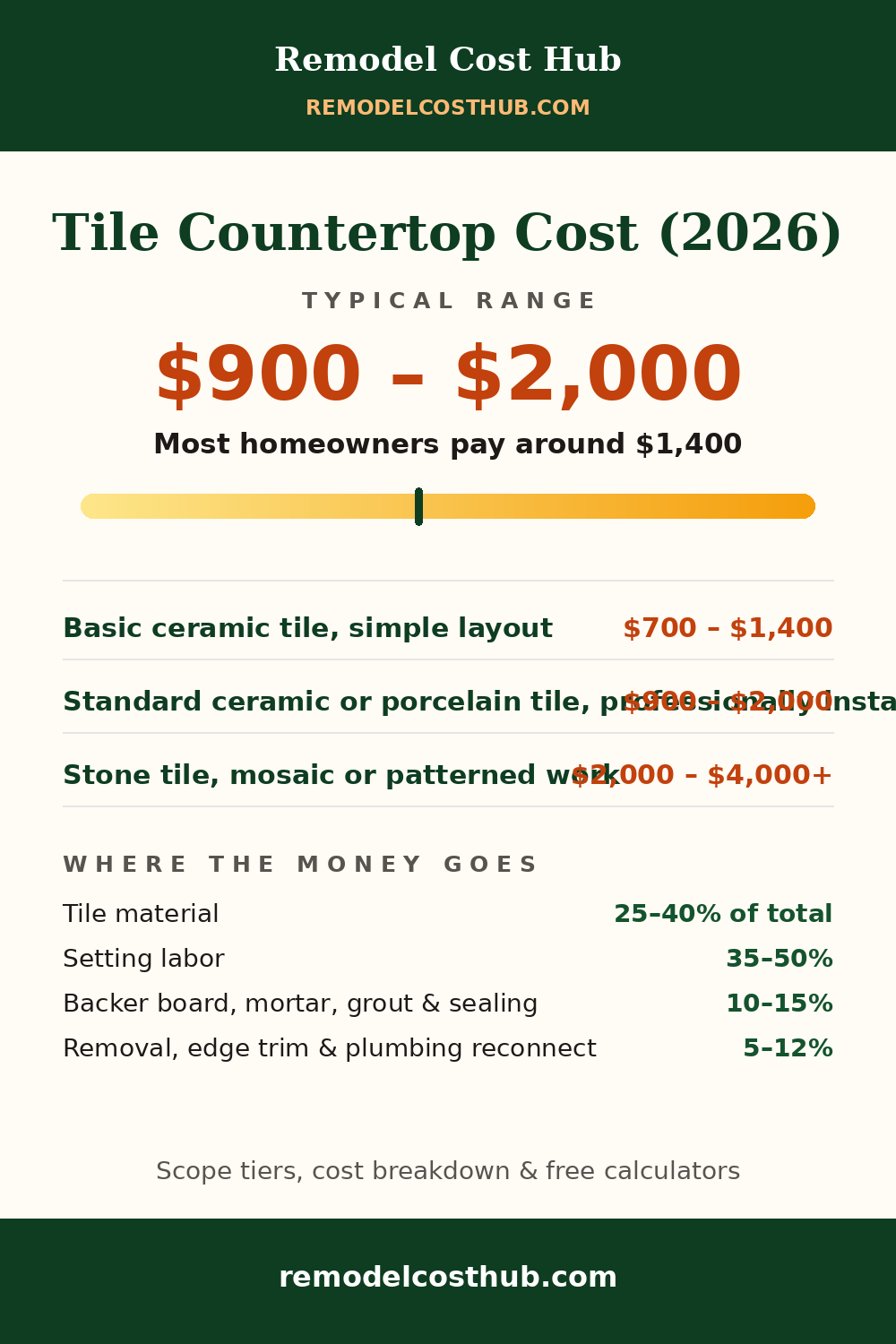
Tile Countertop cost at a glance
- Typical range: $900 – $2,000
- Most homeowners pay: around $1,400
- Per square foot: $22 – $50 per sq ft
- Prices vary most by: Setting labor (35–50% of the budget)
Cross-checked against three published sources for this project. Sources used for this page: the Angi tile kitchen countertop cost guide, HomeGuide's countertop resurfacing and tile cost data and CostOwl's tile kitchen countertop cost data. Sources last checked: October 2026 — HomeGuide, Angi. Last updated October 2026 · How we calculate these costs
Cost by scope
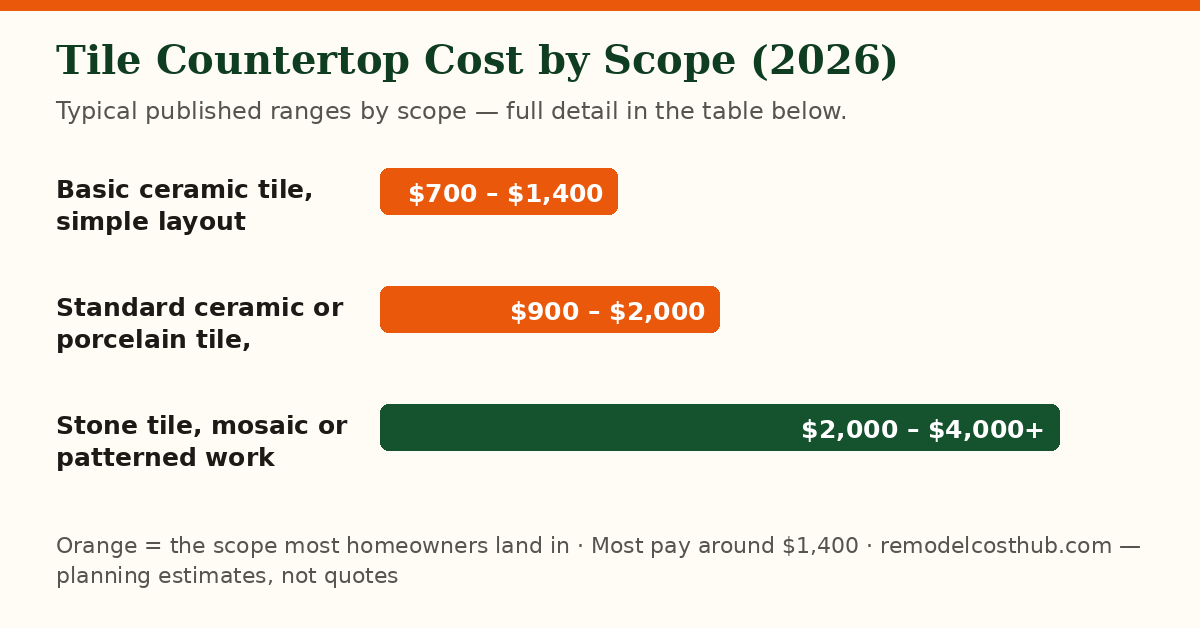
| Scope | Typical cost | What it includes |
|---|---|---|
| Basic ceramic tile, simple layout | $700 – $1,400 | The budget classic: machine-made ceramic tile in a straight grid over about 40 sq ft — Angi prices counter-grade ceramic at $5–$30 per sq ft for the tile itself and HomeGuide puts new tile counter installation at $10–$50 per sq ft all-in |
| Standard ceramic or porcelain tile, professionally installed | $900 – $2,000 | Where most tile kitchens land: about 40 sq ft of grade 3–5 ceramic or porcelain tile on a proper backer base, with edge trim and sealed grout — Angi puts tiling a countertop at $18–$100 per sq ft across all tile types, with an average 30–40 sq ft kitchen at $540–$4,000 |
| Stone tile, mosaic or patterned work | $2,000 – $4,000+ | Natural stone tile, mosaics or a diagonal/patterned layout — Angi prices natural stone tile at $50–$100 per sq ft for the material and glass tile at $40–$80, and a large or complex kitchen can reach $6,000 in its size table |
Where the money goes
| Part of the job | Share | Note |
|---|---|---|
| Tile material | 25–40% of total | The tiles themselves: Angi puts counter-grade ceramic at $5–$30 per sq ft by grade and porcelain tile at $10–$120 across its full range, while CostOwl puts ceramic and porcelain tile material at $5–$30 — format and finish move this line more than brand does |
| Setting labor | 35–50% | Laying, cutting and grouting tile piece by piece is handwork: HomeGuide's tile installation data puts tile labor well above slab-setting labor per foot, and CostOwl adds $3–$7 per sq ft for professional installation of stone tile on top of material |
| Backer board, mortar, grout & sealing | 10–15% | The base a tile counter stands on: cement backer board over plywood, thinset, grout and grout sealer — CostOwl budgets $100–$300 for these consumables on a DIY-scale project, and on a pro job they are priced into the square foot |
| Removal, edge trim & plumbing reconnect | 5–12% | Removing the old counter, the metal or bullnose edge trim that finishes a tile counter (Angi puts bevel and bullnose edges at $10–$15 per linear foot), and disconnecting and reconnecting the sink |
What moves the price most
Tile choice is the tile-counter budget — within a very wide gate. Angi's material table runs from $1 per sq ft for basic ceramic to $50–$100 for natural stone tile, with counter-suitable grades 3–5 at $5–$30; CostOwl puts ceramic and porcelain at $5–$30 material and $10–$40 installed. The standard-grade overlap is the rate this page publishes as typical — the same kitchen can honestly quote at a third of the price in basic ceramic or three times it in stone tile. Layout is the second lever: a straight grid is the baseline every guide prices, and patterns, diagonals and mosaics add cutting labor on every foot. Grout is the third, and it is a lifetime lever, not just a price one: grout is the porous, stain-prone part of this counter — epoxy grout and regular sealing cost a little more at install (HomeGuide lists tile repair at $10–$15 per sq ft when it is neglected) and decide whether the counter still looks clean in five years. Finally, the base matters more than the tile: tile telegraphs every flex and dip in what is under it, so backer board and a rigid, flat substrate are in every honest quote — a cheap bid that tiles over a tired laminate top is borrowing trouble.
Worked example: how a typical tile countertop budget breaks down
A typical job: about 40 sq ft of standard ceramic tile in a straight grid on a new backer-board base, bullnose edge trim, grout sealed, old counters removed and the sink reconnected. The budget below totals $1,400 — the "most homeowners pay around" figure from the top of this page — split using this page's own cost breakdown. It shows how a real quote at that level is usually composed; every line is built from the ranges on this page, and it is an illustration, not a quote for your project.
| Line item | Example budget |
|---|---|
| Ceramic tile material | $490 |
| Setting, cutting and grouting labor | $630 |
| Backer board, mortar, grout and sealer | $140 |
| Old counter removal, edge trim and plumbing reconnect | $140 |
| Total | $1,400 |
What most people get wrong
- Tiling over a tired or flexing base — tile telegraphs movement as cracked grout within a year; the backer-board line in the quote is the cheapest insurance on the page.
- Choosing grout by colour alone — standard cement grout is the porous, stain-prone part of this counter; epoxy grout costs a little more at install and saves years of scrubbing and resealing.
- Not keeping spare tiles — dye lots change, and a cracked tile in five years cannot be matched from a new box; one extra box from the original batch is the whole repair plan.
- Comparing a tile quote with a slab quote by the total — the tile quote is cheaper because the surface is segmented; decide whether grout lines are acceptable before the price decides for you.
Costs in your city
Tile counter pricing follows setter labor, not the tile: the material ships anywhere for the same few dollars a foot, so the local spread is the day rate and availability of good tile setters. Metros with deep bench strength in tile trades price standard ceramic work near the middle of the band; in markets where setters are scarce, the same job prices toward the top and books weeks out — and a handyman-priced tile quote in an expensive market usually means the backer base or the grout spec has been quietly thinned. Ask each bidder what base they are setting on and which grout they are using; those two answers separate the honest quotes from the cheap ones.
Frequently asked questions
How much does a tile countertop cost for an average kitchen?
About $900–$2,000 installed is the typical band on this page for about 40 sq ft in standard ceramic or porcelain, with most projects landing around $1,400. Angi puts an average 30–40 sq ft kitchen at $540–$4,000 across all tile types, and HomeGuide puts new tile counter installation at $10–$50 per sq ft.
How much does a tile countertop cost per square foot installed?
Angi puts tiling a kitchen countertop at $18–$100 per sq ft across materials, HomeGuide at $10–$50 for a new tile counter, and CostOwl puts ceramic and porcelain at $10–$40 installed. Standard ceramic or porcelain in a simple layout lands around $22–$50; stone tile and patterns run well above it.
Is a tile countertop cheaper than laminate or stone slab?
Cheaper than any slab, and comparable to laminate at the basic end — CostOwl puts ceramic and porcelain tile at $10–$40 per sq ft installed, overlapping laminate's published bands, while even budget granite starts far higher. What tile gives back is grout maintenance: the surface is a grid of tiles plus a porous joint that needs sealing and scrubbing.
How do you maintain a tile countertop?
Seal the grout, not the tile — glazed ceramic and porcelain are non-porous, but grout drinks spills. HomeGuide prices tile counter repair at $10–$15 per sq ft when joints or cracked tiles need attention, and keeping spare tiles from the original batch is the cheapest insurance there is, because dye lots change.
Can I tile over my existing countertop?
Sometimes over sound laminate, never over damage — the guides' shared condition is a rigid, flat, dry base, usually cement backer board screwed to plywood. Tile adds height and weight and telegraphs movement as cracked grout, so a flexing or water-swollen old top has to come off first; that is why removal is a priced line on this page.