Recycled Glass Countertop cost at a glance
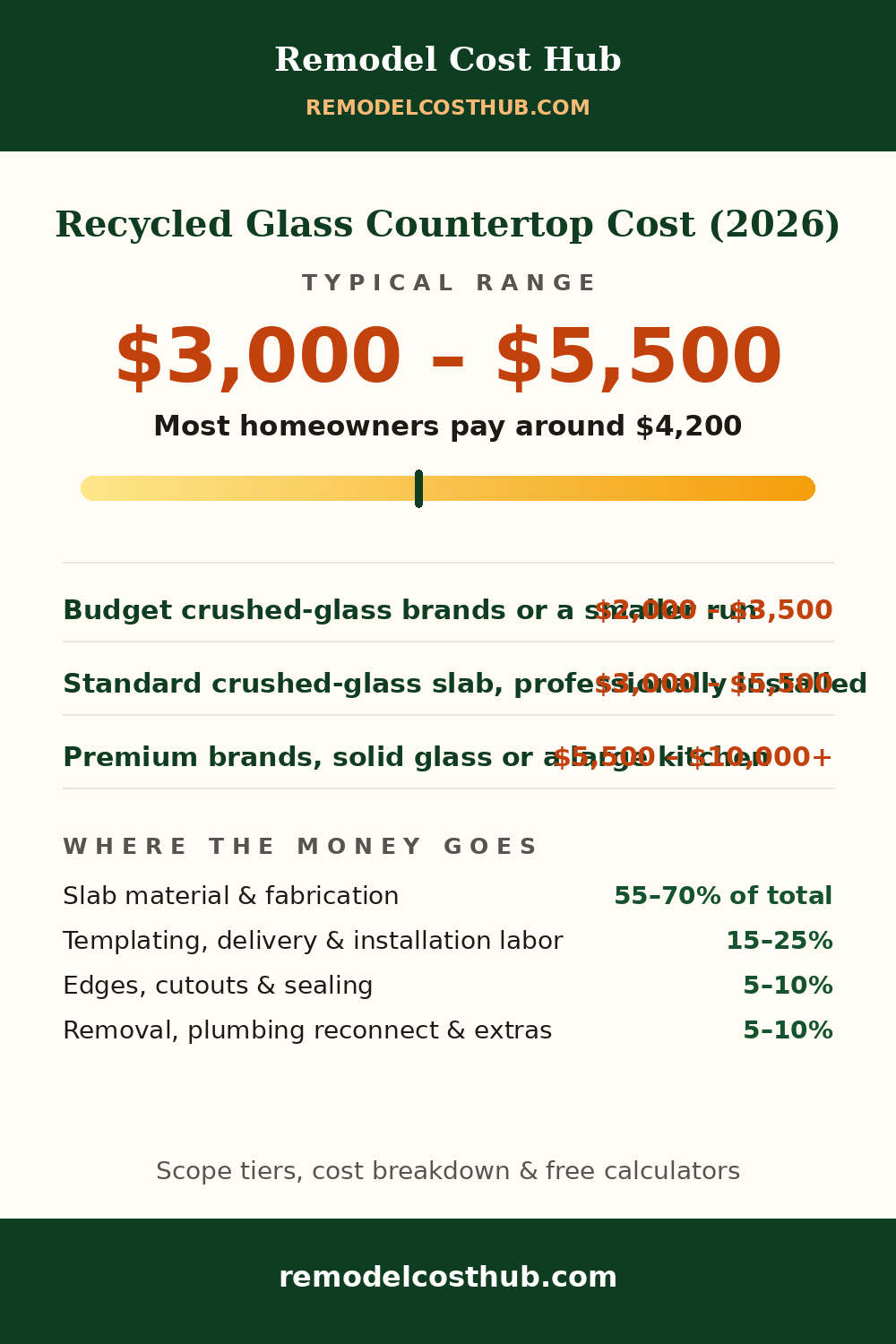
- Typical range: $3,000 – $5,500
- Most homeowners pay: around $4,200
- Per square foot: $75 – $140 per sq ft
- Prices vary most by: Slab material & fabrication (55–70% of the budget)
Cross-checked against three published sources for this project. Sources used for this page: the Angi recycled glass countertop cost guide, HomeGuide's recycled glass countertop cost guide and Fixr's recycled glass countertop cost guide. Sources last checked: October 2026 — HomeGuide, Fixr, Angi. Last updated October 2026 · How we calculate these costs
Cost by scope
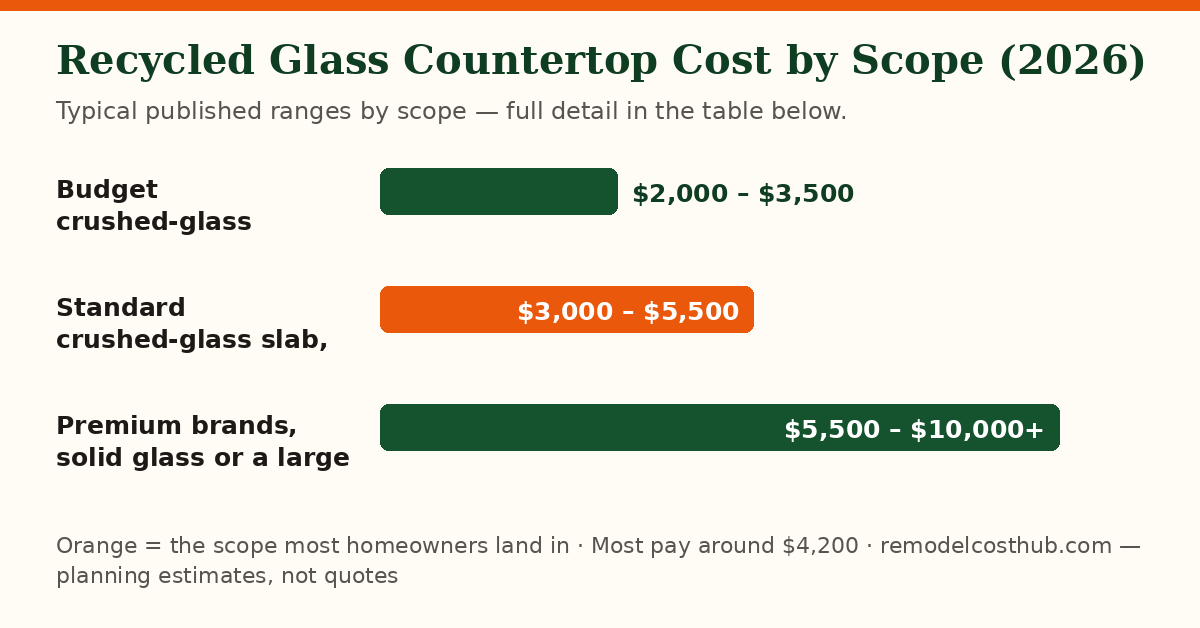
| Scope | Typical cost | What it includes |
|---|---|---|
| Budget crushed-glass brands or a smaller run | $2,000 – $3,500 | The entry point: brands the guides price at the bottom of the material ladder over about 40 sq ft — Angi puts Curava at $50–$70 per sq ft installed and crushed glass generally at $50–$100, and HomeGuide puts IceStone and Curava material at $50–$100 per sq ft |
| Standard crushed-glass slab, professionally installed | $3,000 – $5,500 | Where most recycled-glass kitchens land: about 40 sq ft of crushed glass in a resin or cement binder, templated and installed — Angi puts 40 sq ft at $2,600–$5,600 and the average project at about $2,700, while Fixr puts a 30 sq ft crushed-glass job at $3,600–$5,400 with most paying $4,500 |
| Premium brands, solid glass or a large kitchen | $5,500 – $10,000+ | Handmade or design-led slabs, solid glass, backlighting or a large kitchen — HomeGuide puts solid and sea-glass work at $100–$250 per sq ft installed and Fixr puts solid glass at $200–$250, with a 40 sq ft project reaching $10,000 |
Where the money goes
| Part of the job | Share | Note |
|---|---|---|
| Slab material & fabrication | 55–70% of total | The glass slab itself plus cutting and polishing: Angi puts materials at $55–$130 per sq ft and HomeGuide at $50–$200 by brand, with named brands from $50–$100 (IceStone, Curava) to $100–$200 (Vetrazzo) per sq ft material-only in HomeGuide's brand table |
| Templating, delivery & installation labor | 15–25% | Measuring, moving and setting a heavy, brittle slab: Angi and HomeGuide both put installation labor at $10–$50 per sq ft, and Fixr puts fabrication-and-installation at $40–$75 per sq ft on its own — the guides bundle it differently, which is why quotes must be compared line by line |
| Edges, cutouts & sealing | 5–10% | Upgraded edges run $10–$35 per linear foot in both Angi and Fixr, sink cutouts $200–$240 in Angi, and cement-binder slabs carry a first sealing at $2–$4 per sq ft in Angi (resin-binder slabs skip sealing entirely) |
| Removal, plumbing reconnect & extras | 5–10% | Removing the old counter runs $50–$350 in Angi and is often bundled into labor in HomeGuide, plus disconnecting and reconnecting the sink and any cabinet levelling the slab's weight requires |
What moves the price most
Brand is the recycled-glass budget. There is no commodity market for this material — each maker has its own glass mix, binder and price. HomeGuide's brand table runs from $50–$100 per sq ft material for IceStone and Curava to $100–$200 for Vetrazzo, and Fixr's runs from $40–$54 for IceStone to $85–$165 for Vetrazzo. The standard crushed-glass overlap between those tables is the rate this page publishes as typical; a design-led brand roughly doubles the slab line before anything else changes. Binder is the second lever: Fixr puts concrete-binder material at $60–$100 per sq ft and resin at $60–$120, and the binder decides the upkeep — resin is non-porous and never sealed, while Angi notes cement-based counters need sealant annually at $2–$4 per sq ft. Format is the third: HomeGuide puts recycled-glass tile at $50–$100 per sq ft installed against slabs at $100–$250, so a tiled glass counter is a genuinely cheaper product, bought with grout lines. Finally, colour and custom work price like artwork: Angi puts stock counters at $65–$140 per sq ft against custom at $120–$250 or more, and backlighting a translucent slab adds about $90–$100 per sq ft — the wow factor is a priced line item, not a finish choice.
Worked example: how a typical recycled glass countertop budget breaks down
A typical job: about 40 sq ft of standard crushed-glass slab in a resin binder, templated and fabricated, one sink cutout, a simple rounded edge, old counters removed. The budget below totals $4,200 — the "most homeowners pay around" figure from the top of this page — split using this page's own cost breakdown. It shows how a real quote at that level is usually composed; every line is built from the ranges on this page, and it is an illustration, not a quote for your project.
| Line item | Example budget |
|---|---|
| Recycled glass slab and fabrication | $2,730 |
| Templating, delivery and installation labor | $840 |
| Rounded edge profile and sink cutout | $336 |
| Old counter removal and plumbing reconnect | $294 |
| Total | $4,200 |
What most people get wrong
- Choosing the brand from a sample chip — the glass mix varies across a full slab, and Fixr and HomeGuide both warn that samples are not a reliable indicator for several brands; view the actual slab before it is cut.
- Comparing quotes by the total alone — one fabricator bundles templating, transport and removal into the square-foot rate (Fixr's model) and another lines them out (Angi's); line the two up item by item.
- Ordering a square edge to save money — the guides price bullnose and bevel edges at only $10–$12 per linear foot, and a square glass edge is the one most likely to chip.
- Assuming every recycled-glass counter is seal-free — resin binders are, cement binders are not; buying a cement-binder slab without budgeting its annual sealing repeats the granite mistake in a new material.
Costs in your city
Recycled glass pricing follows the dealer network, not local labor: each brand sells through selected fabricators, so the local spread is whether your metro has one of them at all. Cities with an authorised fabricator for the brand you want price standard crushed glass near the middle of the band; where the nearest dealer is a state away, freight and a travelling install crew push the same slab toward the top, and some brands simply will not ship. Ask each bidder which brands they are authorised to fabricate — that answer, more than their labor rate, decides both your price and whether the manufacturer's warranty applies.
Frequently asked questions
How much do recycled glass countertops cost for an average kitchen?
About $3,000–$5,500 installed is the typical band on this page for about 40 sq ft, with most projects landing around $4,200. Angi puts 40 sq ft at $2,600–$5,600 with an average project of about $2,700, and Fixr puts a 30 sq ft crushed-glass job at $3,600–$5,400 with most homeowners paying $4,500.
How much do recycled glass countertops cost per square foot installed?
Angi puts recycled glass at $65–$140 per sq ft installed (about $90 on average), HomeGuide at $60–$250 across all types, and Fixr at $100–$250. Standard crushed-glass slabs in an ordinary kitchen land around $75–$140 installed; solid glass and handmade brands sit at the top of every guide's band.
Are recycled glass countertops cheaper than quartz?
A little, at the standard grades — Angi notes recycled glass at $65–$140 per sq ft against quartz at $50–$200 with most quartz projects at $70–$100, so the two overlap heavily. Budget crushed-glass brands undercut mid-range quartz; premium recycled brands cost more than standard quartz and add a specialist installer into the bargain.
Do recycled glass countertops need sealing?
It depends on the binder. Resin-binder slabs are non-porous and never need sealing in both Angi and HomeGuide; cement-binder slabs do — Angi prices sealant at $2–$4 per sq ft, applied about annually. Ask which binder a brand uses before you buy, because it decides the upkeep for the life of the counter.
Can recycled glass countertops chip or crack?
Yes — glass sits around 6.5 on the Mohs scale in Angi's comparison guide, softer than quartz or granite, and edges are the vulnerable point. Both Angi and Fixr price rounded edges (bullnose or bevel at $10–$12 per linear foot) as the cheap insurance: they cost a little more than a square edge and chip a lot less.