Ceiling Fan Installation cost at a glance
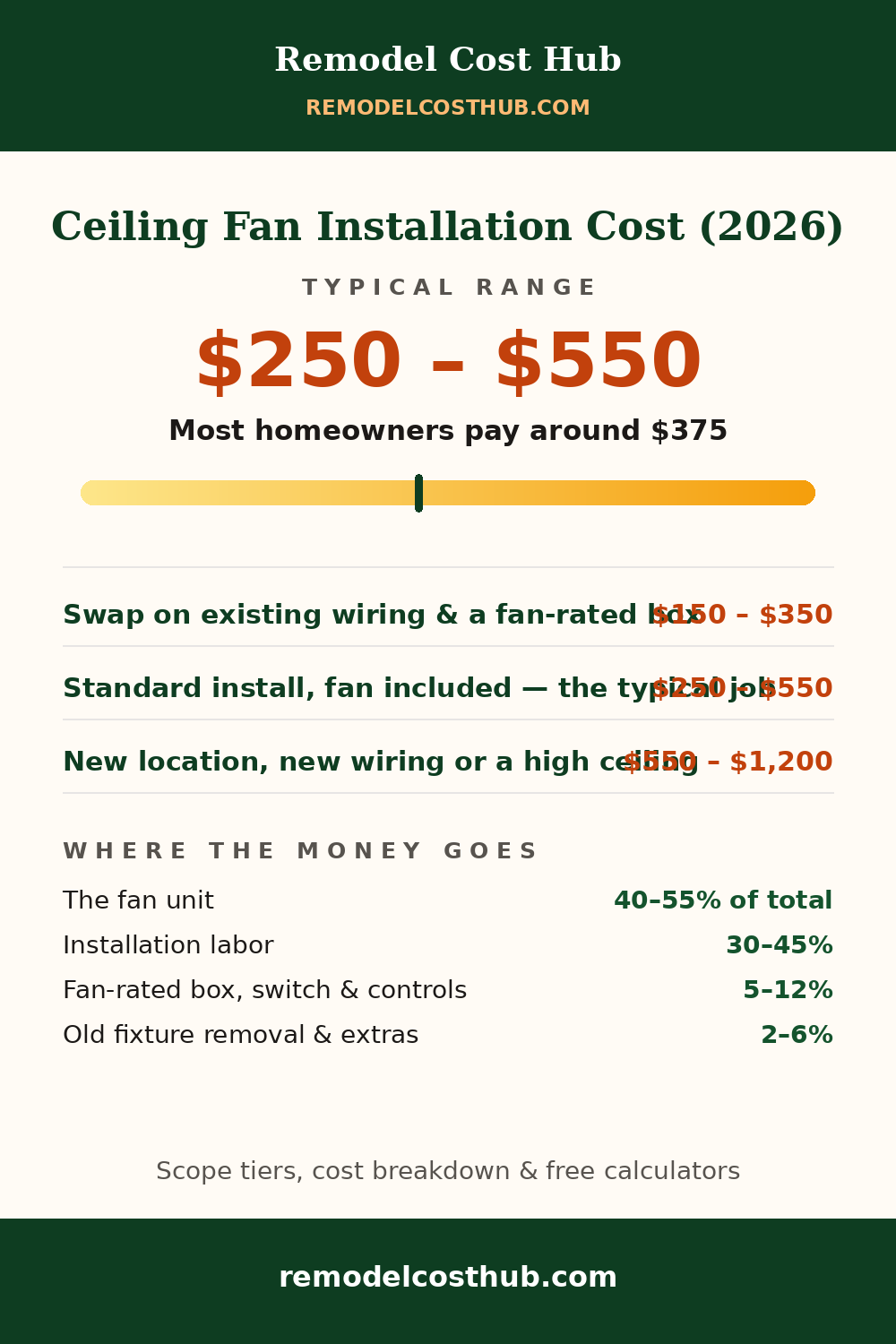
- Typical range: $250 – $550
- Most homeowners pay: around $375
- Prices vary most by: The fan unit (40–55% of the budget)
Cross-checked against three published sources for this project. Sources used for this page: the HomeGuide ceiling fan installation cost guide, Angi's ceiling fan installation cost data and This Old House's ceiling fan installation cost guide. Sources last checked: October 2026 — This Old House, HomeGuide, Angi. Last updated October 2026 · How we calculate these costs
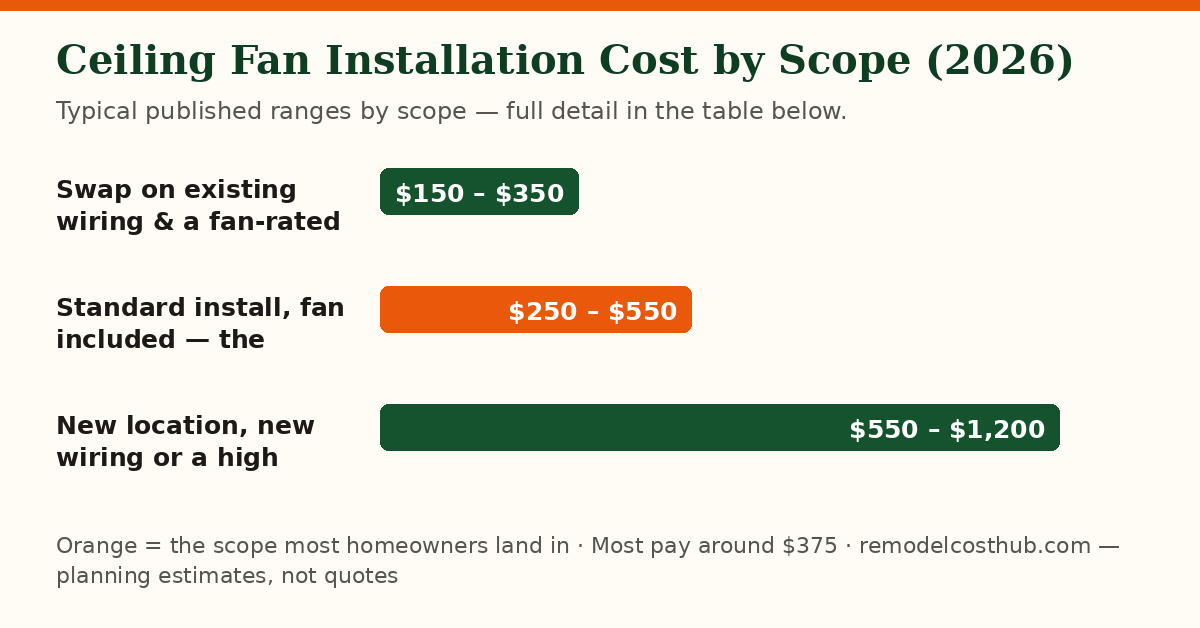
Cost by scope
| Scope | Typical cost | What it includes |
|---|---|---|
| Swap on existing wiring & a fan-rated box | $150 – $350 | The simple end: HomeGuide prices a replacement at $150–$500 including the fan and labor, Angi's professional installation band runs $145–$355, and a like-for-like swap takes about an hour in HomeGuide when the box is already fan-rated |
| Standard install, fan included — the typical job | $250 – $550 | The typical band on this page: a mid-range fan ($50–$300 in HomeGuide) fitted on existing wiring with the box checked or upgraded — Angi averages $250 for ceiling fan installation with a $100–$600 range across its projects |
| New location, new wiring or a high ceiling | $550 – $1,200 | HomeGuide prices a new fan with new wiring at $400–$1,000, with the wiring run itself at $200–$400+ and a new circuit at $150–$300; This Old House notes that installations adding new circuits can run well above standard work |
Where the money goes
| Part of the job | Share | Note |
|---|---|---|
| The fan unit | 40–55% of total | HomeGuide prices fans at $50–$500+, with standard models at $50–$300, and Angi puts the unit at $50–$1,400 across all types — blade span, motor type and smart features move this line |
| Installation labor | 30–45% | HomeGuide prices labor at $100–$300 to replace a fan, with electricians at $60–$130+ per hour; Angi prices professional installation at $145–$355 on standard work, and This Old House puts simple-installation labor at $50–$200 |
| Fan-rated box, switch & controls | 5–12% | A fan must hang from a fan-rated box, not a light-fixture box — the upgrade is a small parts line inside most swaps; a wall switch adds $50–$200 in HomeGuide and an extended downrod for a high ceiling $10–$75 |
| Old fixture removal & extras | 2–6% | Taking down the old fan or light fitting and making good around the canopy — small on a swap, and the line where a new-location job picks up ceiling patching after the wiring run |
What moves the price most
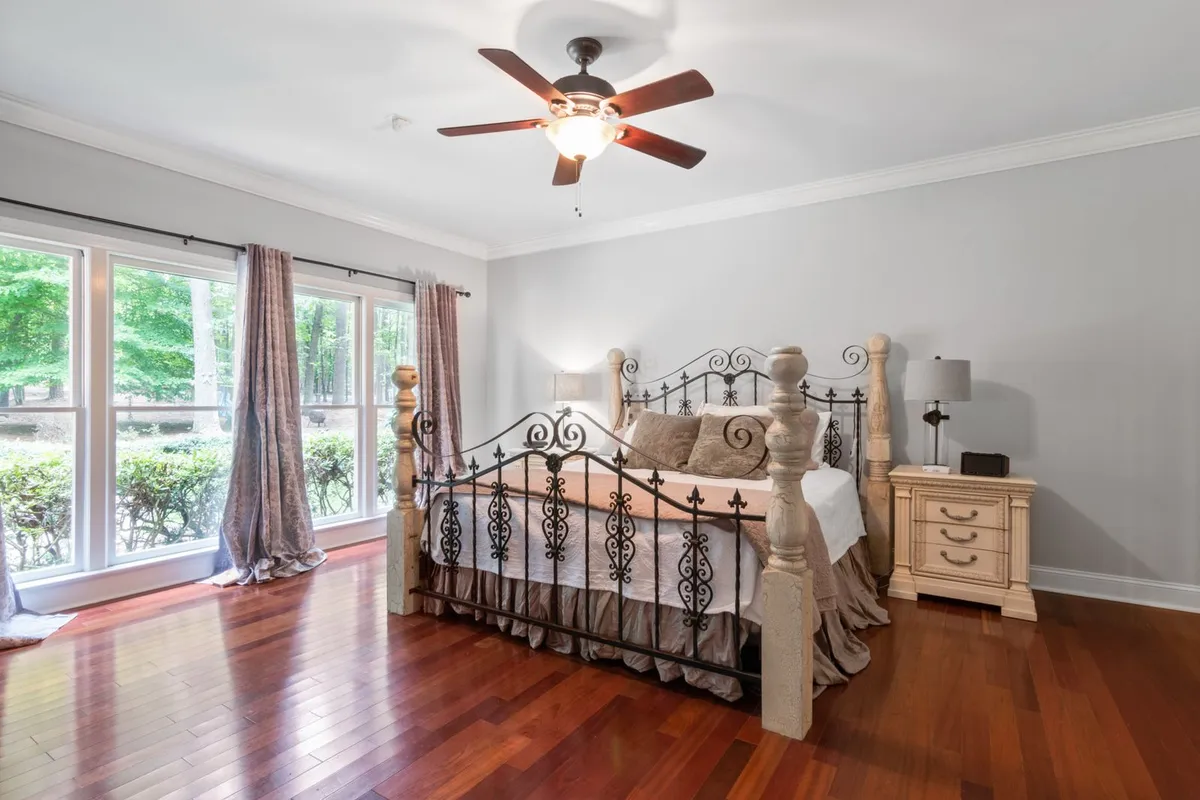
Existing wiring is the ceiling fan budget. Where a switched ceiling box already exists, the job is a swap: HomeGuide prices replacement at $150–$500 including the fan, and Angi averages $250. Where no wiring exists, HomeGuide prices the run at $200–$400+ and a new circuit at $150–$300 on top of the fan and the fitting — the same fan doubles in price because the ceiling has to be wired, not just fitted. The box is the second lever, and the safety one: a fan's weight and movement need a fan-rated box; a light-fixture box is not rated for either, and upgrading it is a small parts line that should appear on every quote for a light-to-fan conversion. Ceiling height is the third: blades should sit 8–9 feet above the floor, so high and vaulted ceilings need a downrod ($10–$75 in HomeGuide) and longer ladder time. Finally, size the fan to the room: HomeGuide's table runs from 29–36 inches for rooms up to 75 sq ft to 50–54 inches for 225–400 sq ft — an undersized fan is cheap to install and expensive to live with, because it never moves enough air to earn its running cost of $2–$5 a month.
Worked example: how a typical ceiling fan installation budget breaks down
A typical job: one mid-range ceiling fan with a light kit fitted in a bedroom on existing wiring — old light fitting removed, fan-rated box fitted or verified, fan assembled, hung, balanced and tested on the wall switch. The budget below totals $375 — the "most homeowners pay around" figure from the top of this page — split using this page's own cost breakdown. It shows how a real quote at that level is usually composed; every line is built from the ranges on this page, and it is an illustration, not a quote for your project.
| Line item | Example budget |
|---|---|
| Ceiling fan unit (mid-range, with light kit) | $175 |
| Electrician labor | $150 |
| Fan-rated box and wall switch | $35 |
| Old fixture removal and patching | $15 |
| Total | $375 |
What most people get wrong
- Hanging a fan from a light-fixture box — the box is not rated for a fan's weight or movement; the fan-rated box is a small line, and a fan working loose is the expensive version of the same job.
- Buying the fan by looks before size — a 36-inch fan in a 300 sq ft room never moves enough air; HomeGuide's table sizes the fan to the room, and the sizing is free to get right at purchase.
- Comparing quotes without asking whether wiring exists — a swap is $150–$500 in HomeGuide and a new wired location is $400–$1,000; the two totals describe different jobs.
- Skipping the downrod on a high ceiling — blades belong 8–9 feet above the floor, and a fan hugging a 12-foot ceiling stirs the air nobody sits in.
Costs in your city
Ceiling fan pricing follows electrician rates — HomeGuide puts them at $60–$130+ per hour with $100–$200 minimum job fees, so the same swap prices higher in high-rate metros and wherever a single small job carries a full call-out fee. Ceiling stock travels with the region too: high and vaulted ceilings, common in newer Sun Belt builds, add downrods and access time, while older northern housing more often needs the box upgrade and switch work. The pattern everywhere is that fans batch well — a second and third fan in the same visit price well below the first, because the call-out is already paid. Ask each bidder for the per-fan rate at your fan count and whether the box is included.

Frequently asked questions
How much does it cost to install a ceiling fan?
About $250–$550 is the typical band on this page for a standard fan installed on existing wiring, fan included, with most projects landing around $375. Angi averages $250 for installation with a $100–$600 range, and HomeGuide prices a replacement at $150–$500 including the fan and labor.
How much does an electrician charge to install a ceiling fan?
Labor runs $100–$300 for a replacement in HomeGuide, with electricians at $60–$130+ per hour and minimum job fees of $100–$200 common even on small work. This Old House puts simple-installation labor at $50–$200 and electricians at $50–$100 per hour; new wiring is priced as its own line, not as extra hours.
What size ceiling fan do I need?
By room size, in HomeGuide's table: 29–36 inches up to 75 sq ft, 36–42 inches for 76–144 sq ft, 44–50 inches for 144–225 sq ft and 50–54 inches for 225–400 sq ft; rooms over 400 sq ft take a 54-inch-plus fan or more than one. Angi's sizing guide divides the same way.
Does a ceiling fan need a special electrical box?
Yes — a fan-rated box, braced for the fan's weight and movement. A standard light-fixture box is not rated to hold a running fan, so light-to-fan conversions include the box upgrade; This Old House lists the fan-rated junction box among the job's electrical requirements, and it is a small parts line next to the cost of a fan that works loose.
How much does a ceiling fan cost to run?
About $2–$5 per month in HomeGuide, at eight to twelve hours of use a day — which is the economic point of the install: the fan circulates air so the air conditioning runs less, and the running cost is a rounding error next to cooling.