Copper Countertop cost at a glance
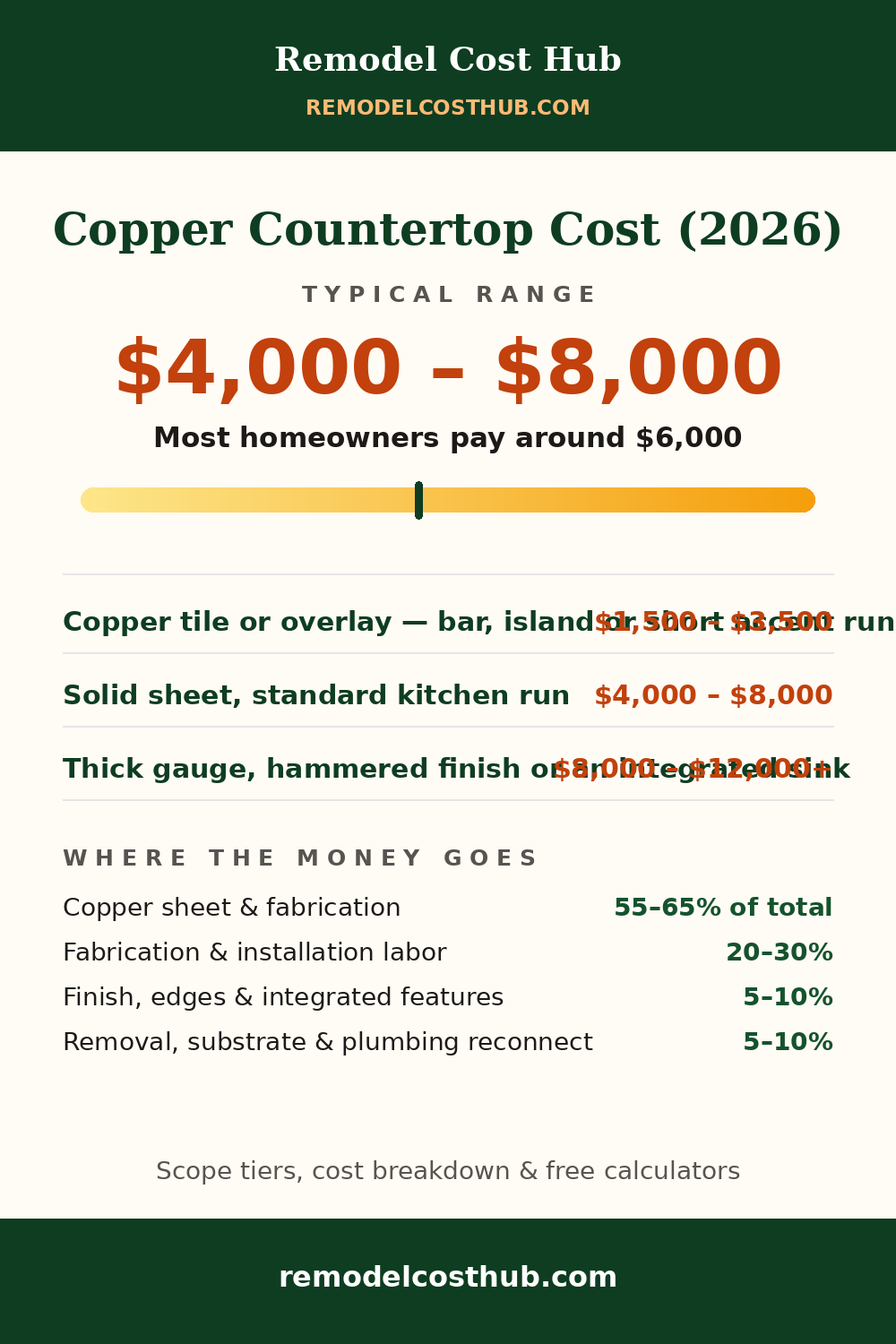
- Typical range: $4,000 – $8,000
- Most homeowners pay: around $6,000
- Per square foot: $100 – $200 per sq ft
- Prices vary most by: Copper sheet & fabrication (55–65% of the budget)
Cross-checked against three published sources for this project. Sources used for this page: the Angi copper countertop installation cost guide, HomeGuide's countertop installation cost guide and HomeAdvisor's kitchen countertop replacement cost guide. Sources last checked: October 2026 — HomeAdvisor, HomeGuide, Angi. Last updated October 2026 · How we calculate these costs
Cost by scope
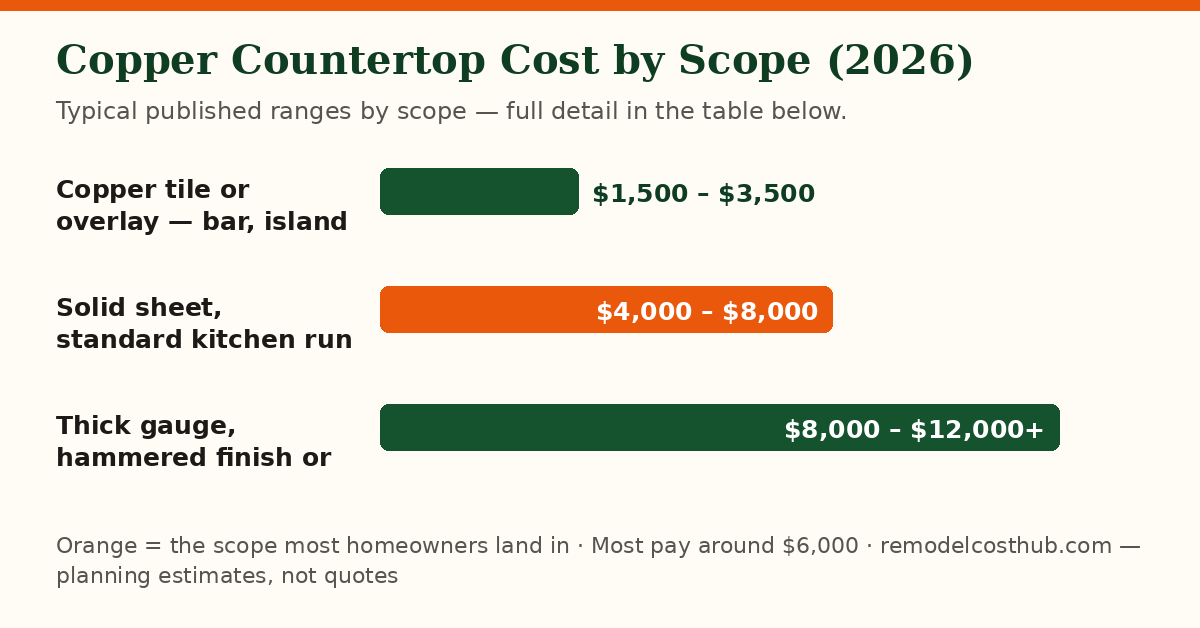
| Scope | Typical cost | What it includes |
|---|---|---|
| Copper tile or overlay — bar, island or short accent run | $1,500 – $3,500 | The budget formats, and where most residential copper actually goes: Angi prices copper tile at $60–$120 per sq ft and overlay at $80–$150, against $100–$200 for solid sheet — a bar top or a single island is how copper enters a kitchen without a full-kitchen price |
| Solid sheet, standard kitchen run | $4,000 – $8,000 | About 40 sq ft of solid copper sheet wrapped over a plywood substrate, templated and installed — Angi, HomeGuide and HomeAdvisor all put copper at $100–$200 per sq ft installed, and Angi's size table puts an average 30–50 sq ft kitchen at $3,000–$10,000 |
| Thick gauge, hammered finish or an integrated sink | $8,000 – $12,000+ | Heavier-gauge sheet, a hammered finish (+$20–$40 per sq ft in Angi) or an integrated copper sink (+$1,000–$1,500) — Angi's dedicated guide averages $7,500 across its project sample and prices large 60–80 sq ft kitchens at $6,000–$16,000 |
Where the money goes
| Part of the job | Share | Note |
|---|---|---|
| Copper sheet & fabrication | 55–65% of total | The metal itself, wrapped and seamed over its substrate: solid sheet is the top format in Angi at $100–$200 per sq ft installed, and gauge is the multiplier — thicker sheet resists dents and costs more before any labor is counted |
| Fabrication & installation labor | 20–30% | Angi prices copper labor at $30–$50 per sq ft ($40–$90 per hour) — sheet-metal work: templating, wrapping, soldering the seams and setting the finished top so it sits dead level |
| Finish, edges & integrated features | 5–10% | A hammered texture adds $20–$40 per sq ft and a patina finish $10–$30 in Angi; custom edge treatments and an integrated sink ($1,000–$1,500) sit in this line when they are in the scope |
| Removal, substrate & plumbing reconnect | 5–10% | Taking out the old counter, the sound, flat plywood substrate a wrapped sheet needs — copper shows every bump under it — and reconnecting the sink and faucet |
What moves the price most
Format is the copper budget. The same metal prices three ways in Angi: tile at $60–$120 per sq ft, overlay at $80–$150 and solid sheet at $100–$200, and the full-kitchen overlap of Angi, HomeGuide ($100–$200 installed) and HomeAdvisor ($100–$200) is the solid-sheet rate this page publishes as typical. Gauge is the second lever: thicker sheet costs more per foot and is the difference between a counter that dents under a dropped pan and one that does not — it is a durability purchase, not a cosmetic one. Finish is the third: hammered texture (+$20–$40 per sq ft in Angi) hides the scratches a smooth finish shows, a pre-applied patina (+$10–$30) buys the aged colour on day one, and a lacquer holds the bright polish — each is a named line, not an assumption. Finally, scope discipline is what keeps copper sane: at these per-foot rates most homeowners put copper on one surface — the island, the bar, the baking run — and a stone or laminate everywhere else, which is why the accent tier, not the full kitchen, is the common project.
Worked example: how a typical copper countertop budget breaks down
A typical job: about 40 sq ft of solid copper sheet in a normal kitchen run, wrapped over a new plywood substrate, one sink cutout, smooth finish left unlacquered, old counters removed. The budget below totals $6,000 — the "most homeowners pay around" figure from the top of this page — split using this page's own cost breakdown. It shows how a real quote at that level is usually composed; every line is built from the ranges on this page, and it is an illustration, not a quote for your project.
| Line item | Example budget |
|---|---|
| Copper sheet and fabrication | $3,600 |
| Fabrication and installation labor | $1,500 |
| Finish, edges and cutouts | $480 |
| Old counter removal, substrate and plumbing reconnect | $420 |
| Total | $6,000 |
What most people get wrong
- Pricing a full kitchen in copper before pricing the island alone — at $100–$200 per sq ft the accent scope is the common project, and the full-kitchen quote is how homeowners talk themselves out of the material entirely.
- Choosing the thinnest gauge to hit a number — thin sheet dents under ordinary kitchen work, and the gauge saving is repaid in dings that cannot be buffed out of a wrapped top.
- Approving a smooth finish for a hard-use family kitchen — a hammered finish (+$20–$40 per sq ft in Angi) hides the scratch record a mirror-smooth copper top keeps.
- Comparing a tile quote with a sheet quote by the total — tile is $60–$120 per sq ft in Angi against $100–$200 for sheet, and the tile surface carries grout lines the sheet quote does not have.
Costs in your city
Copper pricing follows the sheet-metal fabricators, not the stone yards: copper counters are made by metal shops, so metros with architectural metalwork and restaurant-fabrication trades keep several bidders and price standard work near the middle of the band, while in markets where the nearest copper fabricator is a regional specialist, freight and a thin bidder list push quotes up. The second local variable is format availability — tile and overlay products ship anywhere, while solid sheet is cut and wrapped where it is installed. Ask each bidder how much copper they install in a year and whether the sheet is wrapped in their shop or on site; on a dent-prone metal, that answer predicts the finish better than the per-foot rate.
Frequently asked questions
How much do copper countertops cost for an average kitchen?
About $4,000–$8,000 installed is the typical band on this page for about 40 sq ft of solid sheet, with most projects landing around $6,000. Angi's size table puts an average 30–50 sq ft kitchen at $3,000–$10,000, and its dedicated copper guide averages $7,500 across a project sample that includes larger and more custom work.
How much do copper countertops cost per square foot installed?
About $100–$200 per sq ft for solid sheet — Angi, HomeGuide and HomeAdvisor all publish the same $100–$200 installed band. The formats below it are copper tile at $60–$120 and overlay at $80–$150 per sq ft in Angi, and a hammered finish adds $20–$40 per sq ft on top of any of them.
Will a copper countertop change colour over time?
Yes, unless it is lacquered — copper is a living finish. It darkens and develops a patina with touch, water and acids, which is the look most buyers are paying for; Angi prices a pre-applied patina finish at +$10–$30 per sq ft for homeowners who want that colour immediately and evenly. A lacquered counter holds its bright polish but gives up the antimicrobial surface behaviour of bare copper and will eventually need the coating renewed where it wears.
How does copper compare with stainless steel on cost and upkeep?
They sit in the same price neighbourhood — stainless runs $80–$200 per sq ft installed in HomeGuide against copper's $100–$200 — and both are non-porous, naturally antimicrobial metals. The difference is temperament: stainless holds a uniform commercial finish and shows fingerprints, while copper is warmer, softer, dents more readily in thin gauges, and changes colour as it lives with you.
Can I install a copper countertop myself?
Tile is the only format the guides treat as a realistic DIY — it is the flexible, lower-cost format in Angi at $60–$120 per sq ft. Sheet work is fabricator work: the metal is wrapped, seamed and soldered over a substrate, Angi prices that labor at $30–$50 per sq ft, and a creased or badly seamed sheet cannot be un-bent — the saving a DIY sheet job risks is smaller than the sheet it risks.