Epoxy Countertop cost at a glance
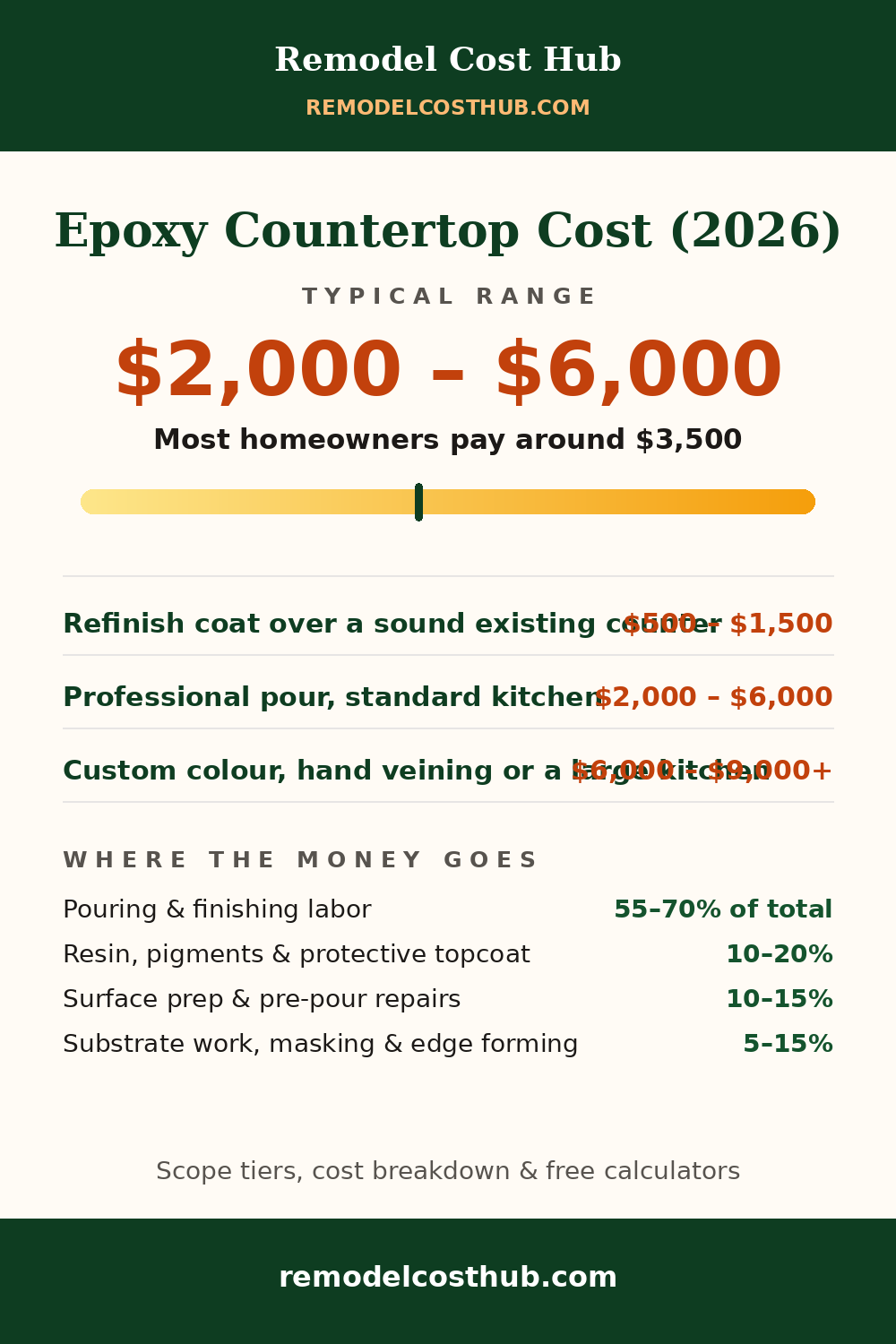
- Typical range: $2,000 – $6,000
- Most homeowners pay: around $3,500
- Per square foot: $50 – $150 per sq ft
- Prices vary most by: Pouring & finishing labor (55–70% of the budget)
Cross-checked against three published sources for this project. Sources used for this page: the Angi epoxy countertops cost guide, HomeGuide's epoxy flooring and countertop cost data and HomeAdvisor's kitchen countertop replacement cost guide. Sources last checked: October 2026 — HomeAdvisor, HomeGuide, Angi. Last updated October 2026 · How we calculate these costs
Cost by scope
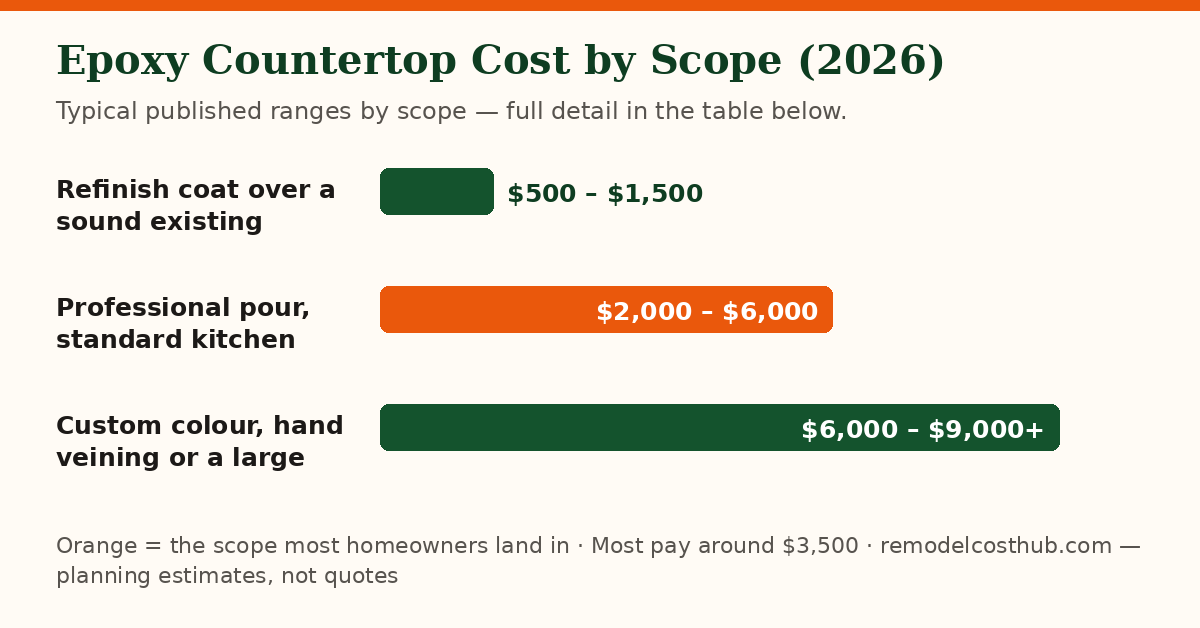
| Scope | Typical cost | What it includes |
|---|---|---|
| Refinish coat over a sound existing counter | $500 – $1,500 | The budget route, and the most common epoxy job: a poured coat over a prepped laminate, wood or tile counter. Angi prices refinishing materials at $4–$8 per sq ft with most refinish projects using $100–$1,000 of material, and its vanity tables run $250–$1,800 by size — the professional total for a small kitchen or vanity lands here once labor is in |
| Professional pour, standard kitchen | $2,000 – $6,000 | About 40 sq ft poured, levelled and finished by a pro — Angi, HomeGuide and HomeAdvisor all put professional epoxy at $50–$150 per sq ft; Angi's average-kitchen table (30–40 sq ft) runs $1,500–$6,000 and its normal project range is $2,000–$7,000 with a $3,500 average |
| Custom colour, hand veining or a large kitchen | $6,000 – $9,000+ | Metallic pigments, a hand-worked marble pattern or a 40–60 sq ft kitchen — Angi prices large kitchens at $2,000–$9,000 and notes intricate designs push labor to the top of the band, because the pattern is made by hand, in the pour, once |
Where the money goes
| Part of the job | Share | Note |
|---|---|---|
| Pouring & finishing labor | 55–70% of total | The dominant line, by the guides' own numbers: Angi prices professional labor at $45–$140 per sq ft against a $50–$150 total — masking, levelling, pouring, working the pattern and babysitting the cure is skilled, unhurried hand work |
| Resin, pigments & protective topcoat | 10–20% | The epoxy itself is the cheap ingredient: Angi prices refinishing resin at $4–$8 per sq ft in materials, with commercial-grade and UV-resistant resins and metallic pigments above the kit grades |
| Surface prep & pre-pour repairs | 10–15% | Cleaning, sanding, filling and repairing the surface the pour has to bond to — Angi budgets $225–$550 for surface repairs before application, and every defect left in the substrate telegraphs through a glossy pour |
| Substrate work, masking & edge forming | 5–15% | A brand-new epoxy counter needs a counter under it — Angi prices the base before epoxy from $1–$15 per sq ft (ceramic) to $50–$100 (concrete) — plus the masking, drip edges and formed edges that keep a liquid surface where it belongs |
What moves the price most
Labor is the epoxy budget — the resin is not. All three guides put a professional pour at $50–$150 per sq ft (Angi's dedicated guide, HomeGuide's epoxy cost data and HomeAdvisor's countertop table agree exactly), and Angi's own split shows why: labor at $45–$140 per sq ft against materials of $4–$8. You are paying for the hand, not the bucket. Design is the second lever: a solid colour is the simple pour; marble-style veining and metallic movement are worked by hand while the resin is liquid, and Angi prices intricate designs at the top of the band for exactly that reason. Refinish versus new build is the third: coating a sound existing counter keeps the substrate cost at zero, while a new epoxy counter carries a real counter underneath it first (Angi: laminate $8–$27 per sq ft, wood $20–$70, concrete $50–$100, before the epoxy). Finally, prep is the line that decides whether the job lasts: repairs before the pour run $225–$550 in Angi, and skipping them is how a glossy finish ends up showing every old scar under showroom light.
Worked example: how a typical epoxy countertop budget breaks down
A typical job: about 40 sq ft of existing laminate counters in sound condition, cleaned, sanded and repaired, then professionally poured in a solid colour with a standard topcoat, edges formed and masked. The budget below totals $3,500 — the "most homeowners pay around" figure from the top of this page — split using this page's own cost breakdown. It shows how a real quote at that level is usually composed; every line is built from the ranges on this page, and it is an illustration, not a quote for your project.
| Line item | Example budget |
|---|---|
| Pouring and finishing labor | $2,100 |
| Resin, pigments and protective topcoat | $525 |
| Surface prep and pre-pour repairs | $420 |
| Substrate work, masking and edge forming | $455 |
| Total | $3,500 |
What most people get wrong
- Comparing quotes by the bucket price — resin is $4–$8 per sq ft of the $50–$150 total in Angi; the difference between quotes is the pourer's hand, prep and cure discipline, not the material.
- Skipping the repair line to save $225–$550 — every unfilled scar and seam telegraphs through a glossy pour, and fixing it afterwards means redoing the pour, not touching it up.
- Choosing a hand-veined marble pattern on a first epoxy job without seeing the pourer's own finished work — the pattern is made once, in liquid resin, and cannot be revised; a solid colour is the forgiving specification.
- Using the kitchen before the full cure — epoxy skins over long before it reaches full hardness, and Angi's guidance to ask about full curing time exists because early heavy use is how soft spots and imprints happen.
Costs in your city
Epoxy pricing follows the specialist pourers: it is a craft trade rather than a fabricator product, so metros with several countertop-refinishing and decorative-concrete businesses price standard pours near the middle of the band, while in thinner markets one travelling specialist may be the only professional bid — and a DIY kit starts to look tempting by default rather than by merit. The second local variable is climate during the cure: hot, humid markets extend curing and can limit pour windows, which pros price into scheduling. Ask each bidder for two finished kitchens you can call on, and what resin system and topcoat they pour; on a labor-priced product, the portfolio is the quote's evidence.
Frequently asked questions
How much do epoxy countertops cost for an average kitchen?
About $2,000–$6,000 installed is the typical band on this page for about 40 sq ft professionally poured, with most projects landing around $3,500 — Angi's average. Angi's size tables put an average 30–40 sq ft kitchen at $1,500–$6,000 and a large 40–60 sq ft kitchen at $2,000–$9,000.
How much do epoxy countertops cost per square foot installed?
About $50–$150 per sq ft professionally installed — Angi, HomeGuide and HomeAdvisor all publish the same band. Inside it, Angi prices the labor alone at $45–$140 per sq ft and the resin materials at $4–$8, which is why epoxy quotes vary so much between pros for identical square footage.
Is epoxy cheaper as a refinish than as a new countertop?
Much cheaper, and it is the most common way epoxy is bought. Refinishing pours directly over a sound existing counter — Angi prices the materials at $4–$8 per sq ft and most refinish projects at $100–$1,000 of materials before labor. A brand-new epoxy counter first needs a counter to pour on: Angi prices the base at $8–$27 per sq ft for laminate and $20–$70 for wood before the epoxy work starts.
How durable is an epoxy countertop, and what are its weaknesses?
The guides credit epoxy with real durability — non-porous, water-resistant, scratch-resistant and cleanable with ordinary non-abrasive cleaners, with no resealing cycle. Its named weaknesses in Angi are staining if spills are left sitting, chipping under hard impacts (repairs run $225–$550), and the unforgiving pour itself: a pattern mistake is not sanded out, it is redone.
Can I use a DIY epoxy kit instead of hiring a pro?
Kits exist at $100–$350 in Angi, against a $3,500 average professional job — the gap is the labor and the risk. Epoxy is poured once, levels itself on its own schedule, and shows every bubble, dust speck and trowel hesitation in a glossy finish; Angi's own advice is that unless you are handy and confident, this is a job better left to a countertop professional, because a failed pour costs a new kit and a new surface.